In late 1928, my grandpa Harold Monks was in Vancouver buying a wardrobe trunk for his upcoming trip to the “Old Country.” Harold lived in Tofino on the West Coast, where in summers he fished for the cannery and winters crewed for the lifeboat. He’d done well with fishing bonuses for a few years so could afford to take the winter off to visit his family back in England (he’d emigrated in 1914).
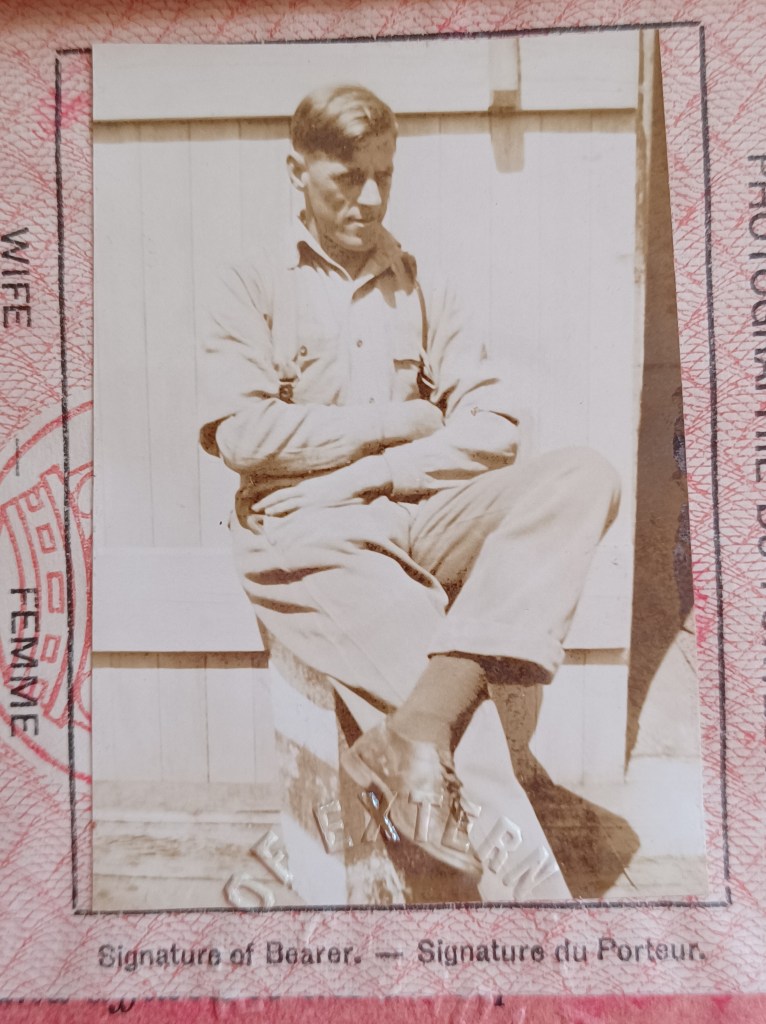
When not in his work boat gear, Harold was a natty dresser — he needed something fitting to carry his garments. A wardrobe trunk was a popular choice of the time for the steamship traveller.
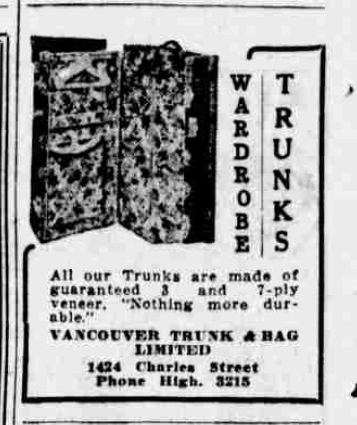
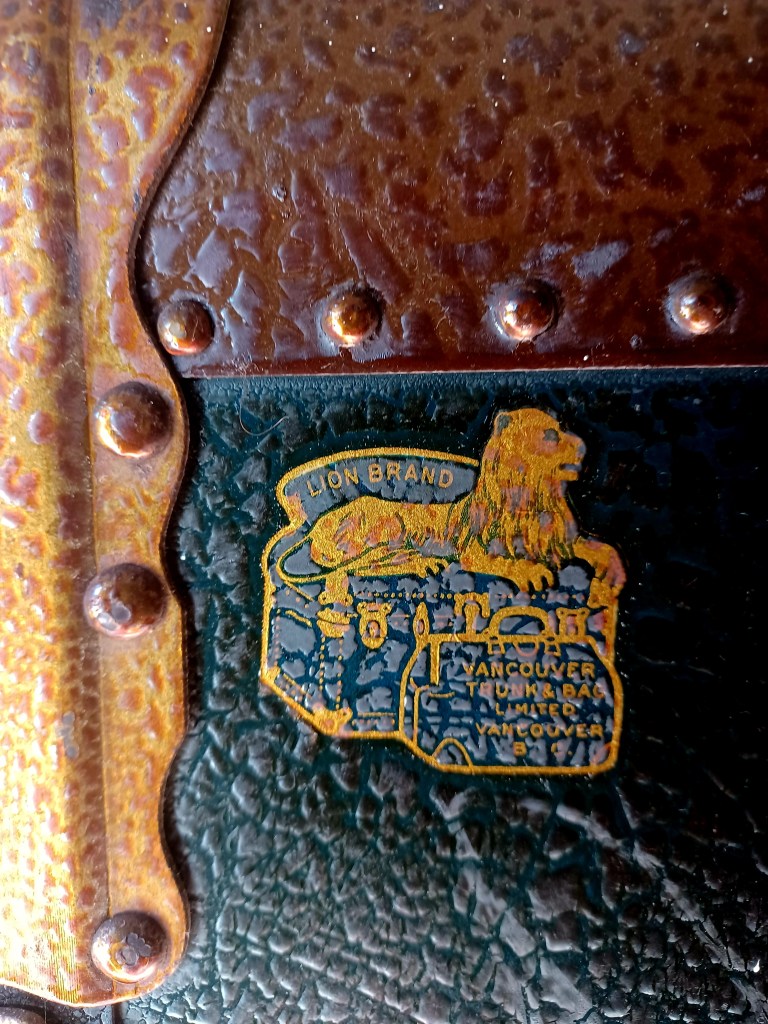
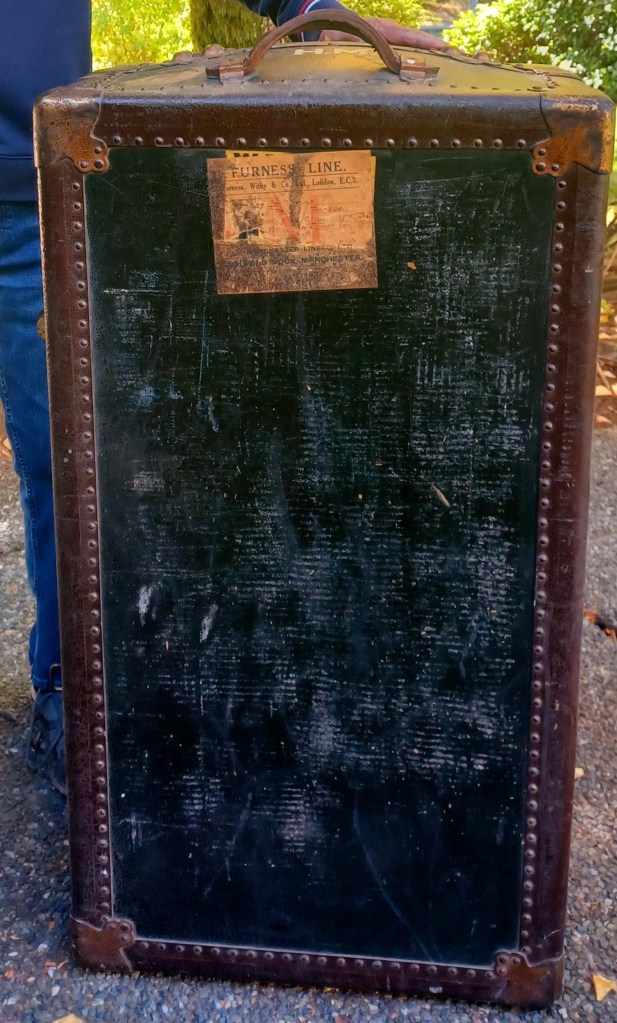
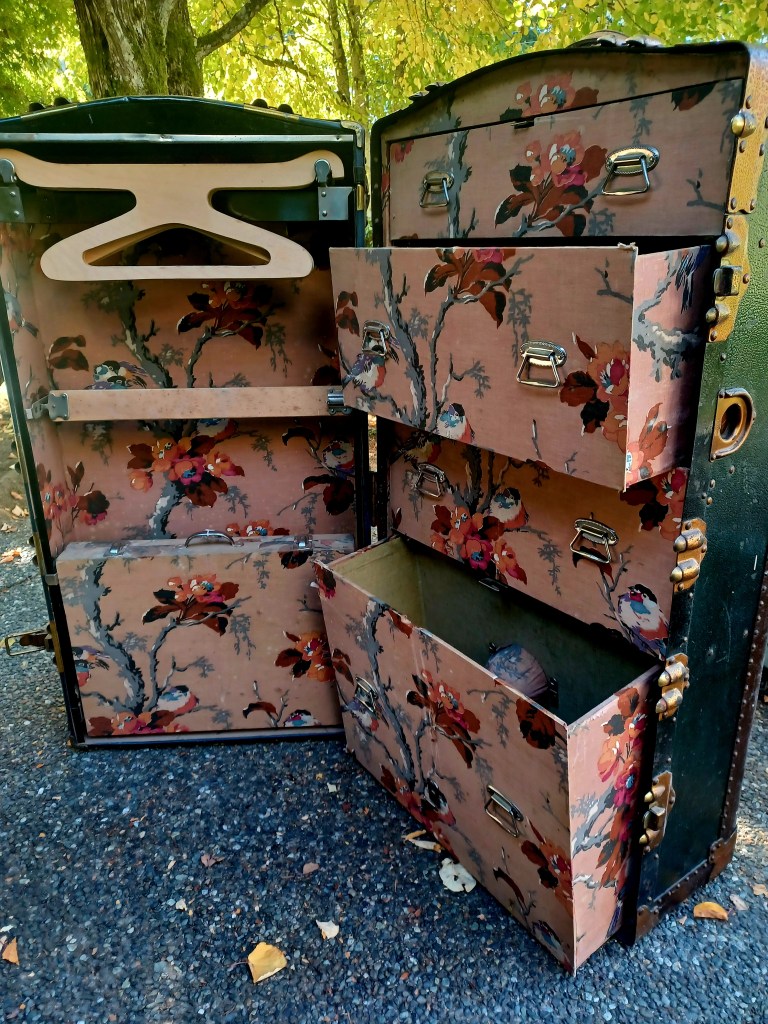
Harold bought this “Lion Brand” wardrobe trunk, made by the Vancouver Trunk & Bag Ltd. in Grandview, Vancouver. The trunk has been in my family for over 90 years. Learn more about this “Made in British Columbia Product” — where it came from, how it was made, and where it went — all the way from Vancouver to Liverpool and the Panama Canal!
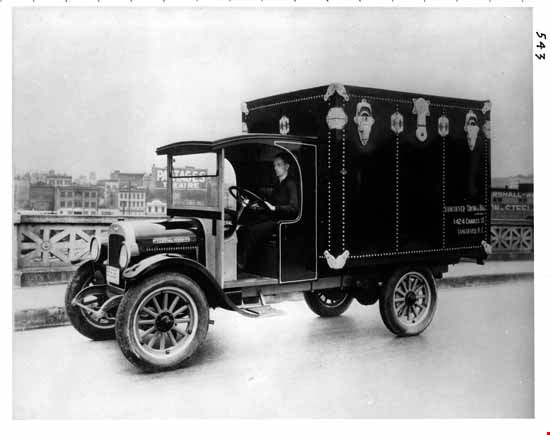
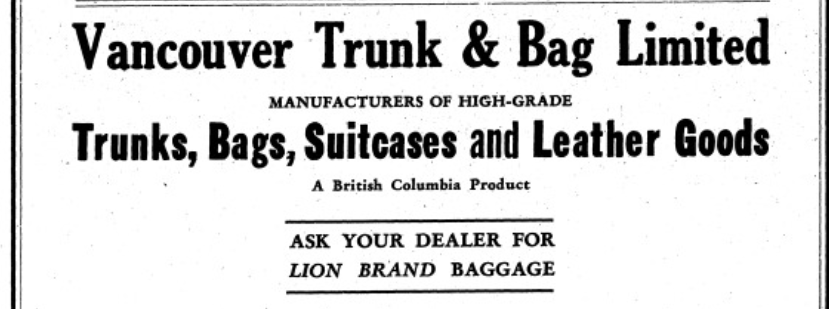
Buy Home Product and Keep Your Dollars in B.C.
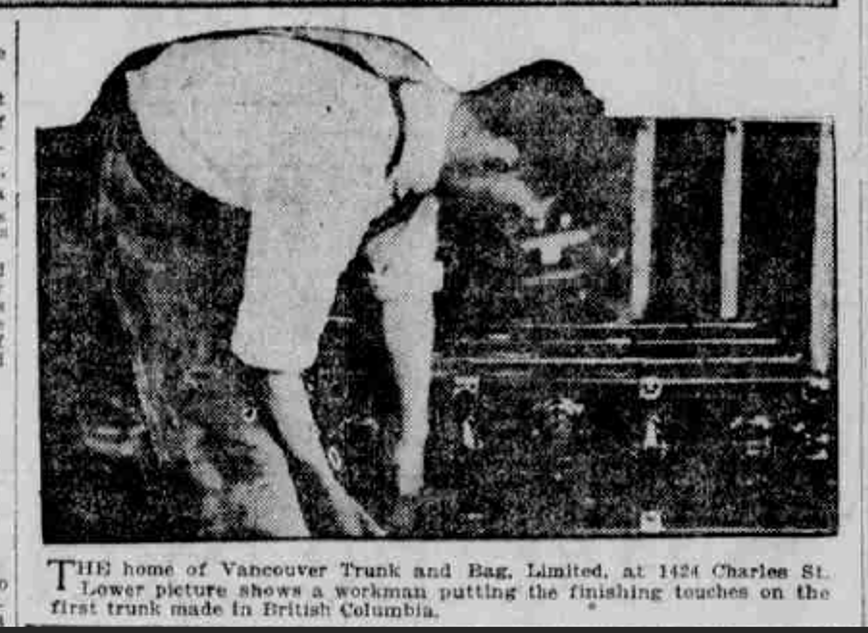
An industry new to British Columbia has recently been established by the Vancouver Trunk & Bag Ltd., which two weeks ago commenced the manufacture in its factory at 1424 Charles Street, of trunks, bags and suit cases.
New Trunk Factory Starts Operations, Vancouver Daily Province April 18 1921
Vancouver Trunk & Bag was granted a certificate of incorporation in December 1920, value $75,000. The company was managed by Frederick Maclean Storey and Charles Brayne. In 1928, all stock in the company was held in Vancouver.
Vancouver Trunk & Bag Limited was a subsidiary of Storey & Campbell, an early Vancouver company focussed on leather ware. Company President Jonathan Storey (1867-1934) came to Vancouver in 1892 from Collingwood Ontario. Storey started in business with Storey and Carson, who sold buggies, dog harness and collars. When Carson retired, Storey joined a partnership with Rod Campbell. Storey and Campbell had a saddle and harness business at 41-45 West Pender. Here’s an image of a Storey & Campbell harness in the Vancouver Archives.
With changing times and economy, Storey & Campbell diversified. “When tractors threatened to plow under the harness business of Storey & Campbell, back in 1921, they looked around for a means of survival.” (City made luggage invades new markets by R.J. Moore, Vancouver Daily Province January 29 1949)
Company president Jonathan Storey said “British Columbia imports just a quarter million dollars every year in trunks, bags and travel wear. There’s no reason for it. We have practically all the raw material right at our doors, so I decided to get into the business.”

Where the trunk was made
The factory, a two-storey one, giving 7370 square feet of floor space, has been equipped with the necessary machinery, and is now turning out its first products.
New Trunk Factory Starts Operations, Vancouver Daily Province April 18 1921
Vancouver Trunk & Bag Ltd.’s factory was located 1424 Charles Street between Odlum and McLean (rising land up from Clark Drive), the industrial area at False Creek,“tall chimneys emitting clouds of black smoke.” (1921 description) This area has been a mix of industrial and residential for over 100 years – fire insurance plans dated 1912 show a house next door to the lots that the factory would be on. Census records show many people living in the area working in labour and manufacturing.
The factory building was built sometime before 1914. Directories show the address as Bettschen-Higgins Show Case Manufacturers, then operating in 1920 as Chalmers Cabinet Works. In October 1920, the owner of 1424 Charles put the property for sale – “a Mill Construction Building, over 15,000 square feet of floor space on two floors, steam heated, excellent light…Suitable for factory or warehouse. This is a snap.” The building was “modern in every respect, with plenty of windows and floor space, guaranteeing the acme of comfort and convenience to the workers.” (W.L. Dyer, Vancouver Sun April 17 1921)
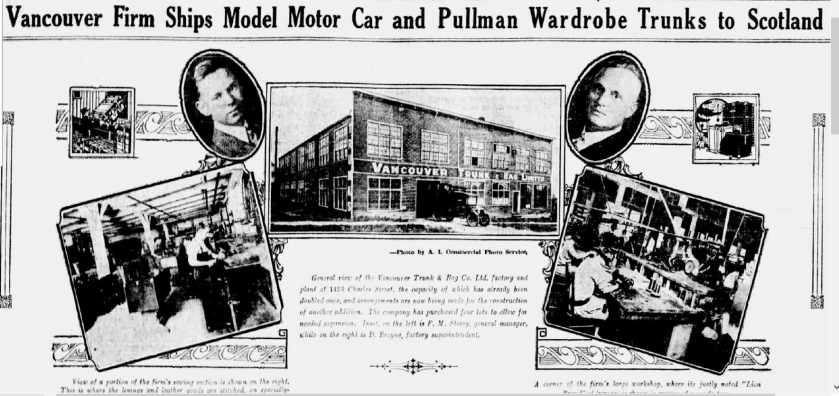
In 1926, a $6,000 large addition was made, designed by architect William Tuff Whiteway, built by P. Tardiff. The factory was now 99 by 132 feet, two stories in height. In spite of this addition, by June 1928 “all available space has become so overcrowded that still another addition to the plant is contemplated in the near future. Anticipating such requirements, the firm some time ago bought four adjoining lots which will give ample room for expansion. (Vancouver Sun June 23 1928) There is a 1929 building permit for J. Storey and P. Tardiff to build a $2,500 addition. (Vancouver Heritage Historical Building Permits Database)
“As strong as an elephant”
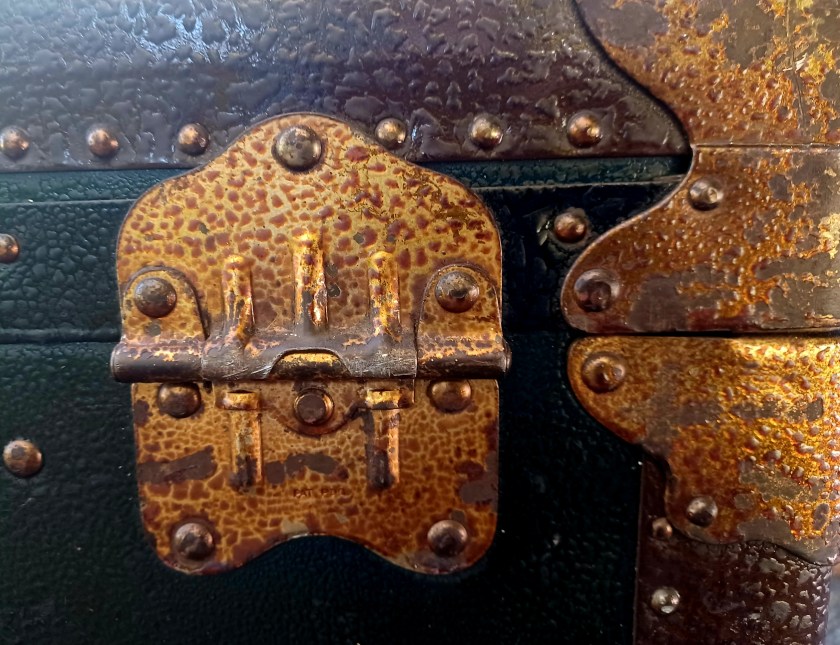
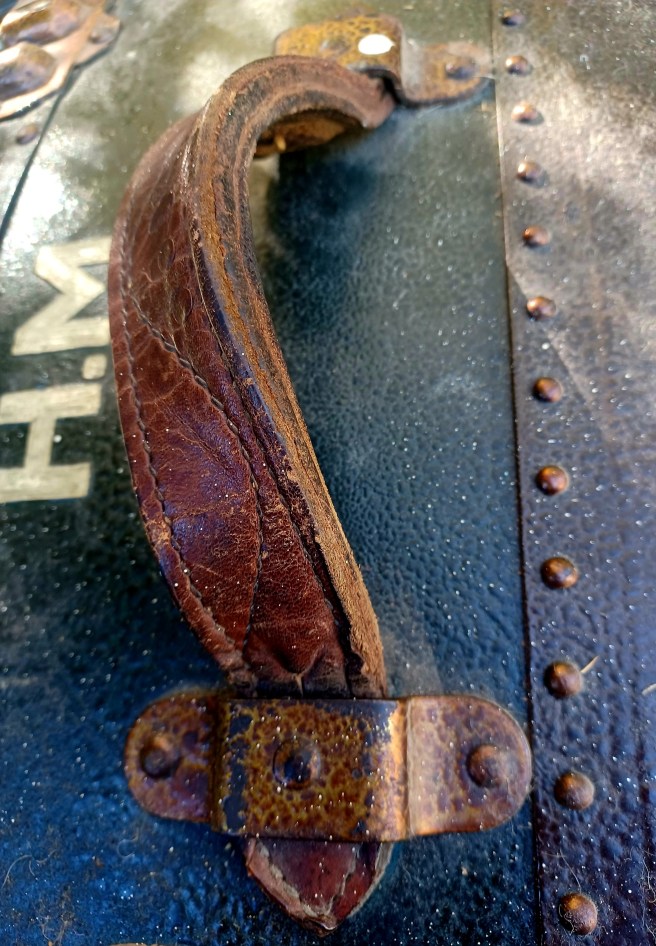
The firm’s experts are particularly proud of the handsome wardrobe trunk, which is strong as an elephant, yet is light enough to be lifted with one finger when empty. Body of five ply selected British Columbia fir veneer, covered in vulcanized hard fibre and fibre interlined and every bit and rivetted, it is fit for the most fastidious traveller.
Description of the Lion Brand wardrobe trunk, Vancouver Sun June 23 1928
In April 1921, Vancouver Trunk and Bag Ltd was producing about 120 trunks. The company planned (with added employees hired in coming months) to produce between 300 and 400. “In addition to trunk making, all types of suitcases and club bags, varying from the cheaper karatol types to cowhides and pigskins, will be made.” (W.L. Dyer,Vancouver Sun April 17 1921)
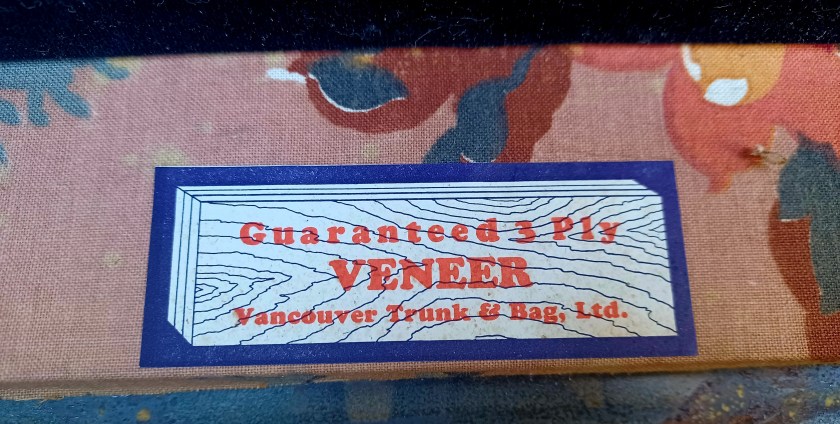
Vancouver Trunk & Bag Ltd. had a lumber yard at the factory, essential for the wood construction of the luggage products. In 1921, the travel trunks’ bodies were made of British Columbia airplane spruce and eleven-ply veneer wood (local made laminated cottonwood). Here’s a 1928 description of the Lion Brand wardrobe trunk – “One of the chief factors which has tended to make this firm’s line of Lion Brand Luggage the finest on the continent is…the use of specially made three ply British Columbia fir veneer for the framework of all trunks… Although the company has been making trunks and suitcases since 1921, not a single unit of its product has ever come back with a broken panel, despite the roughest kind of usage.” (Vancouver Sun June 23 1928)
Expert Artisans
“The buzz of the rip-saw in the mill room, the steady chuck-chuck of the stitcher and the rasp of other machinery used in the construction of modern luggage…”
Sun April 17 1921
The Sunday Sun April 17 1921 reported “The first completely finished trunk and club bag manufactured in B.C. was turned out at this model plant last week. Both stand up well in appearance when compared with the product of Eastern and U.S. factories. In workmanship they are undoubtedly better and reflect great credit on the manufacturers.”
In April 1921, Vancouver Trunk & Bag Ltd. started operations with “a staff of 17 highly trained trunk and bag workers imported to Vancouver… within a short time a score or more of Vancouver men will be taken on and instructed in the work.” (W.L. Dyer, Vancouver Sun April 17 1921) A 1928 article mentions “fifty expert artisans of both sexes who find employment here.”
“Want ads” for the 1920s show some of the jobs at the factory.
The Vancouver Daily Province May 10 1921 – Man Wanted – sewing machine operator on heavy machines. Apply Vancouver Trunk and Bag Ltd.
The Vancouver Daily Province June 23 1921 – Girl Wanted – One experienced in pasting of paper box making. Apply Vancouver Trunk & Bag Limited.
The Vancouver Daily Province June 1922 – Wanted – young man 18 or 20 with experience in woodworking or box factory.
The Vancouver Daily Province November 22 1922 – Wanted – Young Girl for factory – must be experienced in leather goods and can operate a Singer sewing machine.
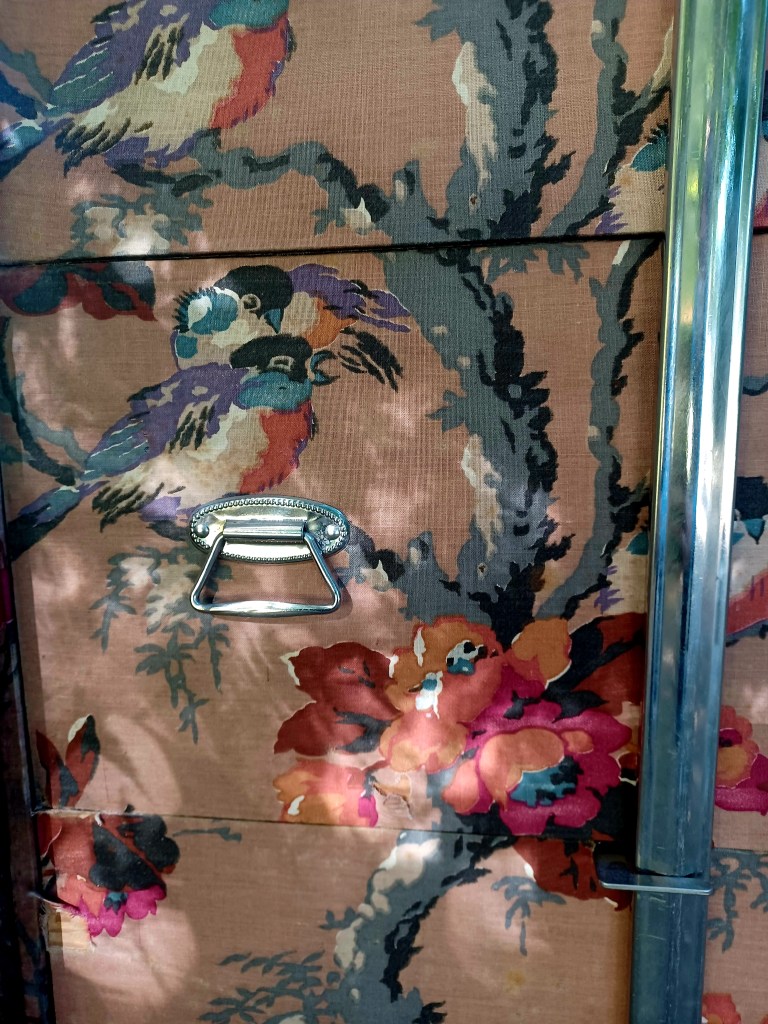
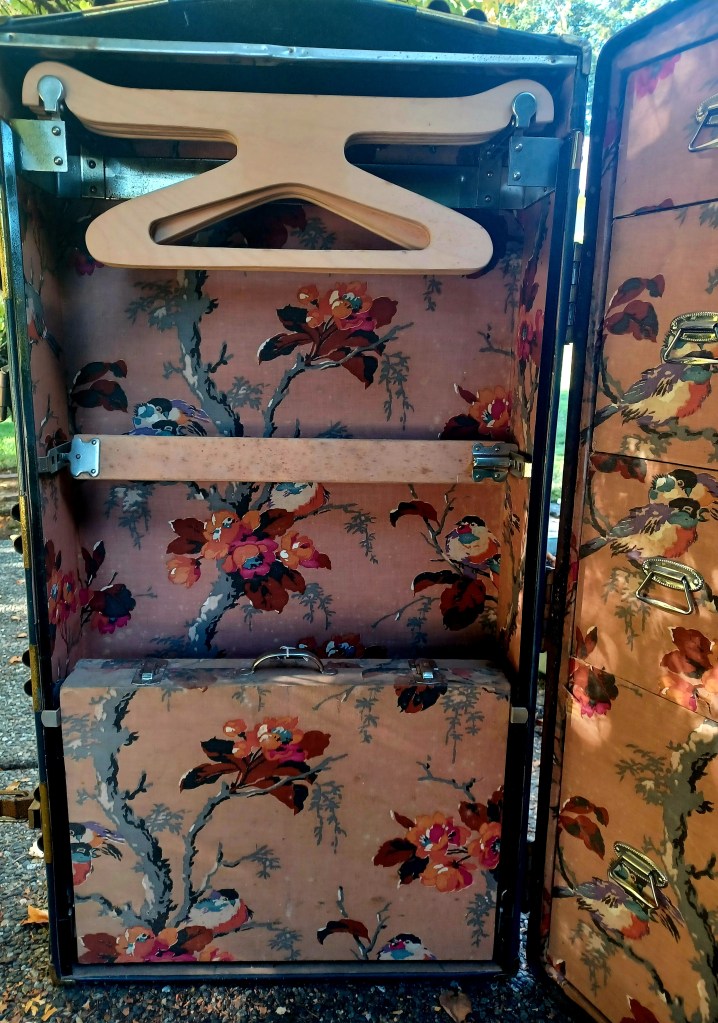
A dainty cretonne lined interior
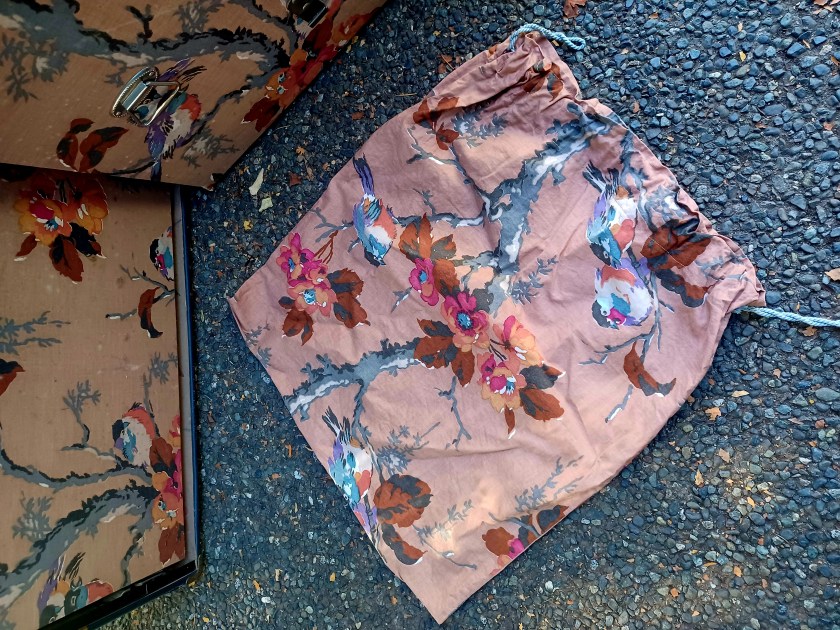
Here’s a description of the Lion Brand wardrobe trunk. This is a bit higher end version than Harold Monks’ trunk — “In its dainty cretonne* lined interior there are constant hangers for a dozen suits or dresses, a laundry bag, shoe box, an ironing board, an electric iron holder, hat box and removable hat form, all with a self locking draw bar which fits over the drawer fronts, and a roller curtain to keep the contents free from dust when the trunk is open.” (Vancouver Sun June 23 1928) *Cretonne is a type of upholstery material.
How much the trunk cost
Where did Harold buy the trunk, and how much did it cost? Contemporary advertisements give some ideas. Most major department stores in Vancouver – sold wardrobe trunks. These were sold in the “Traveling Goods Section, Men’s Furnishings, Main Floor” at Spencer’s. By the description below, these seem to be Vancouver Trunk & Bag Ltd. products. The prices varied by type of trunk (and features inside), and the price seems to have gone down over the years.
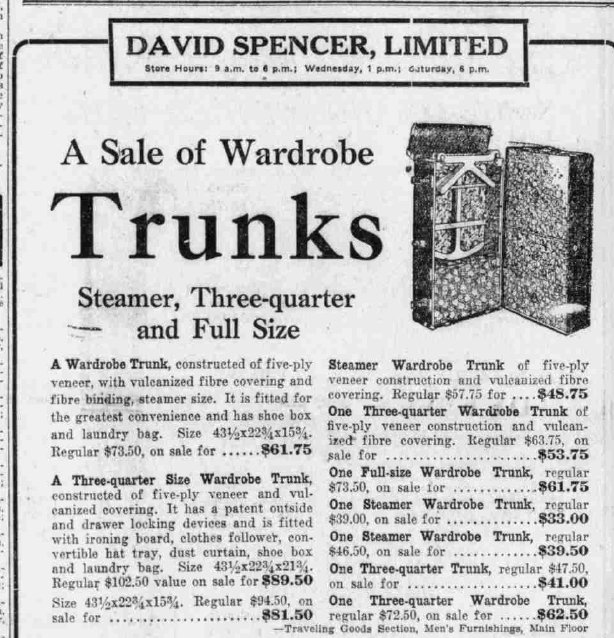
In 1924, a three-quarter size wardrobe trunk of the same dimensions as Harold’s cost $81.50. In 1925, the Vancouver newspapers ran a “save the labels of BC products” campaign, and offered a prize of a “Lion” wardrobe trunk, manufactured by the Vancouver Trunk & Bag Ltd., value $75.
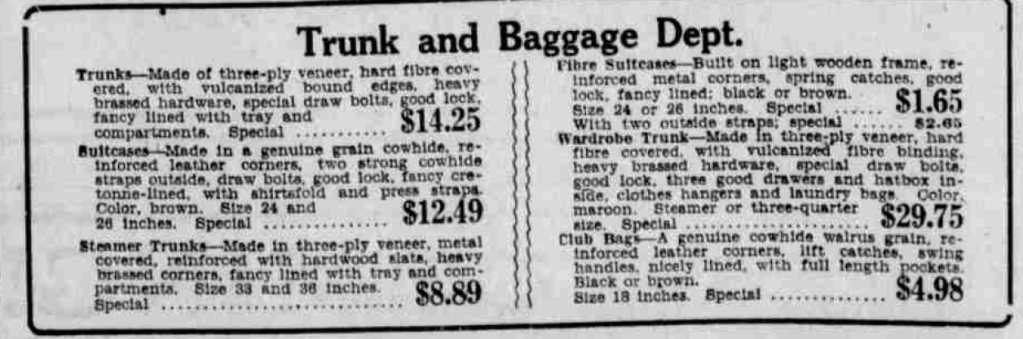
In July 1928, a Woodward’s “BC products” advertised a wardrobe trunk for $29.75. The description of this trunk matches that of Harold’s, “made of three-ply veneer, hard fibre covered, with vulcanized fibre binding, heavy brassed hardware, special draw bolts, good lock, three good drawers and hatbox inside, clothes hangers and laundry bag inside.” Note – the colour for sale was “maroon” – Harold’s, minus the years of discoloration, is teal green. Perhaps “maroon” was an unpopular colour?
How did the price of trunk compare to price of a ticket to England on a Canadian Pacific steamship? In 1928, a one way minimum fare for Third Class on the Canadian Pacific steamship “Montclare” was $85.
Where the trunk went
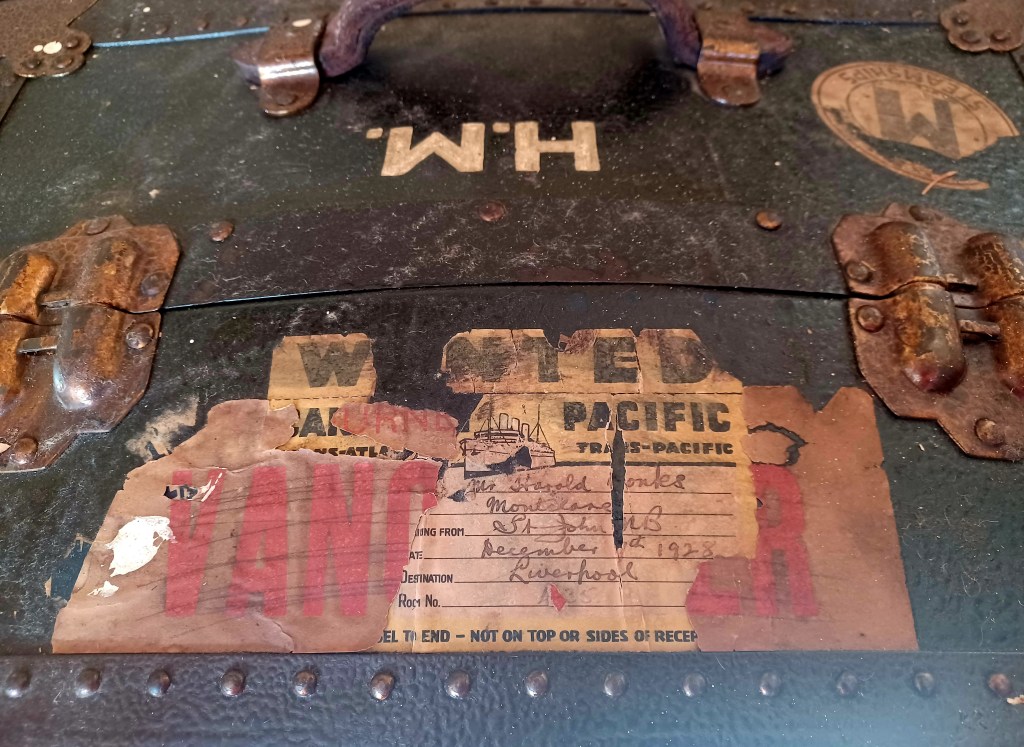
Sailed Saint John NB 7 pm. Snowed very heavy.
Harold Monks’ diary December 7 1928
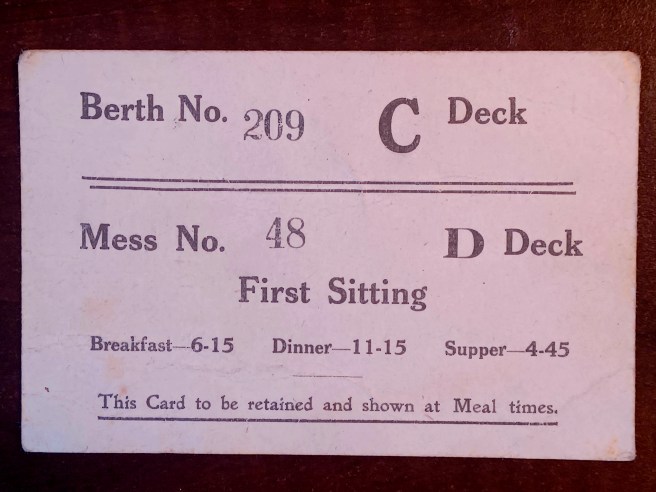
In December 1928, the trunk and its new owner Harold Monks left Vancouver by train for Saint John New Brunswick. They boarded the Canadian Pacific Steamship “Montclare”. Harold was travelling Third Class in a two-person berth. The room was interior, meaning facing the corridor and no outside windows, but in December weather, probably a good thing!
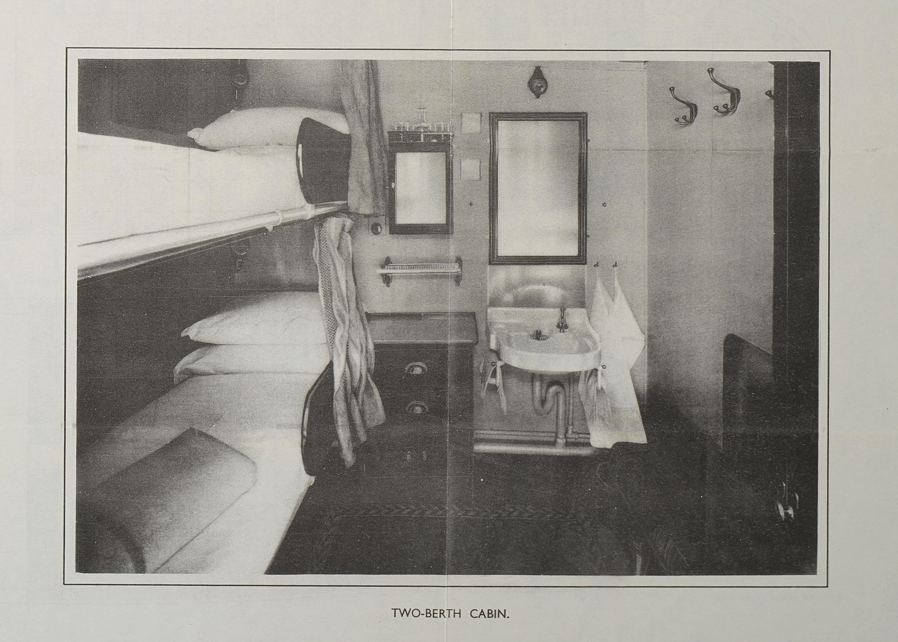
The trunk probably did not fit inside Harold’s room. The 1928 passenger booklet for the “Montclare” has this comment — “Wardrobe Trunks – The attention of the passengers is called to the fact that the steamer has a baggage room where trunks may be stored during the voyage. It is not always possible to have large wardrobe trunks placed in an accessible position in passenger staterooms.”
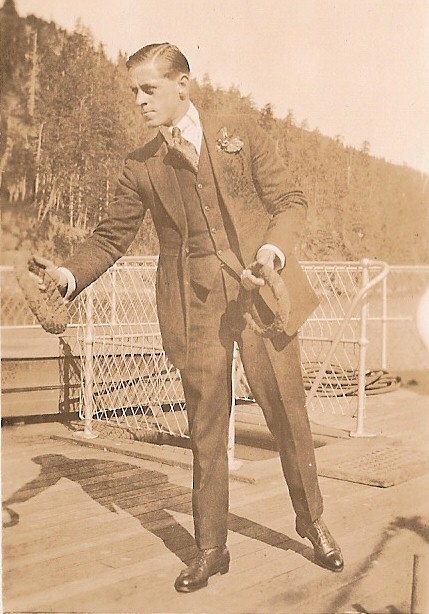
What kind of clothes would a 1920s traveller like Harold Monks be storing in his wardrobe trunk? Here’s Harold on deck on December 12 1928 in a white shirt, tie, V-neck argyle knit sweater. The guy next to him has a “flat cap”. Harold’s hair is “brylcreemed” – the brush and supplies would probably be kept in one of the drawers.
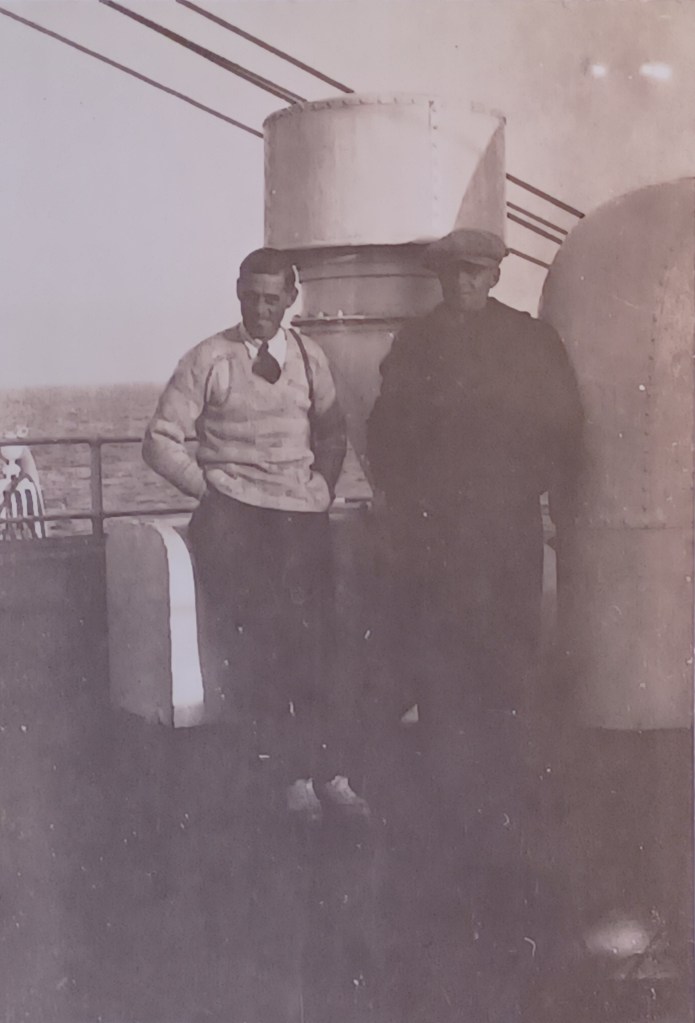
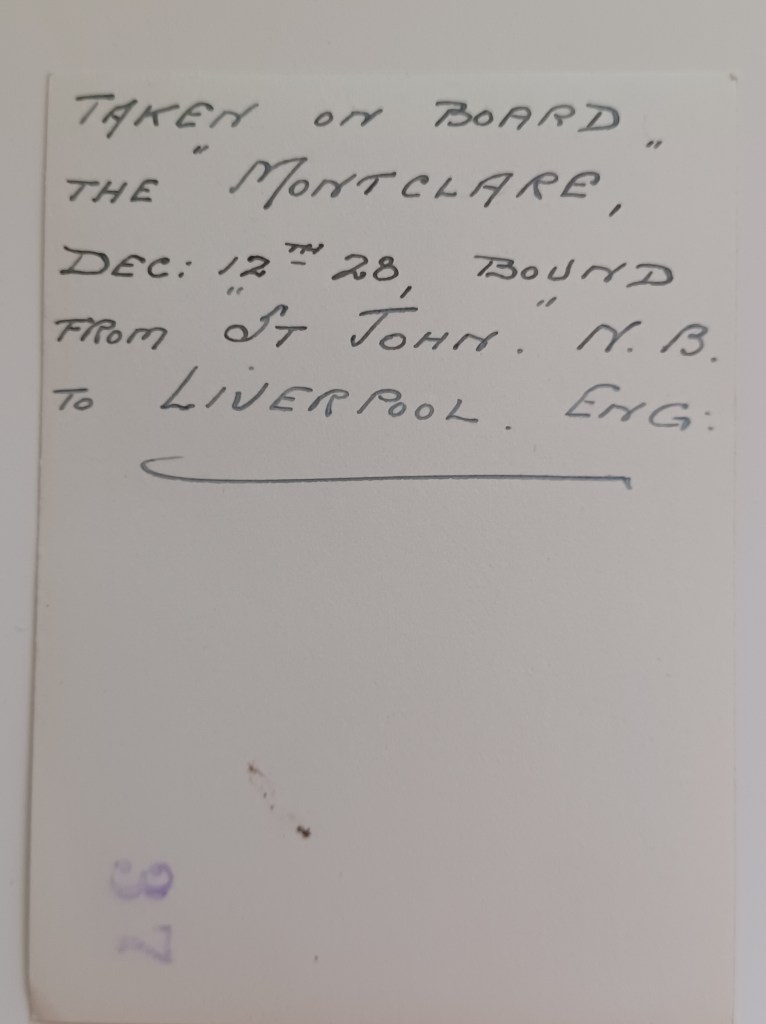
Harold’s diary entries give a glimpse of activities on board.
December 8 1928 – Rain, fairly smooth. Dancing in main lounge. Ship’s orchestra. Night thick fog. [There was a “Montclare orchestra” – see this programme from 1928 in the Chung Collection at UBC]
December 10 1928 – Lovely bright morning. Took snapshots on board. Smooth sea. Dancing in lounge.
December 11 1928 – Heavy rain. Smooth sea. Movies in lounge.
On December 14 1928 Harold was “in bed most of day with severe cold High Temp.” The following day, he was “in bed all day. Very bad cold.” The ship anchored in the Mersey about 8.30 pm. On December 16, the ship dock at 9 o’clock a.m. and Harold was home about 11 o’clock.
The trunk and Harold spent the next few months at his family home in Earlestown, Lancashire (with a trip to London to see his brother and catch some West End shows).
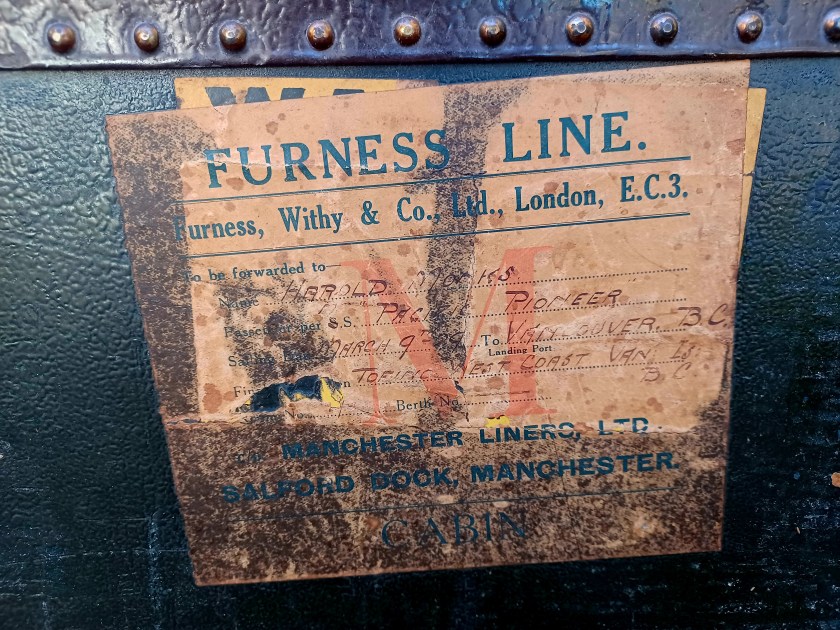
In March 1929, the trunk and Harold sailed from Salford Docks, Manchester on the Furness Line “Pacific Pioneer”. They were started on a thirty-three day journey to Vancouver, via the Panama Canal. The Furness line ran a cargo service with “a small select number of passengers who are real sea-lovers.” Accommodation was “first class” and the experience was “The luxury of a comfortable party in a country house.”
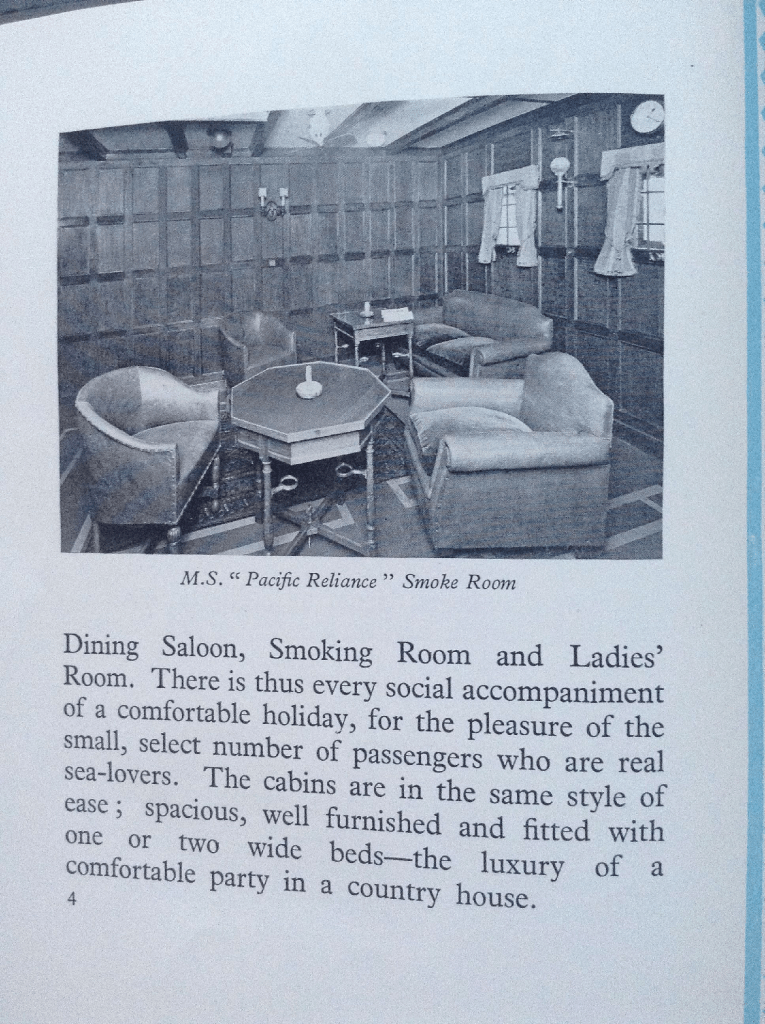
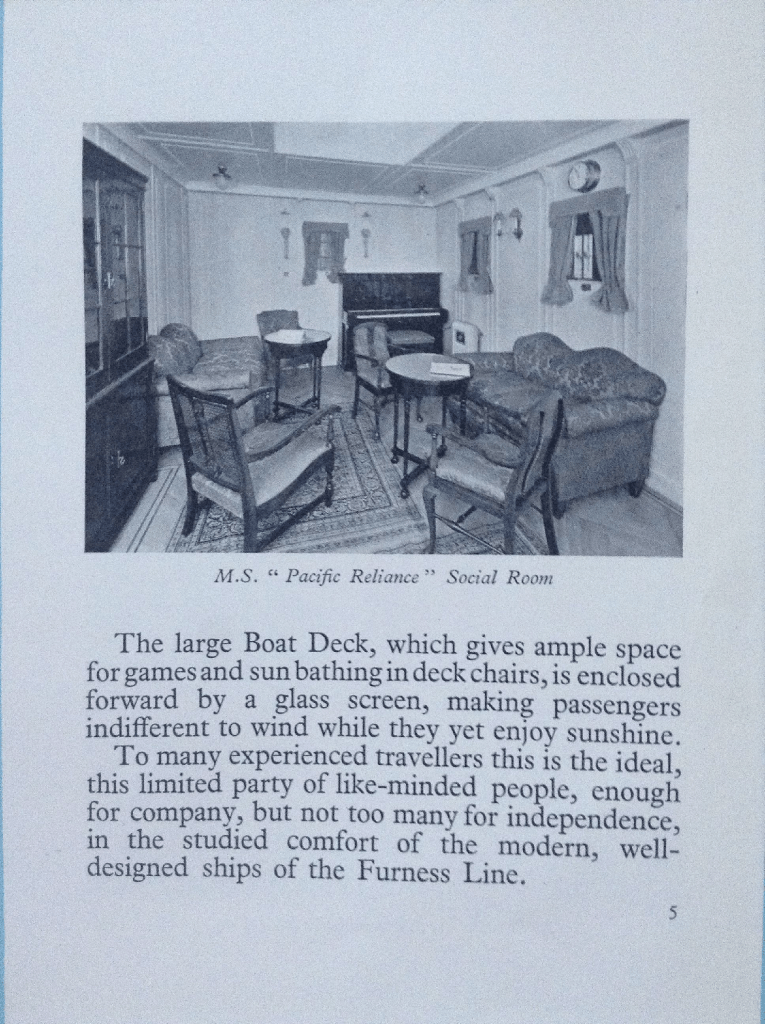
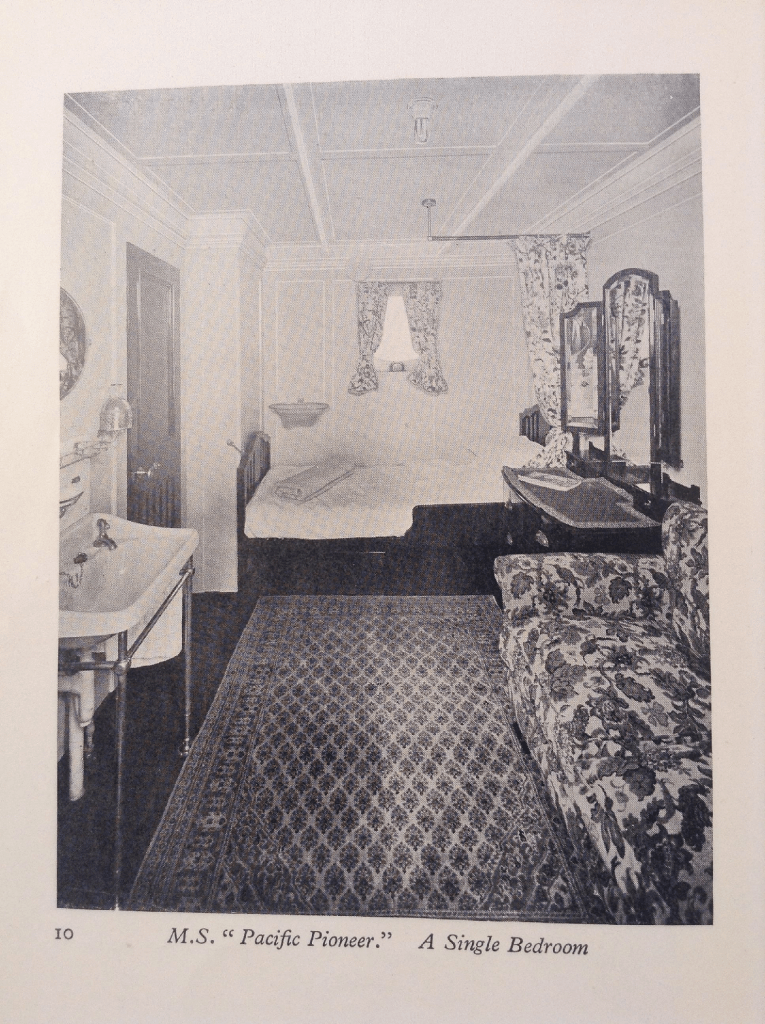
No berth or baggage room for the trunk this time – on the “Pacific Pioneer” the trunk enjoyed the nice surroundings of a bedroom with a carpet and a floral chesterfield. “Good accommodation for a limited number of first-class passengers on the bridge deck. Here they enjoy large rooms, placed amidships with direct lighting and ventilation.”
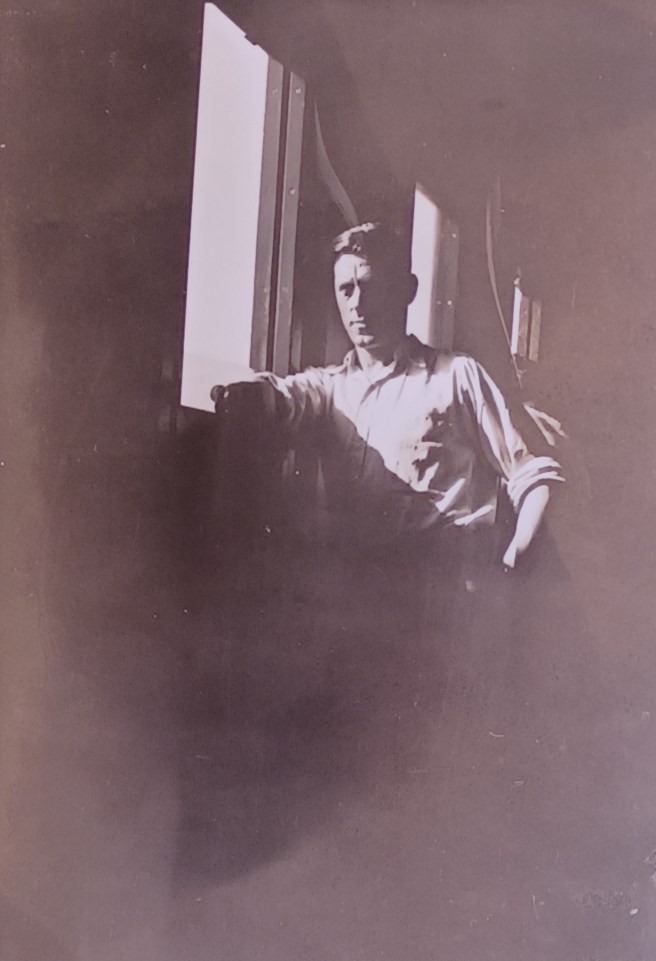
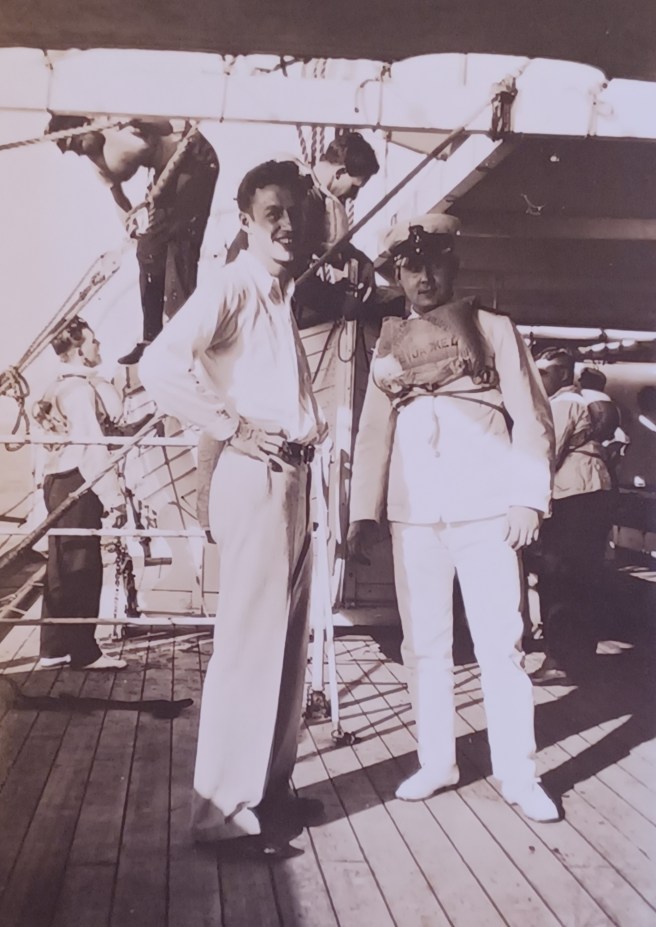
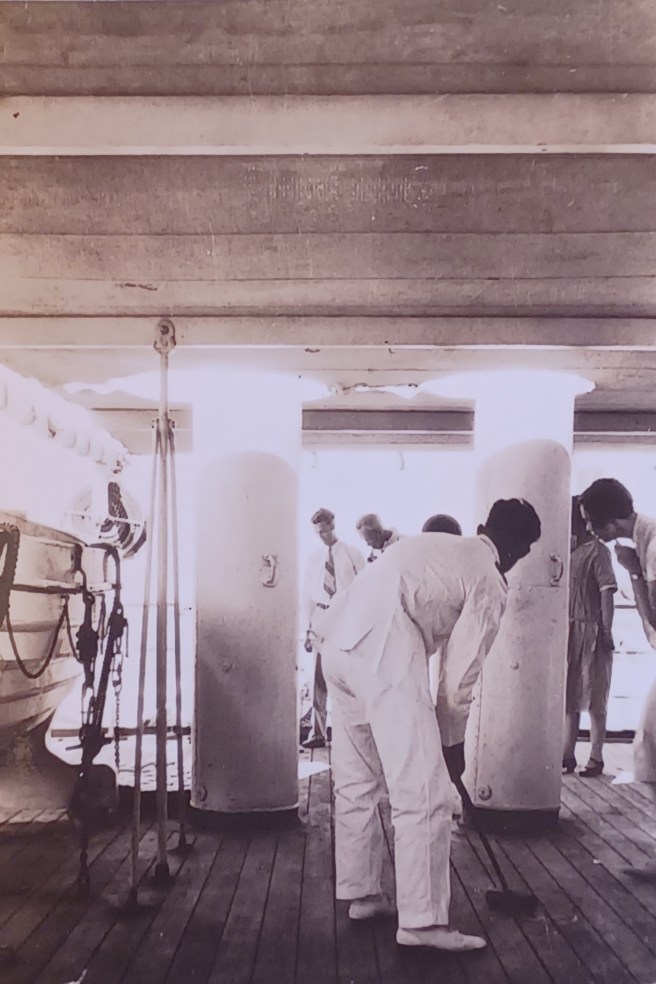
When the ship reached Colon Panama, Harold and other passengers “Went up town, arriving back at boat 3.15 a.m. (28th).” (Harold’s notebook of purchases notes he bought drinks in a local bar). On March 28 1929, the “Pacific Pioneer” passed through the Panama Canal. Harold saw an alligator. March 31 1929 was a “very hot day. Smooth sea. Lots of turtles. No land in sight.” On April 5 1929, the ship held “farewell dinner aboard and dance afterwards.” The “Pacific Pioneer” docked in San Pedro Harbour, Long Beach and San Francisco. Harold’s last diary entry says April 12 1929 – Rain, smooth sea. Passed Cape Flattery 7 pm.
By the end of April 1929, Harold and the trunk were in Tofino. He put the trunk into storage and started his annual work as a fisherman for the Clayoquot Sound Canning Company. The trunk remained in storage while Harold bought a marine gas station and house, got married, had children. Once a year, Harold went from Tofino to Vancouver for medical-dental-shopping trips.
“Designed for perfect packing”
Meanwhile, Vancouver Trunk & Bag Ltd. moved on from the golden age of steamship travel trunks into new products for a new era.
During World War Two, Vancouver Trunk & Bag Ltd. obtained supply contracts from Ottawa for soldiers’ personal boxes and attache cases. There was a restriction on the manufacture of luggage and leather goods, lifted on October 1 1945. ‘It will be after the turn of the year before we are able to step up production to any extent,’ John Macdougall manager of Storey & Campbell said.
In 1946, Dominion Construction was awarded a contract to build a $50,000 addition to the Vancouver Trunk & Bag Ltd. factory. “It will be a two storey reinforced concrete structure, and when completed will employ 130 people.” (Sun January 19 1946). Here’s the building, when I visited the area in November 2025.
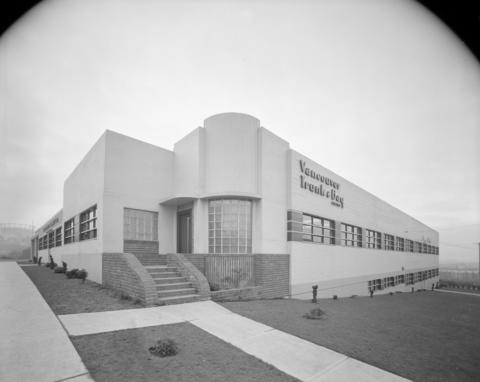
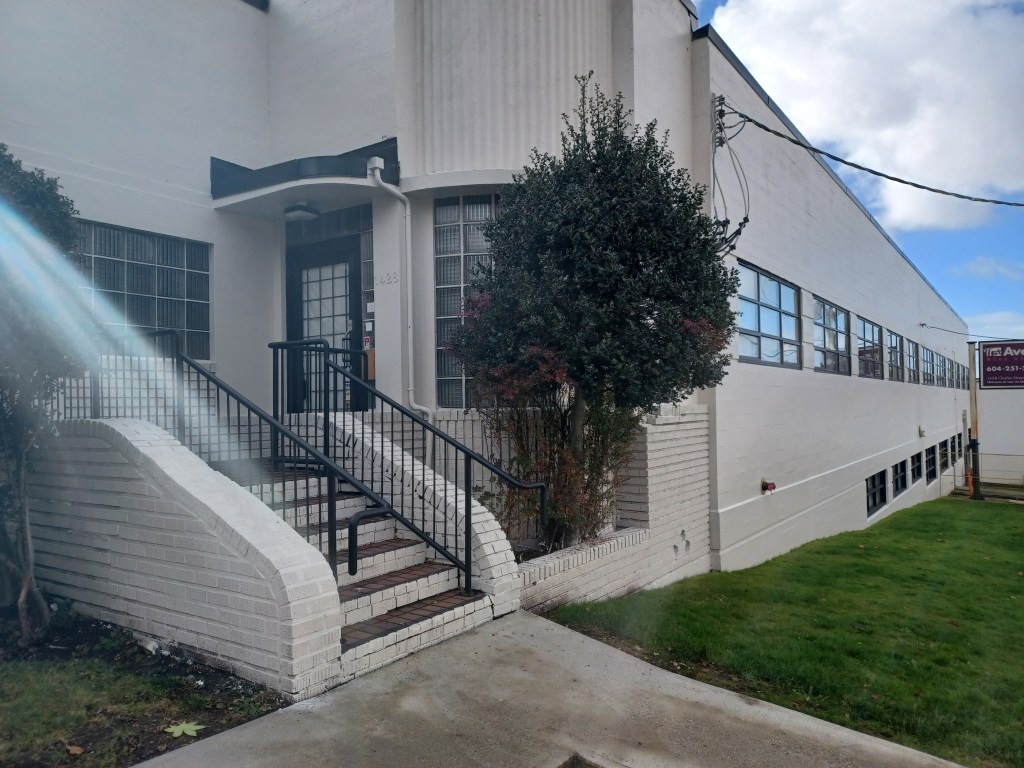
The plant in turn using BC products gives indirect employment to hundreds of others. It is the concrete symbol of the struggle upwards against stiff competition.
R.J. Moore, Vancouver Daily Province January 29 1949
In 1949, Vancouver Trunk & Bag Limited employed 75 persons the year round and 90 at the peak. Fred Storey was still manager. “Mr Storey is proud of his products which are literally hand-made. Clear grained cedar from BC forests and top-grade plywood from Vancouver factories go into the light, sturdy travel cases, which carry the Travelgard and Skyway labels…There are dozens of whirring machines but the skilled hands of men and women are responsible for the beautiful work in linings, coverings and bindings.” (R.J. Moore, Vancouver Daily Province January 29 1949)
The company made “Travelgard” and “Skyway” luggage, catering to the post-war popular in vacations by airplane. “Light for air travel yet sturdy enough to cope with the baggage room crowd!”
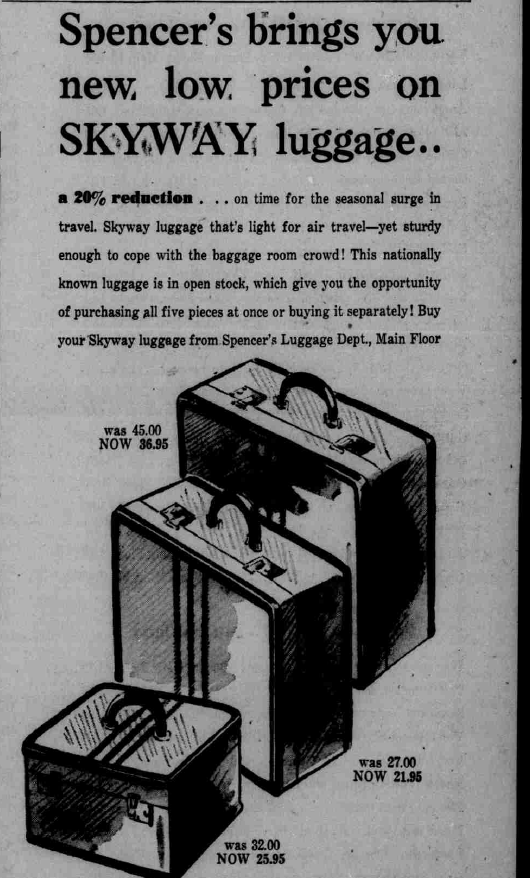
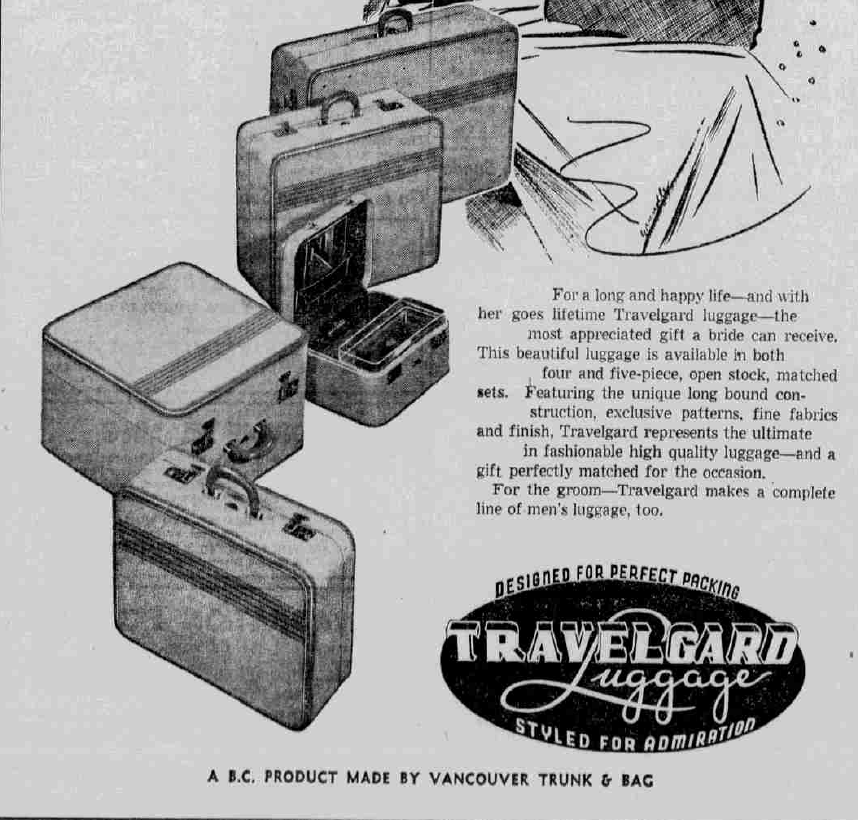
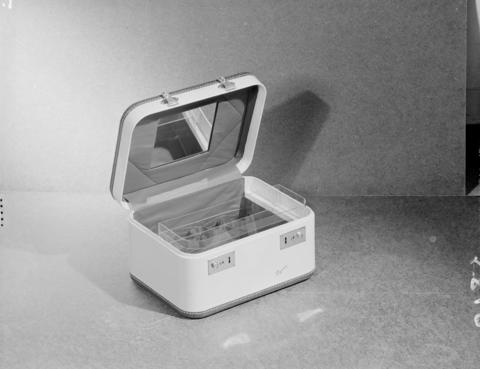
Here’s a 1947 image of a Travelgard brand train / cosmetic case. My mom – Harold’s daughter – was given a similar looking Travelgard case in the 1950s. The exterior was ivory and interior was lined in a butterscotch brown satin material. The case lasted well into the 2010s, used for tent trailer camping.
“Nothing more durable”
Almost 90 years later, Harold Monks’ 1928 “Lion Brand” wardrobe trunk is still in good condition, a testament to the quality British Columbia materials and workmanship of a British Columbia factory.
Related Stories
Harold Monks’ West Coast Snapshots – more photos from Harold’s camera of his friends and neighbours in Tofino area in the 1920s and early 30s.
A Vancouver Wedding, 1934 – Harold’s wedding to Katie Hacking and the wedding cake ornament!
 Stephanie Ann Warner