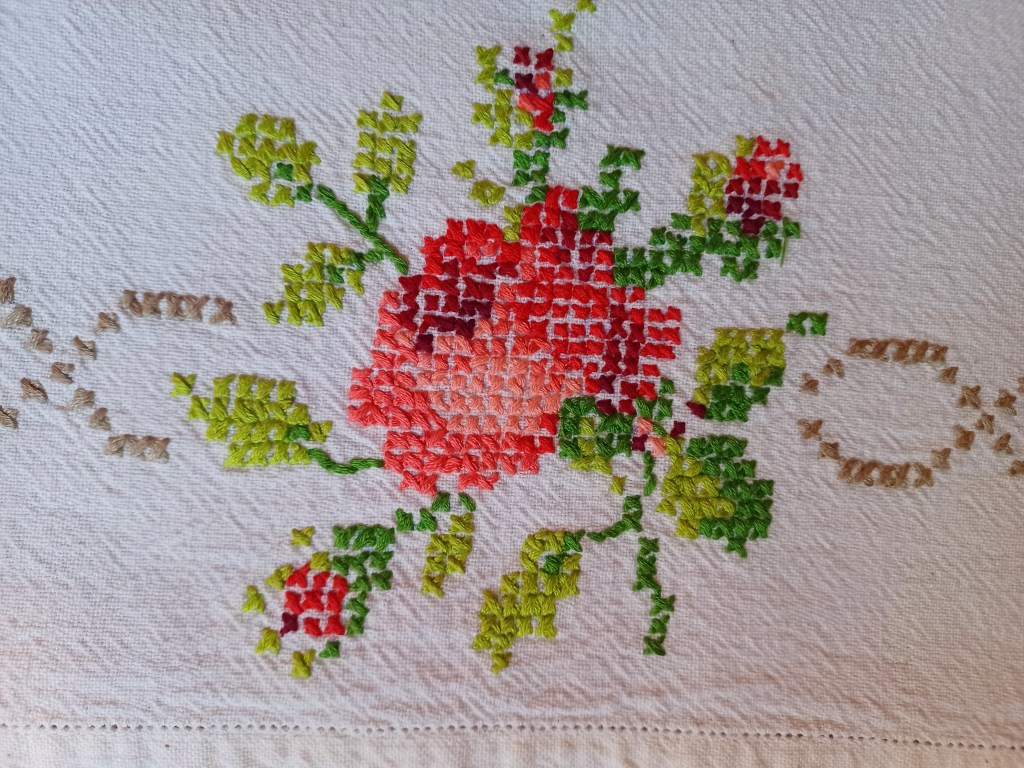
“Can’t you just see how lovely they’ll look and how they’ll brighten your home for spring?”
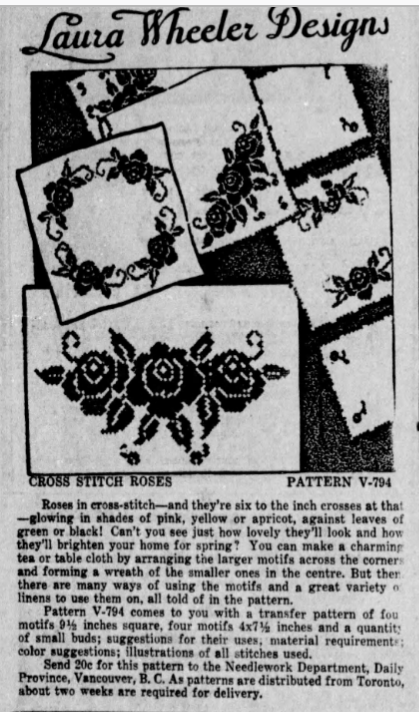
Advertisement for Laura Wheeler Designs Cross Stitch Roses
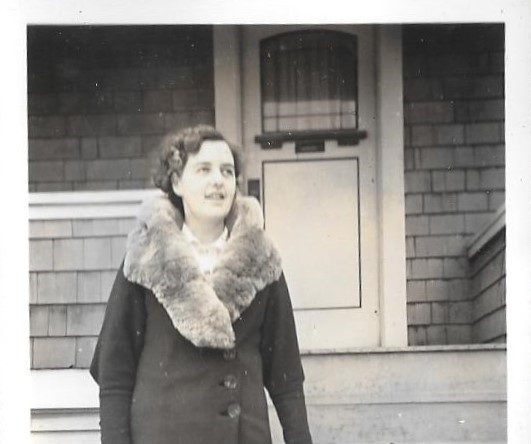
In 1933, some transfer embroidery patterns were sent to my grandmother Katie Hacking at 43 E. 45th Avenue, Vancouver. These Laura Wheeler Designs were provided by the Needlecraft Department of the Vancouver Daily Province Newspaper. The patterns were intended to be ironed on, then cross stitched or embroidered. These patterns – and a linen tablecloth cross stitched from one of the patterns – have been in my family collection for over 90 years.
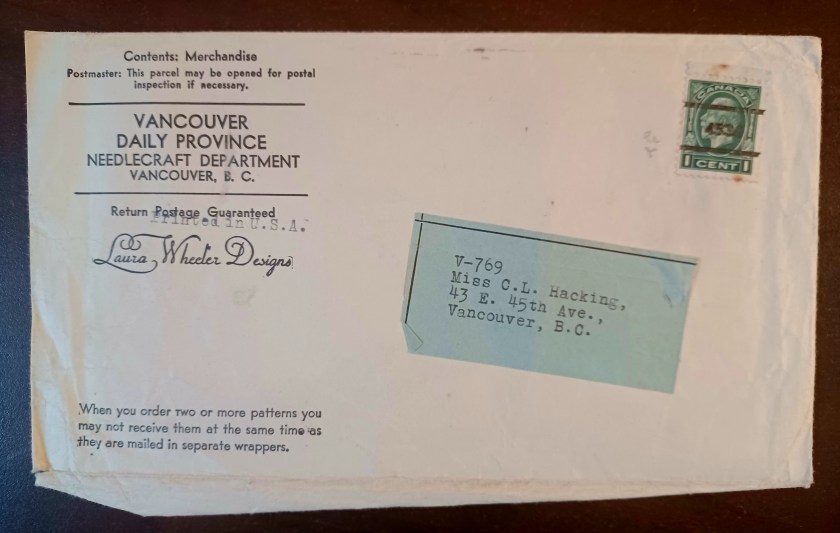
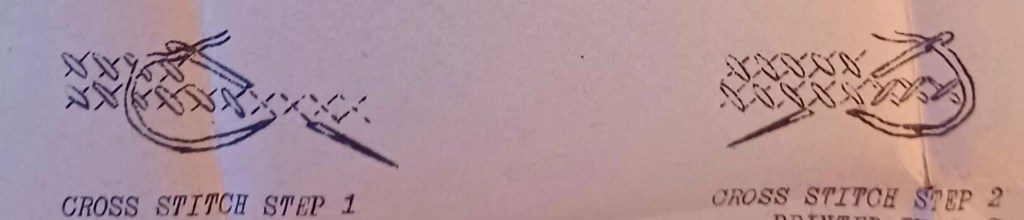
“Cross Stitch, that ever popular needlework”
Cross stitch is such fun to do, either by counting threads to copy a pattern direct, or simply by filling all the little crosses where the design is stamped.
Doris Hale, Cross Stitch for Fun, Better Homes and Gardens March 1934
An advertisement for Laura Wheeler Designs Cross Stitch Roses says “Cross Stitch, that ever popular needlework.” — Yes, it was popular! A search for “cross stitch” in the Vancouver Daily Province from August 1909 (Katie’s birth month) to November 1934 (her wedding month) yielded 809 results!
Cross stitch was especially popular and fashionable in the early 1930s. Canadian women’s magazine Chatelaine April 1933 has an article “The Charm of Cross Stitch” by Marie Le Cere — “An Old World Craft has become the latest decorative novelty. Enter any up-to-date modern home and you will find grouped on the walls quaint old-world pictures…for cross stitch has come back into fashion these last few months.” The article has accompanying patterns for black cross stitch silhouettes. “The Hope Chest” by Constance Templeton in Chatelaine May 1932 says “white table linen, too, is a highlight of fashion again…luncheon and breakfast cloths and table napkins are as gay as they choose — cross stitch has come back for them in the same designs and motifs used in last century samplers.”
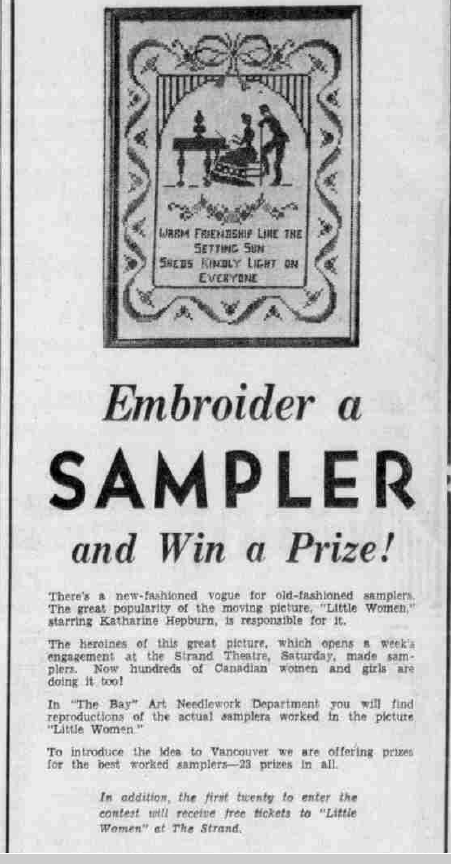
The Vancouver Sun December 29 1933 says “There’s a new fashioned vogue for old fashioned samplers. The great popularity of the moving picture Little Women, starring Katherine Hepburn, is responsible for it.” Embroidered samplers showing the “simple character of the cross stitch work” could be seen in the Bay’s Art Needlework Department.
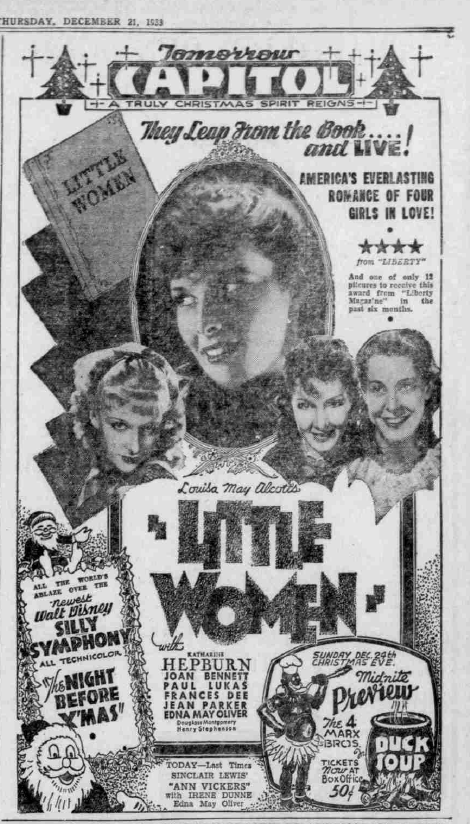
Katie and her sisters and friends may have gone to see Little Women, “an elaborate production” which opened in Vancouver in December 1933. “Made strictly in accordance with the author’s original story, and involving an enormous amount of research work and a large cast of players, Little Women stars Katharine Hepburn as Jo.” (Province December 21 1933)
Embroidery transfers from England
Cross stitch and embroidery transfer patterns were popular in England. Twentieth Century Embroidery in Great Britain to 1939 by Constance Howard says there was a “craze” for cross stitch in the 1880s. A nineteenth-century Manchester firm even created special fabrics with cross stitch holes pre-punched onto the fabric. Mary Thomas’s Dictionary of Embroidery Stitches, published in England in November 1934 says “Cross Stitch must be worked on a material of which the threads can be counted or by means of a transfer which gives guiding spots, as it is essential that all the crosses should be even in size and shape.” Iron-on embroidery patterns were patented in 1874. By the 1930s transfers were condemned by fabric artists as “dull and lifeless patterns.”
English needlecraft magazines were available in Canada. (Katie may have been aware of these magazines, as her Dad was English and she had three English women first cousins in Lancashire). In October 1935, The Province advertised the English publication Good Needlework and Knitting Magazine, available at two downtown newsagents. The Edmonton Journal has notices in 1935 that “Mike’s Newsstand” had the ‘Old Country’ magazines, Good Needlework and Stitchcraft.
A review from The Globe in Toronto of July 3 1934 – “I’ve just been leafing through the pages of an English magazine called Stitchcraft, which is full of suggestions for the needlewoman…On the cover there is reproduced a bright and easy design carried out on a canvas like background, and a transfer pattern for this is folded inside the magazine — also several pages showing how the work is done, and pictures of a beach coat, some cushions, and even a mirror frame decorated in this gay stitchery.” Stitchcraft – For the Modern Woman and Her Home was produced monthly from 1932. This link from the Knitting and Crochet Guild website shows an image of Stitchcraft’s first issue cover from October 1932 “with free transfer inside”.
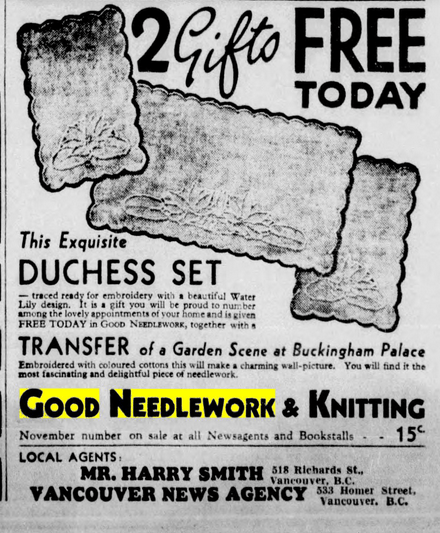
Good Needlework magazine presented “free gifts” with each issue, such as “a handkerchief sachet all ready to embroider with a charming cut work design and an embroidery transfer for “a gay ‘Old English Garden’ wall picture.” In October 1936, Vancouver needlewomen could receive a free transfer of a garden scene at Buckingham Palace. The Hamilton Spectator October 22 1936 has a review of the latest issue of Good Needlework, which included “a free transfer for an embroidery wall plaque.” Types of embroidery shown inside that issue — “among the artistic needlework designs illustrated are the Vase of Flowers for pin cushion cover, the Flower Posies, a design in Jacobean manner, and various other ideas which can be worked out by even the beginner in needlework.” Constance Howard says that “the bowl or vase of flowers was a favourite subject for embroidery until the late 1930s. Many transfer patterns were issued on this theme in women’s magazines and those on needlecraft.”
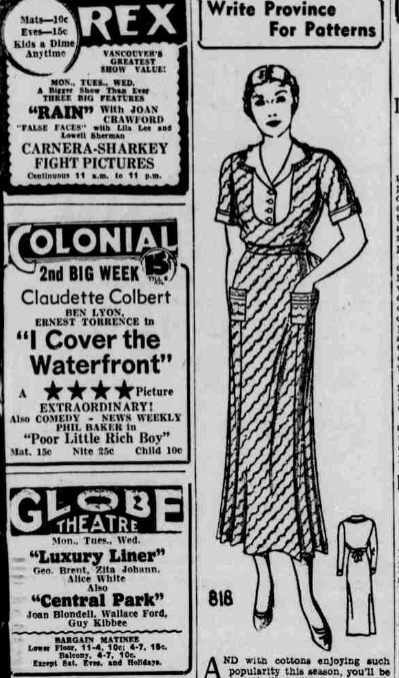
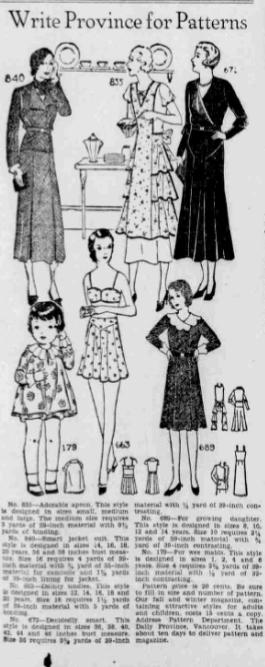
“Write Province for Patterns”
Closer to home, Canadian women could order patterns from their local newspapers. For many years, The Daily Province newspaper had a Pattern Department. Vancouver readers could order clothes patterns for 20 cents.
The first mention I found of the Province’s Needlecraft / Needlework Department is March 13 1934. This was an advertisement for Laura Wheeler Designs – “Send 20 cents for this pattern to the Vancouver Daily Province Needlecraft Department.” Laura Wheeler Designs appears to have been a popular product sold in Canadian newspapers of the 1930s. I found mentions of Laura Wheeler Designs in the Calgary Herald, Regina Leader-Post, and other eastern papers. A note in the Calgary Herald shows the popularity of Laura Wheeler Designs – 1,098 orders were placed in February and March 1936.
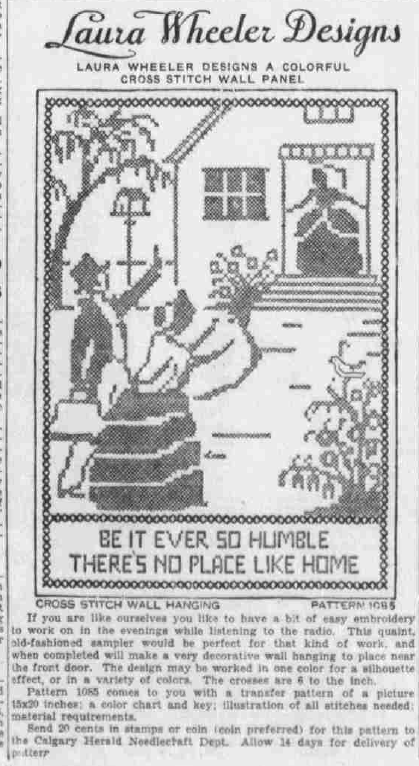
The above pattern for a colourful cross stitch wall panel says “If you are like ourselves you like to have a bit of easy embroidery pattern to work on in the evenings while listening to the radio.” (Calgary Herald January 3 1936) A side note — the 1931 Canada Census was the first to include a question about radio ownership. It found that 33.9% of Canadian households had a radio. In 1931, Katie was listening to a radio in Tofino where she was teaching school, but her family in Vancouver did not have a radio at that time (they were, however, very musical, so perhaps embroidery was done to the accompaniment of piano and viola?)
Charming Table Linen
“Cross stitch and filet crochet are favourite needlecraft for table linen.”
Lydia LeBaron Walker, Fitted Tray Covers, How to Make and Ornament Them, The Vancouver Sun November 4 1933
Here’s an advertisement for Laura Wheeler Designs — Pattern V-794 Cross Stitch Roses, one of the patterns mailed to Katie. “You can make a charming tea or tablecloth by arranging the larger motifs across the corners.”
Here’s a slightly different rose pattern cross stitch that Katie made in the 1930s – roses around the edge of a square tablecloth.
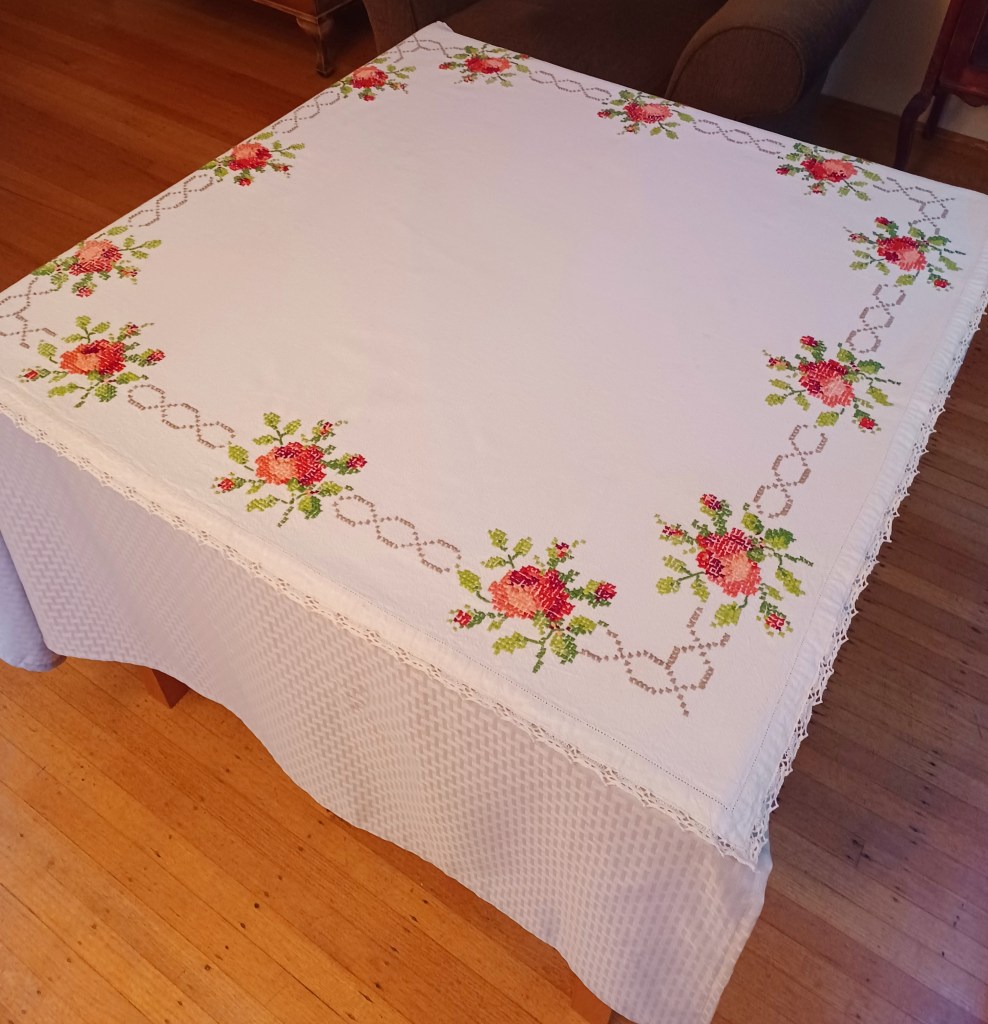
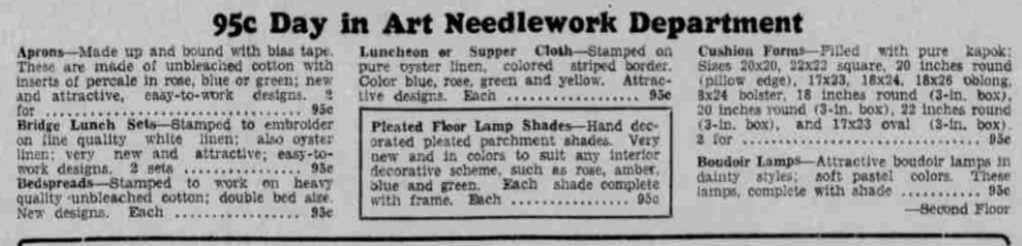
This design doesn’t match any of the Laura Wheeler Design patterns in Katie’s collection. It’s possibly a different design, or could be a pre-printed linen. This advertisement for Woodward’s Department Store 95 cent days mentions several kinds of stamped linens like “Bridge Lunch Sets” or “Luncheon or Supper Cloth”.
In June 1933 Chatelaine Magazine was selling a stamped linen pattern for a daffodil luncheon set. “You would hardly believe anything so striking as this design could be worked in simple cross stitch. The daffodils are, of course, worked in yellow, and the leaves in dark green. A thirty-six inch cloth with four serviettes can be supplied on cream, green or mauve linen for $1.35.”
Trying a 1930s cross-stitch pattern
I decided to try the Laura Wheeler V-794 transfer pattern for Cross Stitch Roses.
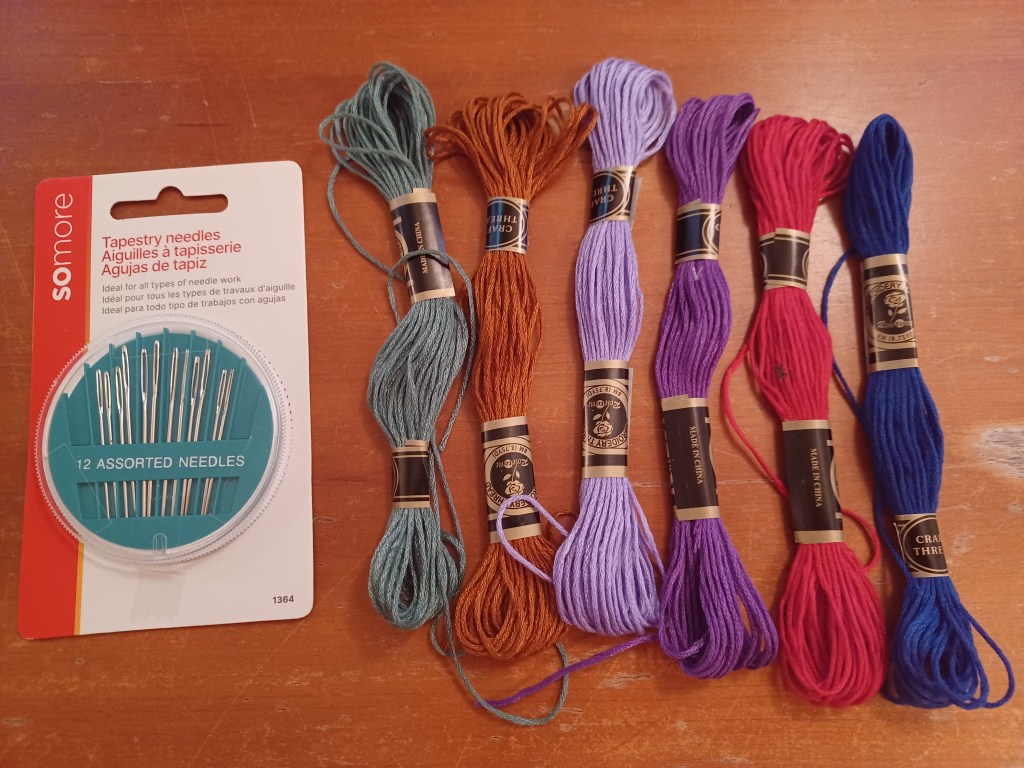
Assembling the materials — In the 1930s, department stores sold needlecraft supplies. Katie could have gone to Spencer’s, Woodward’s or the Hudson’s Bay Company stores in downtown Vancouver. Ads from the early 1930s mention the Bay’s Art Needlework Department — “The place to tell your plans, receive helpful suggestions, and to procure the necessary materials.” I got my needles and embroidery floss from Your Dollar Store with More in Kitsilano. It was harder to find the fabric. No, I was not going to purchase a linen tablecloth! I thought I’d be able to find a cheap blank tote bag or dish towel at a local dollar store, but no such luck. I ended up going to Oomomo Japan Living in Richmond and found a fabric napkin in loose weave.
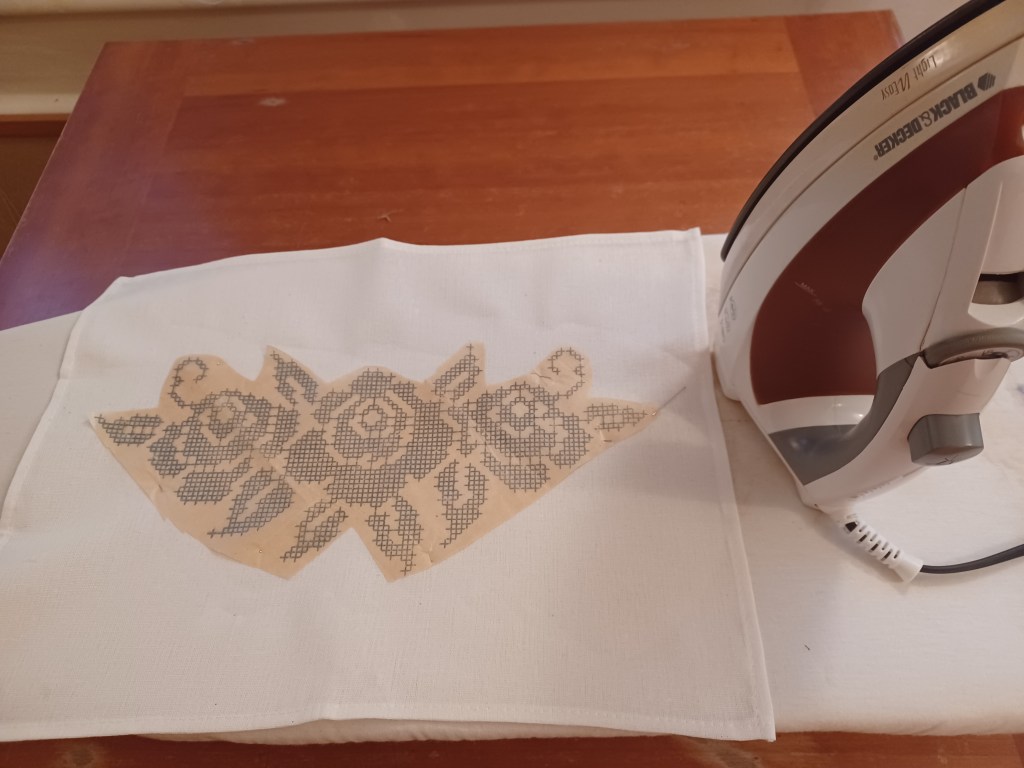
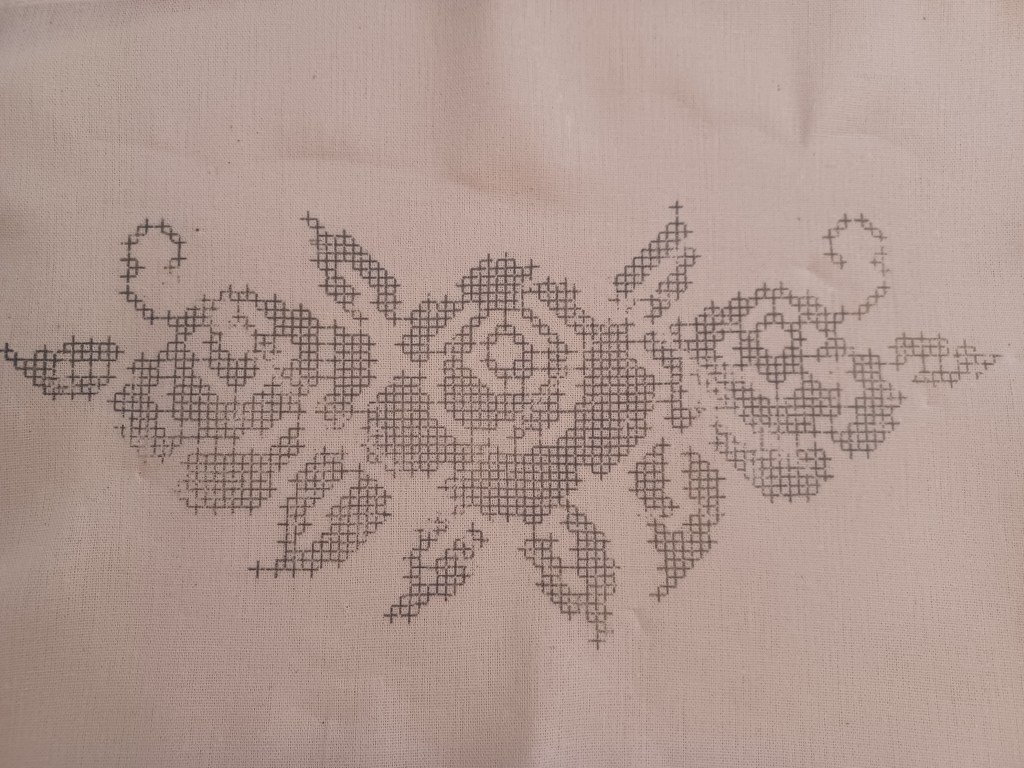
Stamping the fabric — I chose a floral motif and got it ready to transfer. I was skeptical if the ink would transfer to fabric after 92 years, but yes, the pattern still worked!

Choosing the colours — Bright colours were popular in the 1930s. “An attractive colour scheme is that of the new Chinese colours in red, blue and yellow with the colours following each other thus in succeeding flowers.” (Lydia LeBaron Walker, November 4 1933) The Laura Wheeler Designs advertisement for Pattern V-794 suggest roses “glowing in shades of pink, yellow or apricot, against leaves of green or black!” The instructions suggest “black, rose, blue or any other colour in two shades of one colour.” Katie used shades of red and green for her roses. There’s a particularly colourful suggestion – Roses – yellow and orange, leaves – black or brown, buds -blue or orange red. Turquoise is also suggested. Twentieth Century Embroidery in Great Britain to 1939 shows a “vase of flowers” transfer embroidery “in bright colours, including blue, green, yellow, turquoise, red and others.”

I started with what embroidery floss I had on hand – a dollar store package of floss I had picked up to do some “teddy bear repairs” – hence some brown. There was also a muted green and shades of purple.
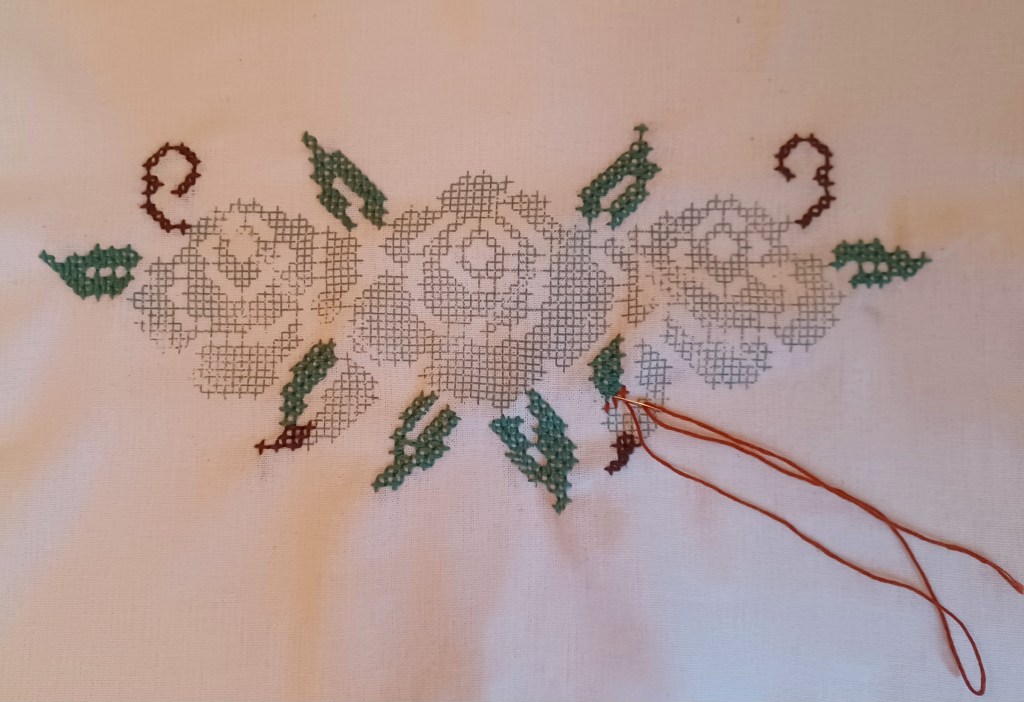
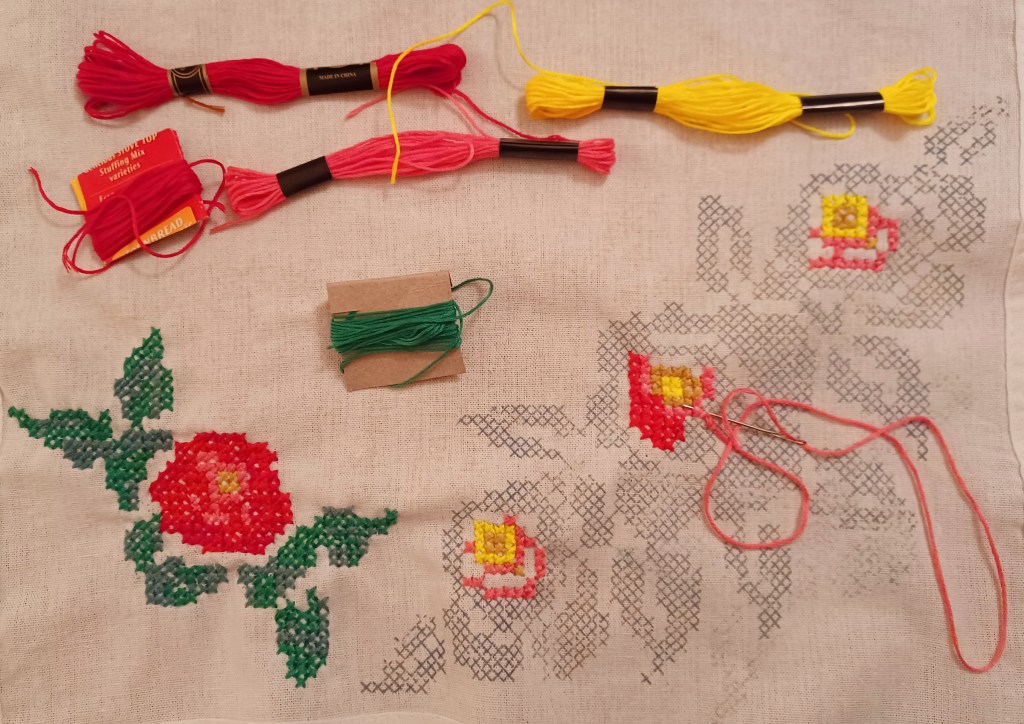
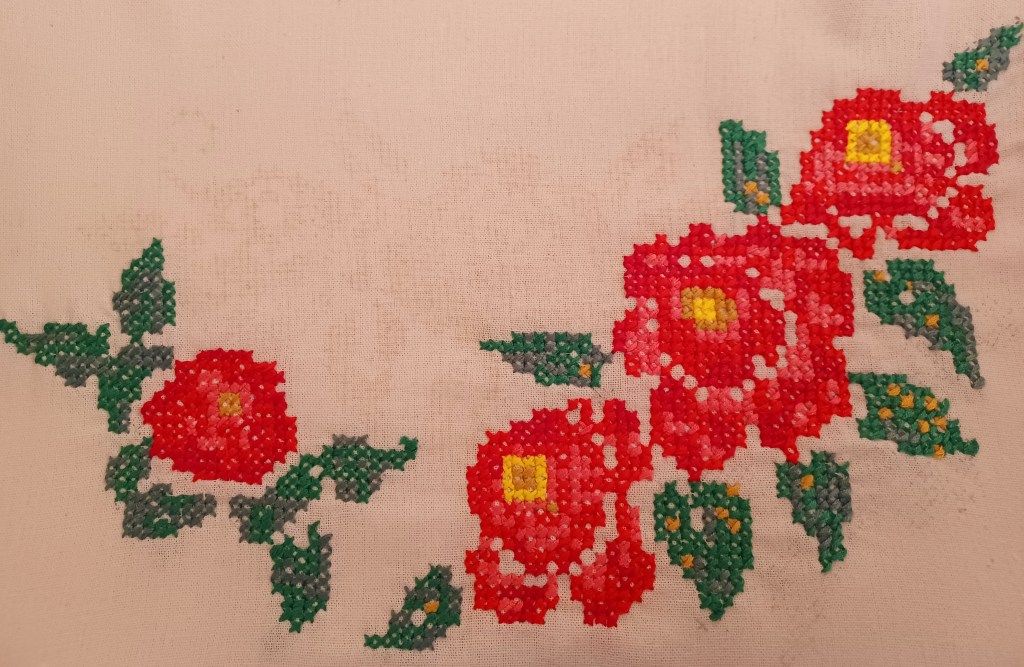
I started with a brown, purple and mauve colour scheme, but not long after decided to go with something more bright and cheerful, and more fitting for the 1930s era. I unpicked the stitches and started again with bright reds, pinks, greens and yellows. Perhaps it will become a holiday inspired “table linen”?
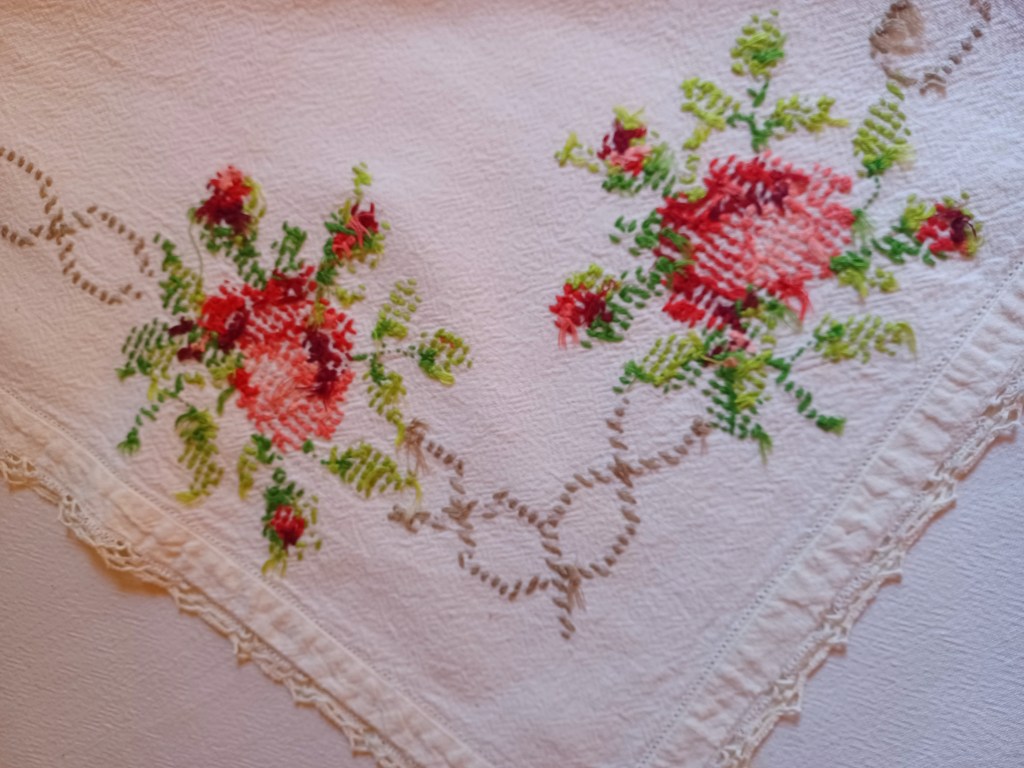
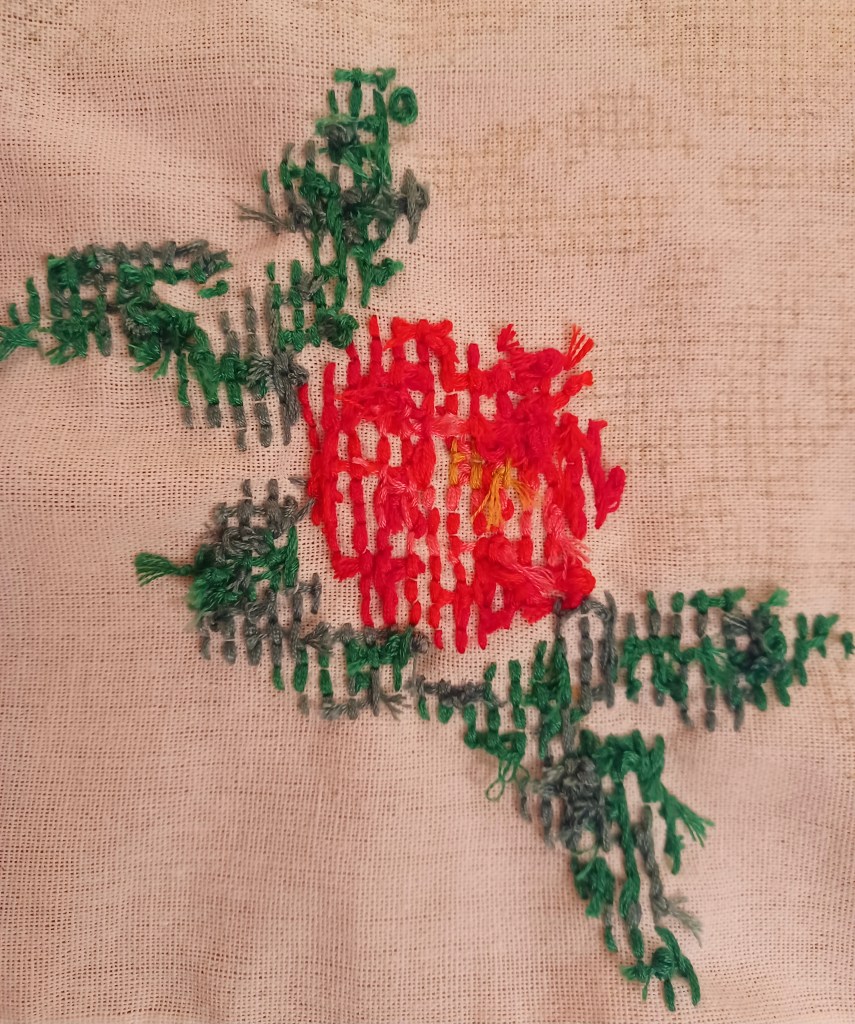
One of the key things, of course, is to make the back stitching as neat as the front. Here’s the back of Katie’s embroidery, and the back of my own.
Crochet edgings – just the thing
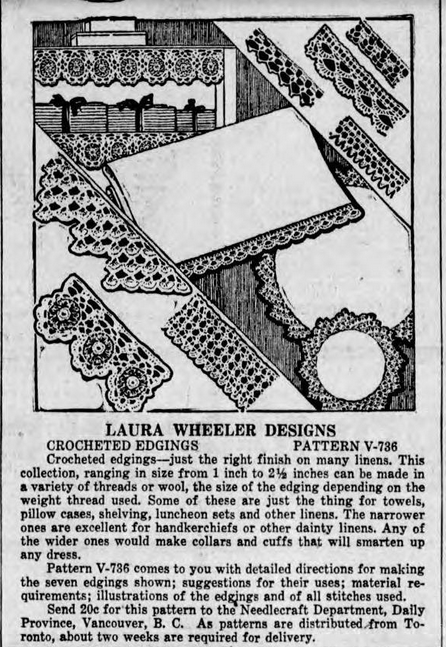
Now this embroidery is complete, I could finish the edge in “blanket stitch, cross stitch, picot crochet or lace.” Here’s a Laura Wheeler Designs pattern to make your own crocheted edgings — “Some of these are just the thing for towels, pillow cases, shelving, luncheon sets and other linens.”
Katie Hacking bought a tablecloth with pre-made crochet stitching.
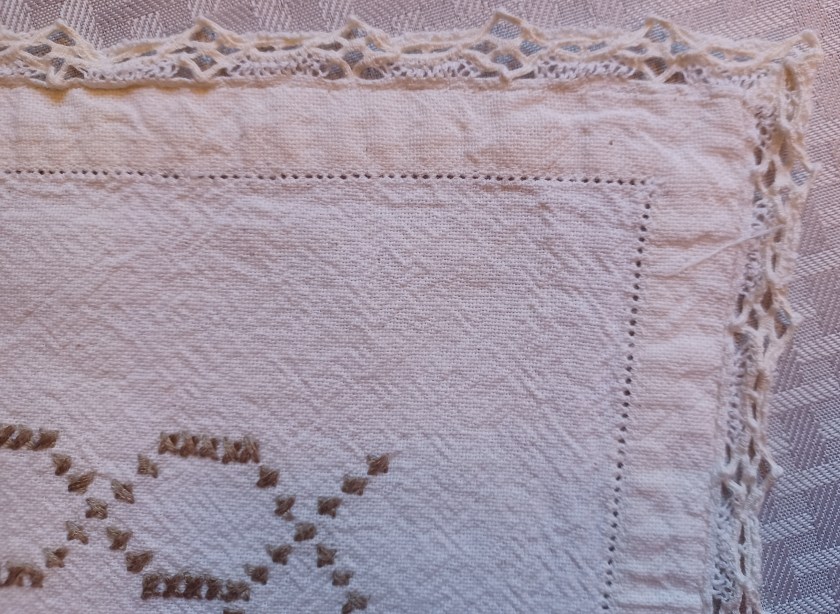
The Laura Wheeler patterns and tablecloth were ordered and embroidered in Vancouver, but spent most of their lives in Tofino, where Katie lived from the early 1930s – early 1980s. After Katie’s ambitious cross-stitching of the tablecloth, most of the patterns remained in their envelopes unused until today.
The tablecloth had more use, as Katie hosted tea parties. She was sociable and community-orientated, active in the Ladies’ Auxiliary to the church, the legion, the hospital. At these tea parties, she used dishes kept in a big glass-front art deco style china cabinet (still in the family). In a letter announcing her 1934 engagement, Katie mentions that she and her fiance Harold were deciding that evening on their chinaware patterns!
Related stories
A Vancouver Wedding, 1934 – Read more about Katie’s wedding and see her cake decoration here.
A South Vancouver Childhood – Explore the 1910s and 1920s with Katie and her siblings at home and at school
 Stephanie Ann Warner