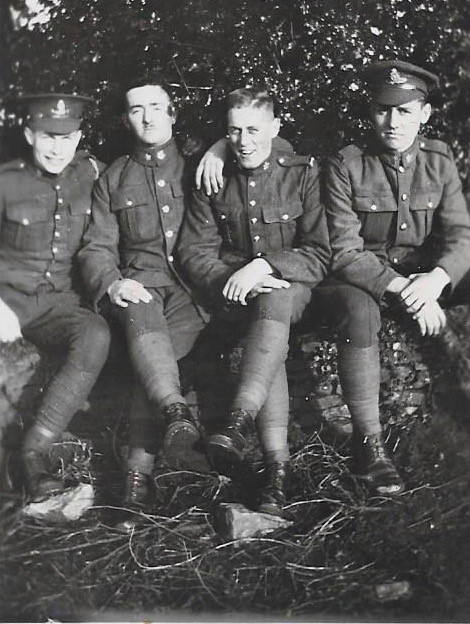
My grandpa Harold Monks enlisted with an artillery draft to the 4th Section of the Divisional Ammunition Column and left Victoria on May 22 1917. I was curious about what the Divisional Ammunition Column’s recruiting practices were – how it began recruiting and how Victoria’s morning paper, The Daily Colonist, reported on the D.A.C.’s recruiting. I wondered if Harold and his cohorts would have been influenced by the news items.
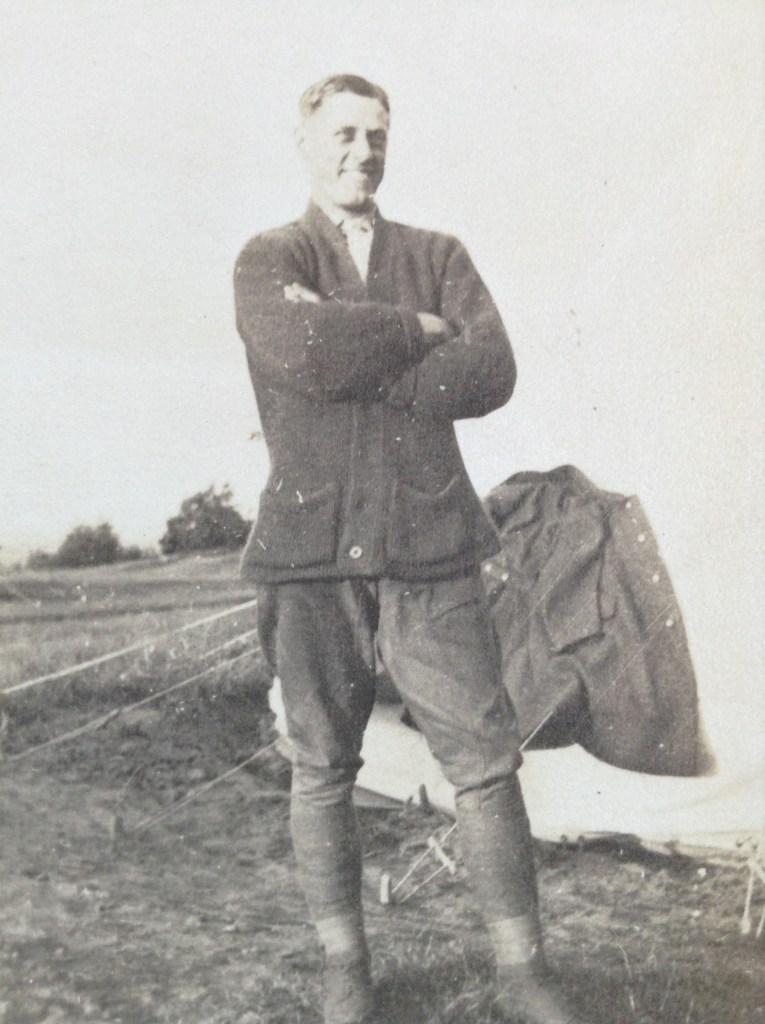
The No. 4 Section of the Divisional Ammunition Column
Divisional Ammunition Columns were responsible for the delivery of ammunition to batteries and other units from ammunition refilling points (source – Library and Archives Canada Guide to Sources Relating to Units of the Canadian Expeditionary Force – Divisional Ammunition Columns)
I’ve learned that there were 5 Divisional Ammunition Columns organized between 1914 – 1917. The name 4th section of the Divisional Ammunition Column is unclear. According to the Library and Archives Canada resources, it could not be the 4th Canadian Ammunition Column, since this was organized in France in May 1917 – the recruiting campaign I’m looking at starts in November 1916.
Steadily Signing On Men For Draft
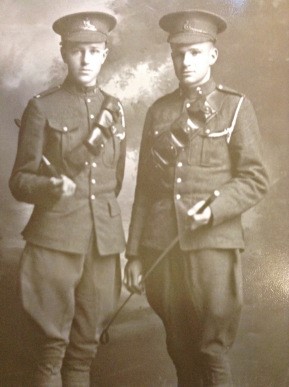
In early November 1916, the local 5th Regiment Canadian Garrison Artillery was authorized to raise a draft of men for the ammunition column (‘5th Regiment to mobilize draft’ November 10 1916) By mid December the draft transferred to Willows Camp and received their new artillery uniforms — puttees, bandoliers and spurs (‘Draft takes up new Quarters At Camp’ December 15 1916.)
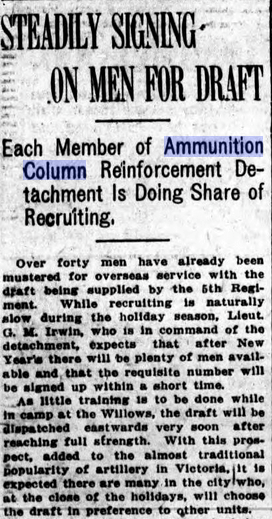
At that point recruiting was carried on at the Willows, and no downtown station would be established. Apparently recruitment was being done by personal connection: “each member of the draft is supposed to be doing his share of recruiting towards the signing on of new men.” (‘Steadily Signing On Men For Draft’ December 18 1917) Lieut. Irwin, officer in command, noted that recruiting is naturally slow during the holiday season but expected that after New Years there would be plenty of men available.
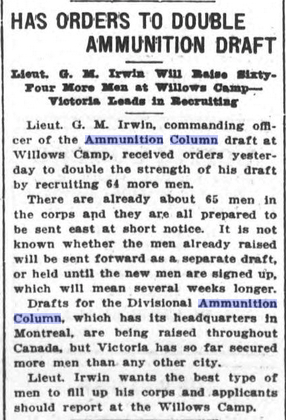
Wants the best type of men
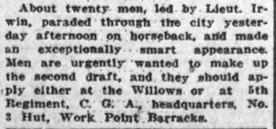
On January 2 1917, the paper reported ‘All Units Prepare to Launch Campaign’ – only about 20 more men were needed before the D.A.C. draft could look forward to the receipt of marching orders — it was not to be. On February 1 1917, the paper reported that Lieut. Irwin had received orders to double the number of men: “Lieut. Irwin wants the best type of men to fill up his corps and applicants should report to Willows Camp.”
The best type of men must have heeded the call – by mid February, Irwin’s draft was awaiting departure (‘Artillery drafts leaving very soon’ February 18 1917) They would go direct to England “on account of the urgent need for artillery men to take part in the spring drive.” The draft arrived in England in mid March (‘Artillery Draft Arrives in England’ March 22 1917). With another comment about “demand for artillerymen on the firing line just now is particularly urgent,” the paper reported: “No time is being lost in recruiting the artillery draft formed here up to full strength.”
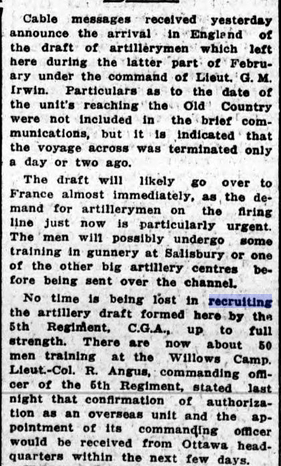
The Daily Colonist March 22 1917
A thorough course in horse riding
Meanwhile, the men were getting a thorough course in riding at Willows Camp. Their instructor was Sergt. B. Olegate, “reputed to be one of the finest horsemen in the Dominion.” It seems that “horses” were an appeal for some of the men. Since most of the men I have looked at (in the April – May 1917 enlisting) were students or office clerks from residential neighbourhoods in Victoria, horses were perhaps an appeal to their sense of adventure and the great outdoors.
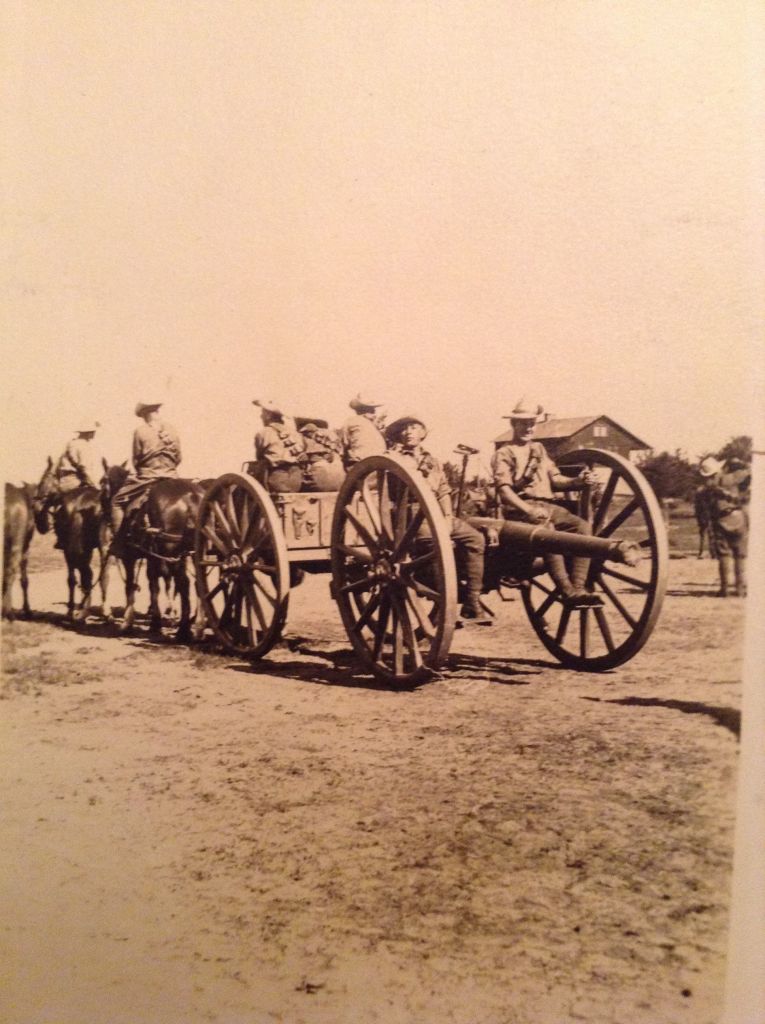
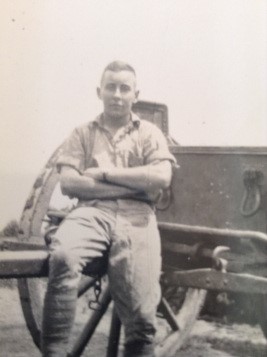
Horses pull an artillery wagon – desk-bound students and clerks needed to learn how to ride horses! Snapshot from Harold Monks’ album.
Impact of Vimy
On April 9 – 12 1917, Vimy Ridge was captured. The Daily Colonist was full of stirring reports of the Canadians’ heroic efforts. The events at Vimy (and the recent U.S. entry into war on April 6 1917) may have encouraged many young Greater Victoria men to enlist. In fact, this item had appeared on the front page of The Daily Colonist on April 12 1917 – “Sir Edward Kemp cables to Sir Julian Byng…should be a spur to enlistment”
“surely young men who have hesitated about enlisting in the overseas forces will, under such inspiration, heed the call of their fellow countrymen to “come over and help” and at once put their names on the scroll of honor and in this way feel that they acted like men when the freedom and the liberty of their country were threatened.”
Vimy was a “spur” — a review of regimental numbers for the draft to the Divisional Ammunition Column shows that there were 6 volunteers on April 10 1917 — the day when the front page of The Daily Colonist reported “Canadians Take Ridge at Vimy” (3 more men enlisted with the D.A.C. draft on April 11 and 12). The week following Vimy, 8 more men enlisted with D.A.C. draft — despite or because of the massive casualty reports now filling the pages of The Daily Colonist that week.
“Act Like Men”
Boys may have wanted to “act like a man” as the Kemp propaganda suggests. Several volunteers for the D.A.C. draft were minors and gave a false age on their attestation papers. These were: William Henry Maxam (born February 11 1900), Robert Redvers Bugslag (born May 19 1900), James Elliot McClellan (September 9 1900), Stanley Richmond Graham (November 20 1900) and Cecil Bartholomew Harlow (born August 4 1901).
“Hard to find a happier and more contented body of men”
During the post-Vimy week, the current D.A.C. draft got standby orders to leave for England. An information/promotional piece was placed in The Daily Colonist (‘Ammunition Draft Gets Standby Orders’ April 18 1917).
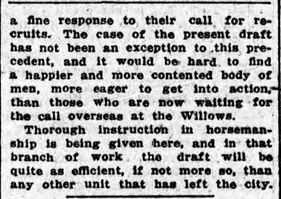
The article stated that the draft of 53 men would be on its way East within the next few days and would go direct to England. The article suggested that recruiting was still open for this particular draft and recommended that those wishing to join up with this “popular branch of service” make immediate application. “The young men of Victoria have always shown a keen interest in the artillery and all previous units have met with a fine response to their call for recruits…”
The article expanded on the “thorough instruction in horsemanship” being given at Willows Camp (possibly a selling point?) and noted that “it would be hard to find a happier and more contented body of men, more eager to get into action than those who are now waiting for the call overseas at the Willows.”
What was the impact of this news item on recruiting? It may have been negligible. One volunteer enlisted on April 19 1917 — Joe Simmons of Port Angeles, who may have already come over to Victoria with the aim of enlisting. On April 20 1917, 3 men enlisted – including my grandfather Harold Monks. However, he had come from Vargas Island near Tofino, where there was limited access to daily newspapers. He had probably already come up on the boat a few days earlier with the intention of enlisting.
Recruiting office downtown – next to Roger’s Chocolates
Joe Simmons and Harold Monks may have joined the Divisional Ammunition Column draft because their recruiting office was the first one they encountered when they left Victoria Harbour and walked up Government Street.
In December 1916, no office had been planned for downtown. Even by February, applicants were required to go to Willows Camp or the 5th Regiment Orderly Room, No. 3 Hut, Work Point Barracks. However, by April 18 1917 (probably earlier?), the Divisional Ammunition Column had a recruiting office at 911 Government Street. This address is reported in the city directory as “vacant.” Its location then – as today – was next to Roger’s Chocolates. Perhaps a good motivation for men to fuel up on sugar and chocolate before they took the plunge to enlist — since there would be little of that in rationed England!
“Smartest Artillery Unit”
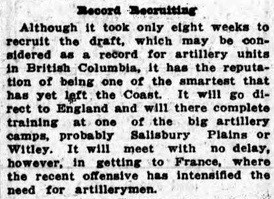
On April 20, 1917, the artillery draft mentioned in the April 18 news item left for overseas. (‘Ammunition Column leaves for overseas’ – April 21 1917) Patriotic and dramatic language was used to describe their send-off (several hundred people, loud cheers, gaily decked flags, etc…). The paper noted that it took only 8 weeks to recruit that draft – a record for artillery units in British Columbia – and that “it has the reputation of being one of the smartest that has yet left the coast.”
Lieut. Finnick, the officer in charge, asserted “The departure of this draft does not mean that our efforts to secure men for the artillery in Victoria will slacken. We will continue with unabated vigor… We cannot have too many recruits as the need is now just as great, if not greater than ever.” The paper stated that “the recent offensive in France has intensified the need for artillerymen.”
Note that on the same day this was said, page 2 of the April 21 1917 newspaper had a full length 2 and a 1/2 column list of casualties. Perhaps because the true toll of Vimy was now becoming apparent, the rate of volunteers slowed down. There were no more volunteers until one on April 27 1917 and one on April 30 1917.
Actresses visit Camp
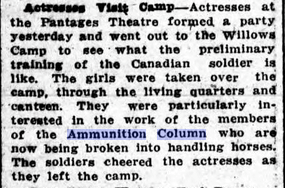
On May 3 1917, a small news item appeared in the paper – ‘Actresses visit Camp’. Actresses from the Pantages Theatre visited the Willows camp – “They were particularly interested in the work of the members of the Ammunition Column who are now being broken into handling horses.” Perhaps this item may have caught the attention of the otherwise desk- or factory- bound man – actresses clearly liked guys with horses!
Between May 8 – 10, 1917, 5 more men enlisted – 3 of them co-workers at the Victoria Machinery Depot who joined up on the same day (Edward Forrest, Louis Sparks Gosse and John Rodger Wood).
To Aid Recruiting – Concert Being Held Tonight
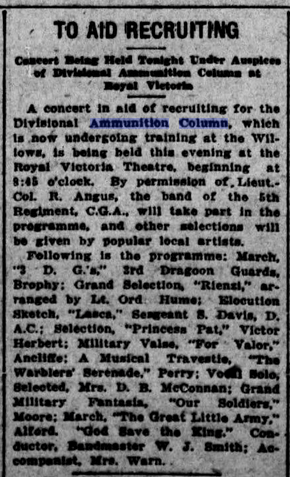
On Sunday May 13, a Divisional Ammunition Column recruiting concert was held (‘To Aid Recruiting – Concert Being Held Tonight Under Auspices of Divisional Ammunition Column at Royal Victoria’ May 13 1917). The well-known 5th Regiment Band and other local artists performed songs like “Our Soldiers” and “Great Little Army”. It’s unclear whether this had impact on recruiting — a couple of days later, on May 15 and 16, 1917 two men enlisted.
Draft will leave Victoria Next Week
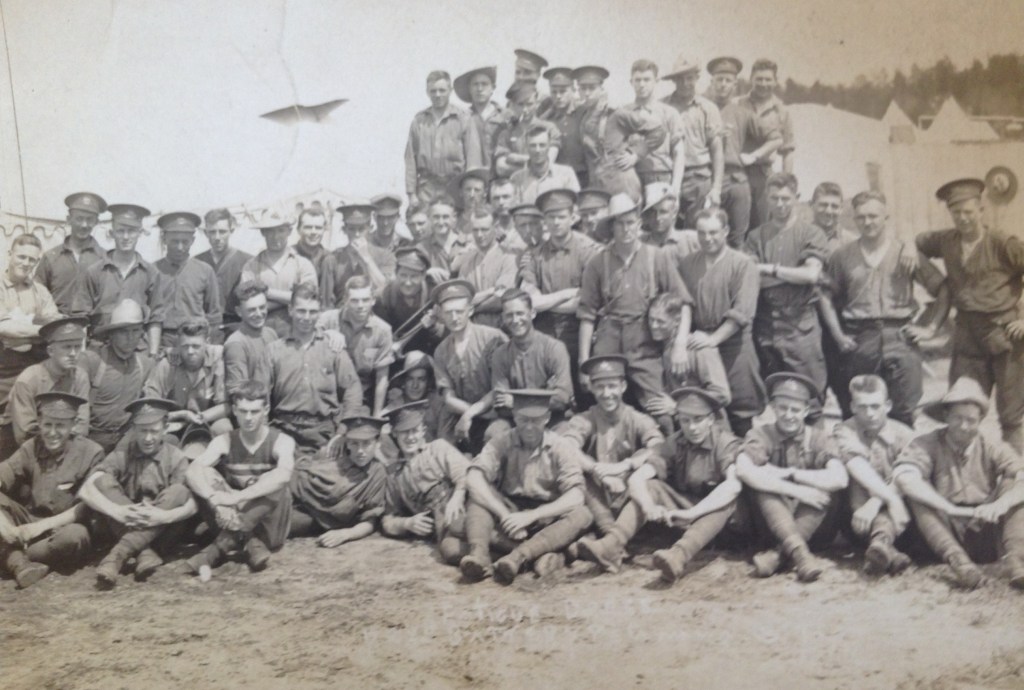
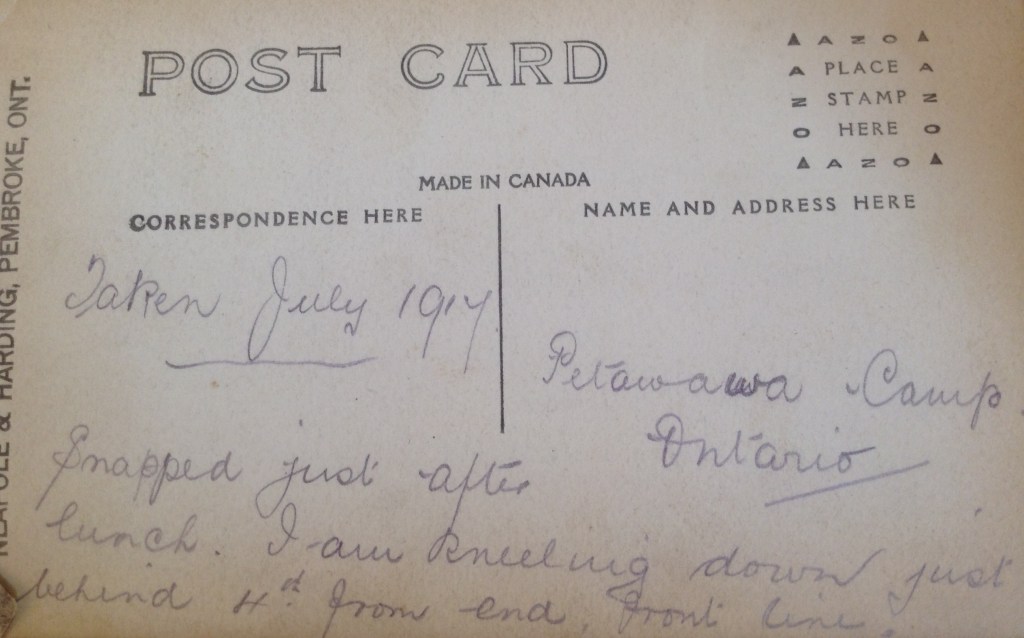
On Saturday May 19 1917, The Daily Colonist had a sensational news item — ‘Artillery will go to Petawawa Camp — Draft from Ammunition Column Will Leave Victoria Next Week for Eastern Centre for Training.’ Lieut. Finnick had received word on May 18 1917 that the men in his draft would not go to England – as had been believed – but would go to summer training camp in Petawawa. If you thought this would be a disappointment to potential volunteers, you’d be mistaken!
The paper noted “Victorians who have hesitated joining the Divisional Ammunition Column in the past on account of the uncertainty of the departure of the next draft are still offered the opportunity of enlisting, and men will probably be accepted right up until the day of leaving.”
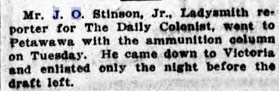
The young men took heed. One man enlisted on that Saturday. The recruiting office was presumably closed on Sunday, but on Monday May 21 1917, 8 men arrived at the office at 911 Government Street and enlisted. The first one in the door was Raymond Harlan Brewster, son of the BC Premier Harlan Carey Brewster. Others were friends Kenneth Greig and Kenneth Maclean who grew up in Victoria’s Fairfield neighbourhood. They were joined by their former neighbour, Joseph Orr Stinson, who had just come down from Ladysmith (he was a news reporter for The Daily Colonist).
Artillerymen leave for Eastern Camp
On Monday May 21, orders were received authorizing the departure of a draft. Six of the 8 men who had enlisted that day got lucky — they left the very next day. Two others had to wait until July to leave. “a sufficient number of men will be left here to continue an active recruiting campaign … as the Divisional Ammunition Column is still under orders to supply drafts at intervals for overseas service.” (‘Artillery will go to Petawawa Camp’ May 18 1917)
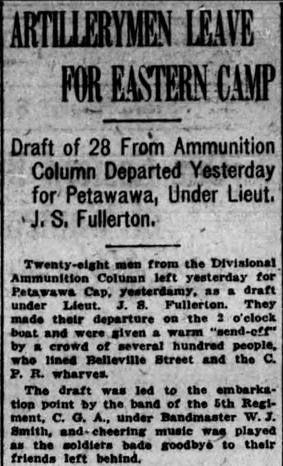
On May 23, 1917 the report ‘Artillerymen leave for Eastern Camp’ gave a glowing report in the newspaper reported that the men were “given a warm send off by a crowd of several hundred people…cheering music played as the soldiers bade goodbye to their friends left behind…” (Note this was almost identical language to the report on the April 20 1917 departure – one wonders if the news writers had got a bit jaded by this point about reporting on so many departures?)
Recruiting continues
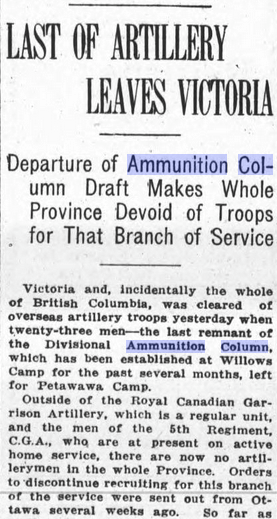
Recruiting continued… now with competition from the 5th Regiment Garrison Artillery, who had received authorization to get 50 men (‘5th Regiment Raising New Artillery Draft’ June 2 1917). Sometime in June, the Divisional Ammunition Column sent out orders to stop recruiting. On July 5 1917, the last draft – 23 men – left for Petawawa…and so ended the Divisional Ammunition Column’s recruiting in Victoria.
The men of these Divisional Ammunition Column drafts would go to Petawawa and then go together to England for training. By the time they got to France, many were no longer affiliated with the Divisional Ammunition Column but with different Brigades of the Canadian Field Artillery.
Related story – An Analysis of a Artillery Draft looks at the men who joined the same D.A.C. draft with Harold.
 Stephanie Ann Warner