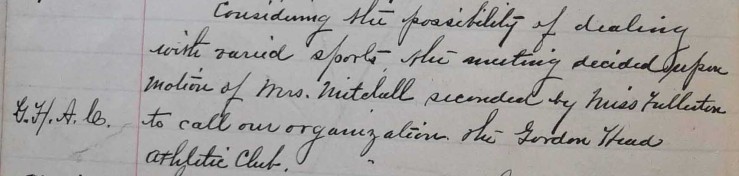
Considering the possibility of dealing with varied sports, the meeting decided upon motion of Mrs. Mitchell seconded by Miss Fullerton to call our organization the Gordon Head Athletic Club.”
Gordon Head Athletic Club minutes May 31 1916
In summer 1916, the Western Powers were fighting on The Somme. But in fruit-growing Gordon Head on Vancouver Island, a group of residents were working together to bring health and recreation to the young people of their community. The Gordon Head Athletic Club built a tennis court and a gymnasium, taught children how to swim and how to sing. They hosted dances through winter months and lent a hand to the war effort. The Club raised money for the Red Cross and sent parcels to soldiers, always keeping in mind their motto: “All for Each and Each for All”.
Years later, the Gordon Head Athletic Club minute book was found in an old Gordon Head barn and eventually made its way to the Saanich Archives. Now, the pages of the minute book have been brought to life with images from Saanich Archives’ Gordon Head collections (donated by former Gordon Head residents and their families), contemporary news items and oral history interviews. You will meet the active community of Gordon Head then see the Club be set up. Next, we’ll explore the Club’s activities through the year before finding out what happened to some of the Club’s members. Come back in time to “a summer in Gordon Head when each member of the club strove to make better and happier the lives of all the rest.”
Gordon Head is an active community
In the early years of the 20th century, Gordon Head in Saanich on Vancouver Island was synonymous with strawberries and daffodils. The area, now covered by an extensive housing development and the University of Victoria campus, was once open fields of fruit and flowers stretching down towards the sea.
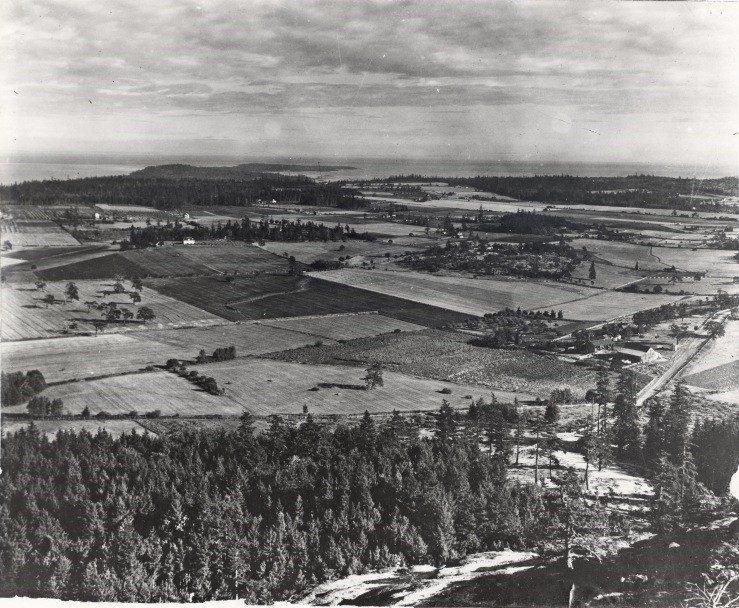
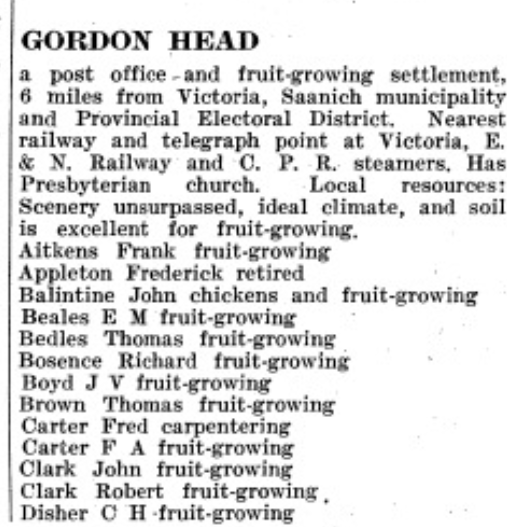
While Gordon Head residents worked hard on their farms, they also played hard — football, tennis, swimming and dances were the order of the day. The focal point for recreation and social gatherings was the Gordon Head Athletic Club, formed in 1916. For about six years, the “G.H.A.C”, through collaboration of its community members, provided athletic entertainment for the young people of Gordon Head.
On August 13 1916, The Daily Colonist published “Gordon Head is an Active Community”, intended to introduce the new Gordon Head Athletic Club. Using this article as a framework, let’s meet the active community of Gordon Head who were going to create the new athletic club.
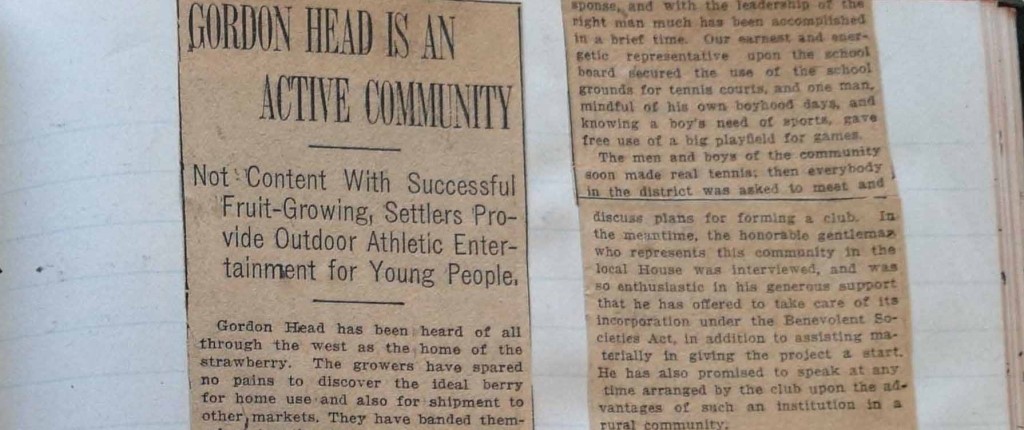
Gordon Head has been heard of all through the west as the home of the strawberry. The growers have spared no pains to discover the ideal berry for home use and also for shipment to other markets. They have banded themselves together into an incorporated and co-operative club, in order to study all sides of the production and marketing of their fruits.
Gordon Head is an Active Community, The Daily Colonist August 13 1916
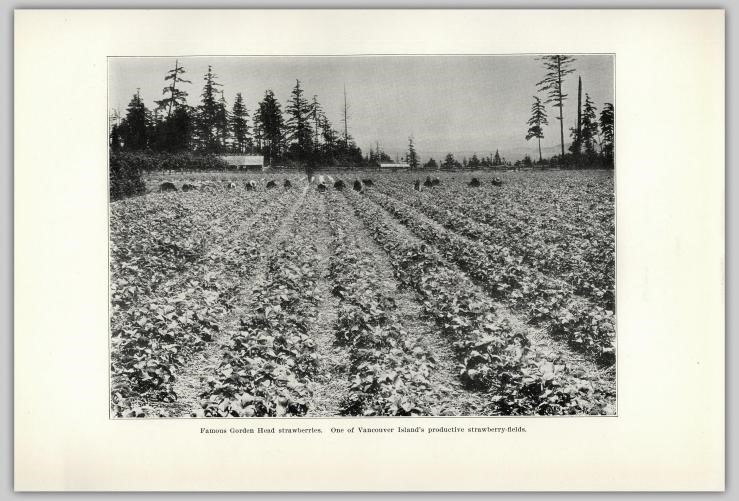
In spring 1915, the recently-formed Gordon Head Fruit-growers Association made their first strawberry shipment to the Prairie Provinces. “Shipments arrived in excellent condition and were most favourably commented upon by dealers,” reported The Annual Report of the Department of Agriculture for the year 1915. Thus, Gordon Head became a famous name for strawberries in the WWI years and into the early 1920s.
Strawberry prices were good in 1915, averaging about $1.70 per crate freight on board. The Annual Report of the Department of Agriculture for the year 1915 stated: “The satisfactory prices received for strawberries were largely due to the good work done by the co-operative associations recently formed at Gordon Head and Keating, a striking instance of the necessity for business organization for the best distribution and marketing of their production.”
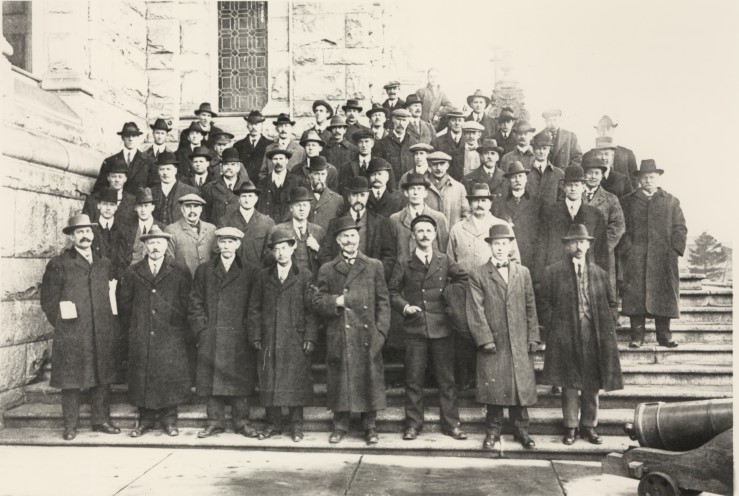
The Daily Colonist July 25 1915 applauded the Gordon Head Fruit-growers Association: “This is a demonstration of what can be accomplished by concentrated effort, organization, inspection and proper distribution….” The original directors of the Gordon Head Fruit-growers Association were G.F. Watson, F.E. Aitkens, William Tucker, H.H. Grist. These men were all original members of the Gordon Head Athletic Club. Another member of the Association was W.T. Edwards, the Club’s president.
Gordon Head is also known for the outstanding ability of her matrons and maids…. The ladies of this district are forging ahead in patriotic work, accomplishing a most commendable result, and are preparing to do still more for the common cause.
Gordon Head is an Active Community, The Daily Colonist August 13 1916
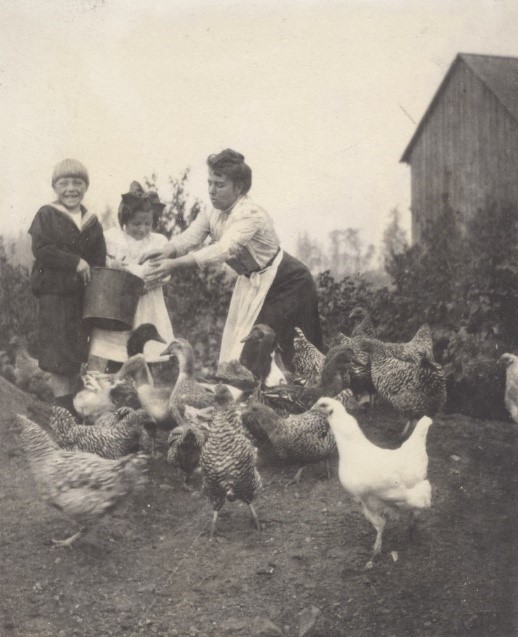
On September 28 1909, Miss Laura Rose of the Guelph Agricultural College addressed a Farmer’s Institute meeting at Gordon Head, and the first Women’s Institute in British Columbia was formed. Miss Laura Rose wrote: “The prominent features of the B.C. Women’s institutes are to promote civic improvement, assist in making the annual fall fairs more of an educational feature, especially for the children, to promote a feeling of greater friendliness and unity in the community as well as to improve the home and its surroundings.” (quoted in The Daily Colonist March 30 1910) The first presidents of Gordon Head Women’s Institute were Mrs. Elizabeth Watson and Mrs. May Atikens. These active “matrons” were wives of original directors of the Gordon Head Fruit-grower’s Association and were original members of the Gordon Head Athletic Club.
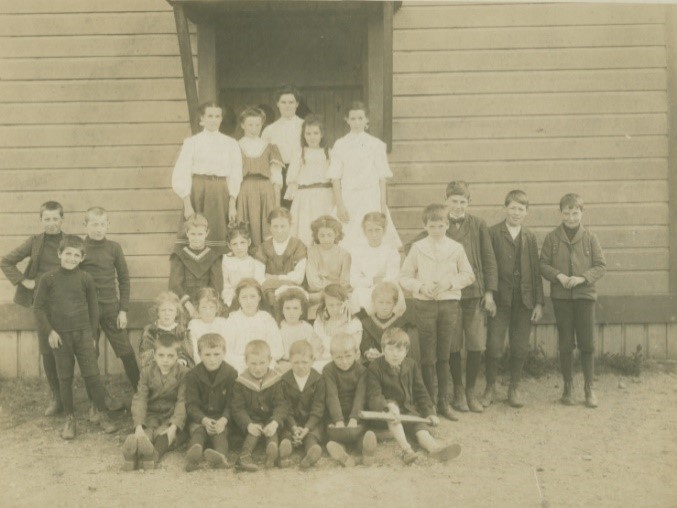
Gordon Head is also becoming known through her school children. Last year and this, the Reeve’s medal has been won here, and this year a Gordon Head maiden, having won the Reeve’s medal in 1915, took second place in the preliminary work at Victoria High School.
Gordon Head is an Active Community, The Daily Colonist August 13 1916
The Gordon Head School was located at the top of Tyndall Avenue near present-day Grandview Avenue. From the 1890s until 1914, the school was a “one-room” school. Many children who became members of the Gordon Head Athletic Club started in this building. In August 1977, two of these former students were interviewed about their school memories.
Ursula (Edwards) Jupp recalled: “It was a yellow colour, a sort of faded yellow colour, with a darker trim and a hipped roof…inside there was a little raised platform, this was the end you came in at with a door at each side. It wasn’t boys and girls, so we were not separated. We had two to a desk.”
Marjorie (Watson) Goodwin recalled: “There were very few children, only about twenty or thirty, but there was all the grades, you see, and we sat in double seats and then there was the teacher’s desk up on a little platform at the front and the stove was right in the middle up by the teacher’s desk. Those that sat by the stove roasted and those that sat near the back, on cold days had to wear their coats. It was so cold.”
By 1914, the population of school children in Gordon Head was growing so much that a new two-room school was opened. The old school later became the Gordon Head Athletic Club’s gymnasium. The larger land space for the new school meant that there was more room for recreational activities — the Gordon Head Athletic Club built tennis courts on the property.
Gordon Head School was academically strong and produced a number of successful High School “Entrance” examination candidates. In 1915, Ursula Edwards had the top entrance examination score in the Municipality of Saanich. She was awarded the Reeve’s Gold Medal (a gold pin). Ursula continued her success at Victoria High School and came second of all preliminary year students. Ursula had a long trip to High School — six miles there and back. She got a ride from her Dad by horse and buggy to the Mount Tolmie street car in mornings, but had to walk all the way back up Cedar Hill Road in afternoons. Marjorie Watson was part of “The Bicycle Brigade” whose parents could afford to buy them a bicycle. She rode a return trip of twelve miles every day, school books in her bicycle basket.
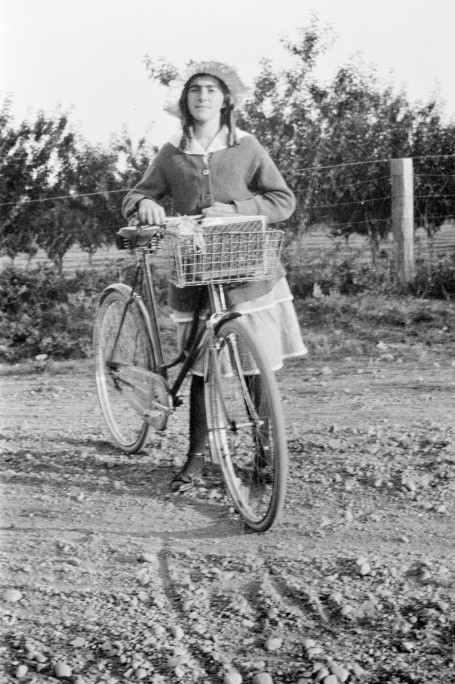
Gordon Head has awakened to the fact that ‘All work and no play makes Jack a dull boy,’ and that the boy without a playground becomes the man without a job.
Gordon Head is an Active Community, The Daily Colonist August 13 1916
Studying hard and riding bicycles twelve miles a day, what else was there for children to do in Gordon Head? Bee Williamson, another High School student and Gordon Head Athletic Club member, recalled: “We made our own fun in those days. Everyone worked on the farms, and all the kids had chores to do.”
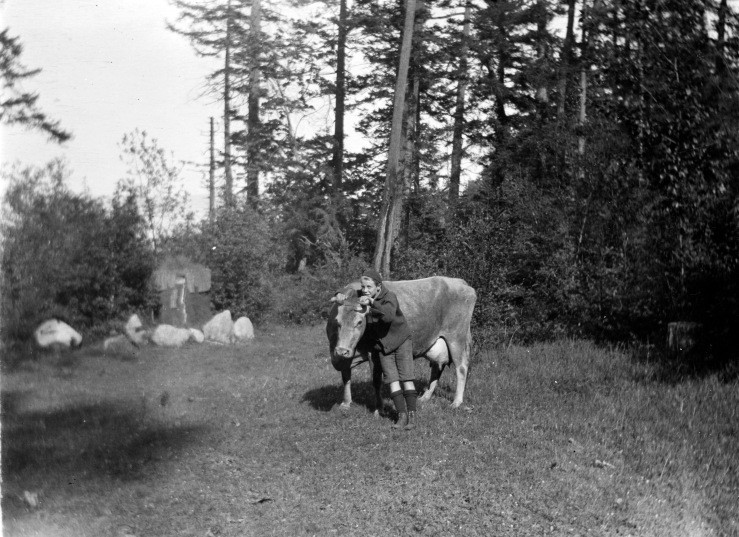
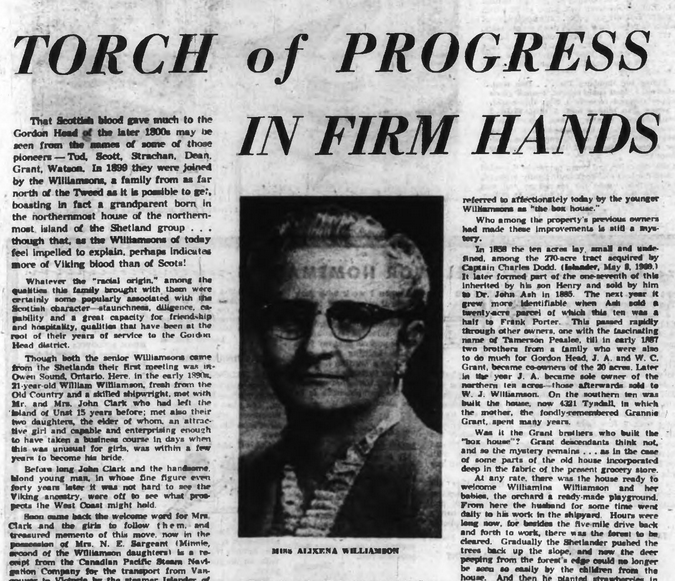
Bee Williamson told Gordon Head historian Ursula Jupp about other memories: “Other happily remembered times were when the mother would pack picnic lunches and all would join the father at work in the clearing at the top of the hill. There the boys would build a tepee of branches while the little girls swung around gaily on the merry-go-round made by the father from a sapling pegged to the centre of a newly-cut stump.” (Torch of Progress in Firm Hands, The Daily Colonist April 19 1964)
And then there was Sunday…no work and no fun? Bee Williamson was one of many of Gordon Head’s Scots Presbyterians who attended Sunday School at the Gordon Head Hall. (Her dad was the long-time instructor) Marjorie Watson, from a Scots family, recalled typical Sundays….and how the war changed that: “Before the First World War on Sunday, you weren’t allowed to do anything but go to Sunday School, go for a walk or something like that. But during the War we started rolling bandages.”
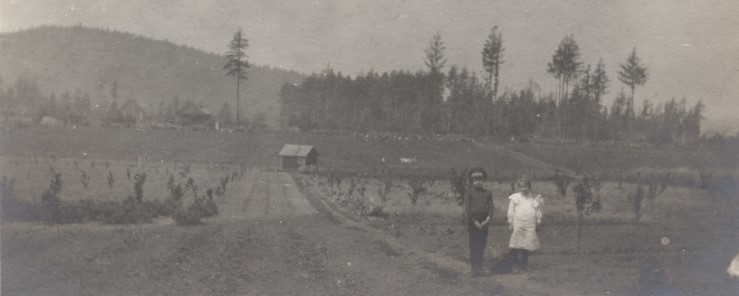
Women’s Institutes were thinking of ways to remedy the problem of “no fun” for farm kids. In September 1915, Mrs. May Aitkens of the Gordon Head Women’s Institute attended the Second Annual Convention of the Women’s Institutes of Vancouver Island.
“Recreations for Young People in Rural Districts” formed the topic for an address by Mrs. Graves, who spoke in an interesting manner on the problems confronting the mothers of the community in that respect. They might be, to a large extent, eliminated in her opinion. She advocated healthy exercise in all things and made a plea for the women of the Institutes to see that the children were given their rightful share of recreation as well as study.” (The Daily Colonist September 9 1915)
This talk may well have been an inspiration starting the Gordon Head Athletic Club a few months later.
Starting the Club
Therefore, when a group of residents particularly interested in the very promising young people of the district, met together and talked over the situation, there was an immediate response…
Gordon Head is an Active Community, The Daily Colonist August 13 1916
At Gordon Head Hall on May 31 1916, a group of Gordon Head residents “much interested in the young people of the community gathered to discuss the possibility of forming some sort of association for the purpose of securing and controlling recreation centres for Gordon Head.” The group decided to call their organization the Gordon Head Athletic Club.
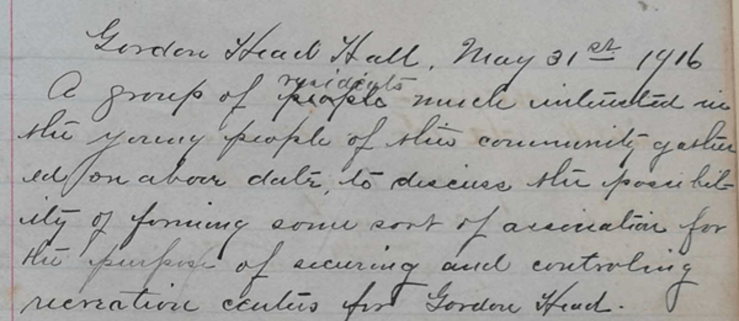
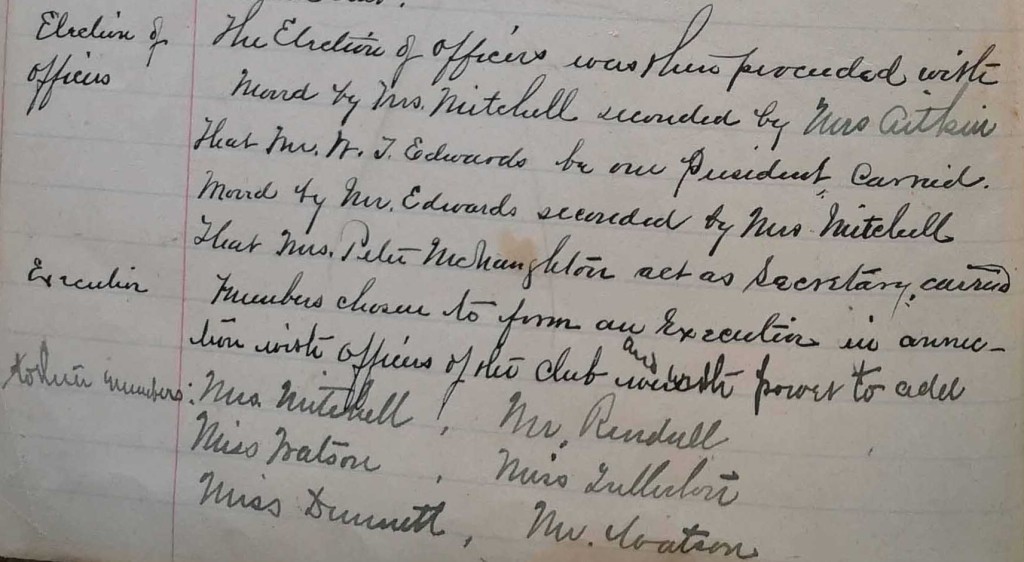
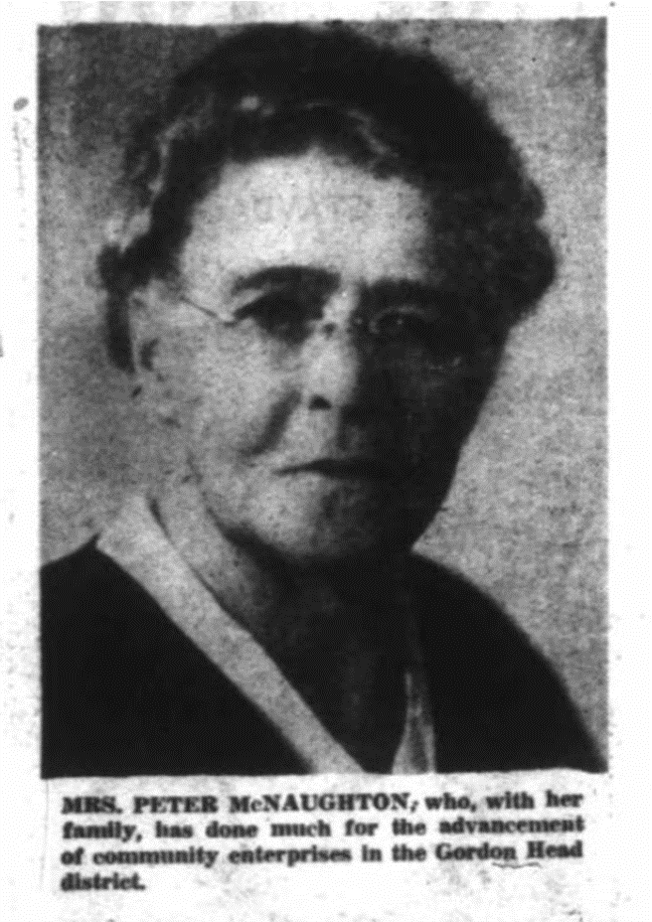
Among these interested residents were Mr. William Trevellick Edwards, Mrs. Peter (Marie) McNaughton, Mrs. Florence Mitchell, Mr Ernest Rendle, Miss Jessie Dunnett, Miss Jessie Fullerton, Miss Airlie Watson and Mr. George Fraser Watson, Saanich School trustee. “The election of officers was thus proceeded with, moved by Mrs. Mitchell, seconded by Mrs. Aitkens, that Mr. W.T. Edwards be our president, carried. Moved by Mr. Edwards, seconded by Mrs. Mitchell, that Mrs. Peter McNaughton act as secretary, carried.”
The Secretary and Our President
“The coming to Gordon Head of Mrs. Peter McNaughton added much to the activities of the District. With a wide experience in public service in Vancouver behind her, she was soon busy in this country neighbourhood and encouraged the formation of the Gordon Head Athletic Club.”
Ursula Jupp, The Daily Colonist May 29 1960
Gordon Head Athletic Club Secretary Mrs. Peter McNaughton and President W.T. Edwards came from different worlds. She was a well-to-do “prominent woman”, he was a financially struggling widower raising two daughters. But both shared an interest in making a better place for the young people of Gordon Head.
Marie Henrietta McNaughton (almost always referred to as ‘Mrs. Peter McNaughton’, as was the custom of the time) was the driving force behind the Gordon Head Athletic Club. The McNaughtons, in their fifties, arrived in Gordon Head in 1915, in what appears to be a “retirement” to the country after active city careers. Mrs McNaughton was president of the Vancouver President of the Local Council of Women, a non-denominational, non-sectarian affiliation of women’s organizations across the city, which acted as a lobby group on governments. “Mrs. McNaughton was in the chair and succeeded in getting a large amount of business put through during the afternoon.” (B.C. Saturday Sunset, December 10 1910) Mrs McNaughton was the “Second Lady Trustee” on the Vancouver School Board, elected in 1912.
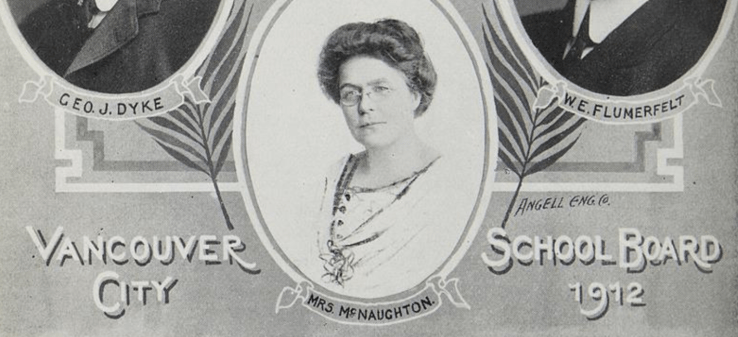
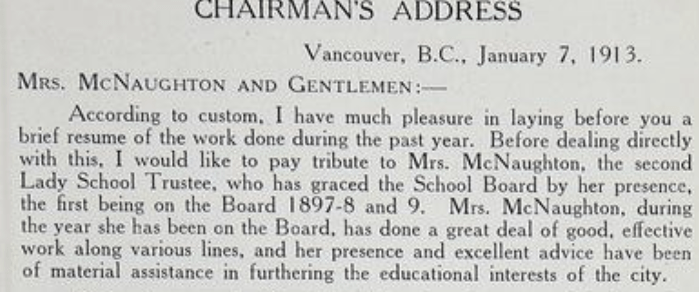
In October 1913, Mrs. McNaughton attended the annual meeting of the British Columbia School Trustees Association, held in Victoria. “The afternoon session was brought to a close by the reading of an interesting paper by Mrs. Peter McNaughton on ‘Health as an Asset to the Students and Our Methods of Protecting It.’ Mrs. McNaughton brought forward in a very lucid manner the various points, dealing in a very able way with the various reasons why health is as contagious as disease.” (The Daily Colonist October 22 1913)
Mrs. McNaughton’s public roles focussed on health, children and education, interests she brought to the Gordon Head Women’s Institute and the Victoria Women’s Canadian Club. Her role as Club secretary was much more than just taking the minutes. Mrs. McNaughton co-ordinated all the club meetings (often by hand written note, when not everyone in the rural district yet had a telephone). She hosted Club executive meetings at her home and was usually on hand making tea for Club volunteer events like building their tennis court or improving their school grounds. Mrs. McNaughton was a spokesperson for the Club to outside businessmen, politicians, and the media. (She likely wrote all the promotional pieces that appeared in The Daily Colonist such as ‘Gordon Head is an Active Community’). She appears to have been instrumental in using her connections to get various prominent people to come up to Gordon Head to speak to the Club.
“After my mother died and my father was in his forties, and at the same time the McNaughton family moved to Gordon Head and Mrs. McNaughton was a woman of wide vision. Had done a lot of public work in Vancouver and I think she recognized in my father someone who could have his time used up, who was very active athletically and so on. And consequently, from that, came the Gordon Head Athletic Club….”
Ursula Jupp interview August 19 1977
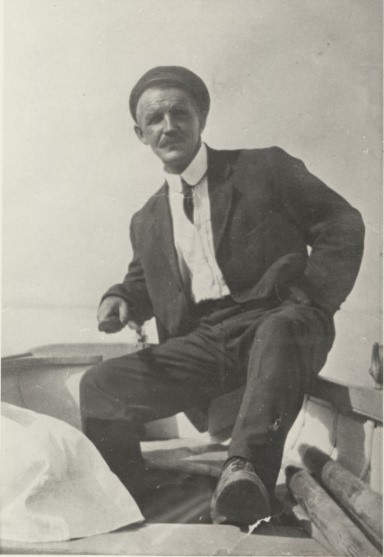
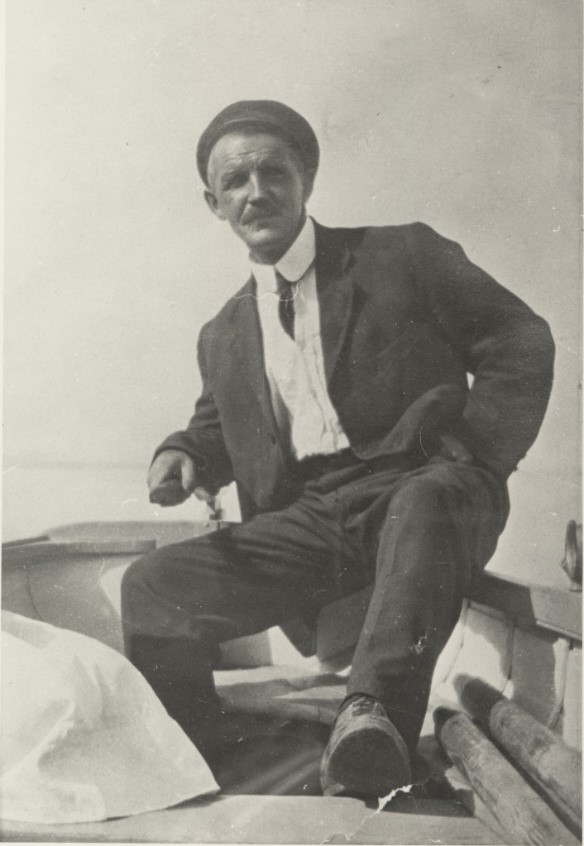
William Trevellick Edwards, his wife Elise and his young daughters Ursula and Pomona arrived in Gordon Head in February 1912. Edwards, originally from the Scilly Isles off Cornwall. “After a year spent in wheat-growing in Alberta had proved that Prairie air was too dry for an island-born farmer, he moved on to Vancouver Island…” (Ursula Jupp, Golden Harvest of Gordon Head, The Daily Colonist July 3 1960) Like most of his neighbours, Edwards began strawberry growing. He had moderate success (but was soon to encounter the dreaded strawberry weevil that plagued the Gordon Head fruit-growers for years). He asked his brother to send a shipment of daffodil bulbs from their Scilly Isle home farm. The daffodil crop was first sold by a Victoria florist. Then Edwards decided to try selling in Calgary, with successful results. Edwards’ daughter Ursula recalled the day a $50 cheque arrived in their home. In early 1916, W.T. Edwards was starting his daffodil growing venture, and Ursula Edwards was finding academic success at High School. But all was not well at home. Elise Edwards, ill for some time, died on March 13 1916. Ursula was 13 and Pomona was 9.
With help from neighbours, W.T. Edwards raised his daughters on his own. Unlike many girls of that era who lost mothers, Ursula was not expected to leave school and run the household. A neighbour’s daughter (probably Dolly Beales) came to help out at the Edwards’ house during day. Ursula continued to attend Victoria High School and had a highly successful academic career. In a 1977 interview, Ursula Jupp continually referred to money being “tight”. Her mother’s sister in England used to send out “hand-me-down” dresses and a neighbour lent her shoes for a dance. As a way to save money, but keep informed about the war news, the Edwards also “borrowed” their neighbours’ newspaper after the Houlihans had finished reading it — this practice had an added bonus of building a strong friendship between the families.
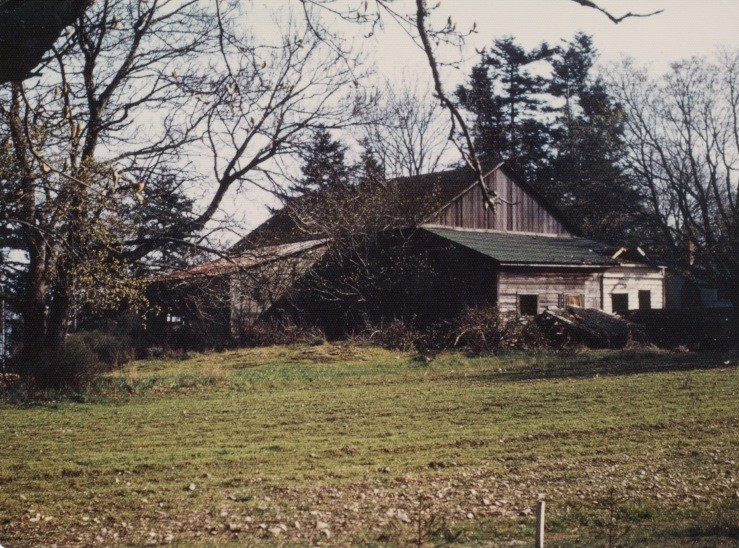
W.T. Edwards was Master of the Gordon Head Sea Scouts, who he met every Friday evening. Ursula Jupp recalled: “They learned to handle boats…learned to row and respect the sea. This was one thing my father was very keen on….” Land-based training included rope climbing — in the Edwards barn! “There is a big old barn there on the corner of Ferndale Road where you can see the chalk marks…at any rate, my father was very athletic and there was this big rope hanging down from the beams. And this is one of the things the boys had to do, climb up this rope and so on.” At a May 1917 Red Cross fundraiser, the Sea Scouts showed off their skills for the first time. “The performance of the Gordon Head Sea Scouts was heartily applauded, their manipulations of rope-knotting and splicing being particularly clever.” (The Daily Colonist May 26 1917).
Ursula Jupp recalled that much of the Sea Scout training was in the Edwards’ kitchen: “they learned the Morse code and knots, and on our kitchen wall for a long time was a drawing of a diagram of a full-rigged ship with the full names of the sails.” Referring to this group of young boys who used to hang out in their home, Ursula observed “it was rather strange with no mother there really. What I mean to say, I’m wonder really how tidy the kitchen actually was.” In the evenings, the Edwards’ family life was cozy. Ursula recalled fondly: “at bedtime we always had hot cocoa and Ormond’s hard tack biscuits and so on, homemade butter you know, that sort of thing. My father played the tin whistle you know, listening to that and having cocoa…..”
Choosing the Executive
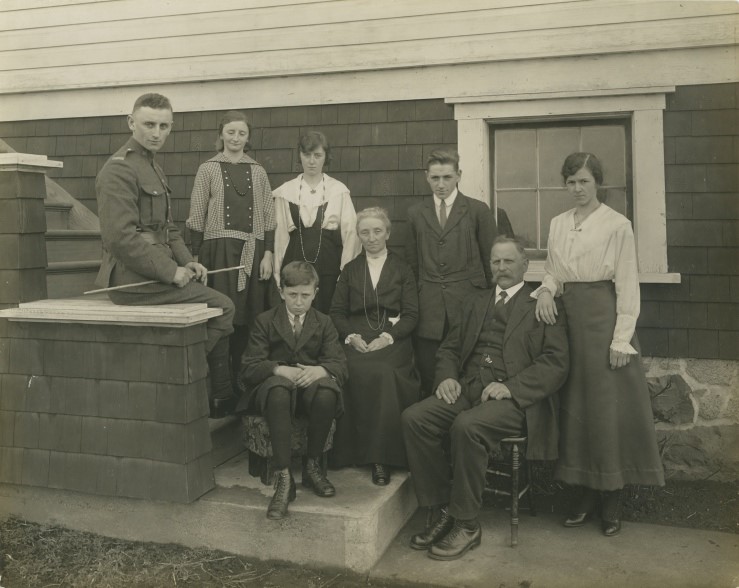
“Moved by Capt. Todd, seconded by Mr. Tucker, that Mr. Jack Williamson act as our treasurer. Carried.” Jack Williamson was the local mailman before he went overseas for military service. The Williamson family lived at the corner of Tyndall Avenue and San Juan Avenue. They operated the local store and telephone exchange. This family portrait taken was donated to the Saanich Archives in December 2020.
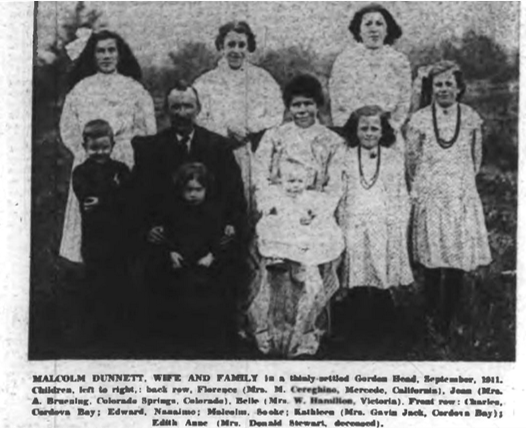
“Moved by Mr. Watson, seconded by Mr. Pearson, that Miss Jean Dunnett be our Assistant Secretary. Carried.” Assistant Secretary Jean Dunnett (back row centre in the photograph below) was a young school teacher from large family of pioneer Gordon Head residents. Two of her sisters were also involved Club activities: Jessie Belle Dunnett, aka “Miss Dunnett” (back row left) and “Flo”, back row right.
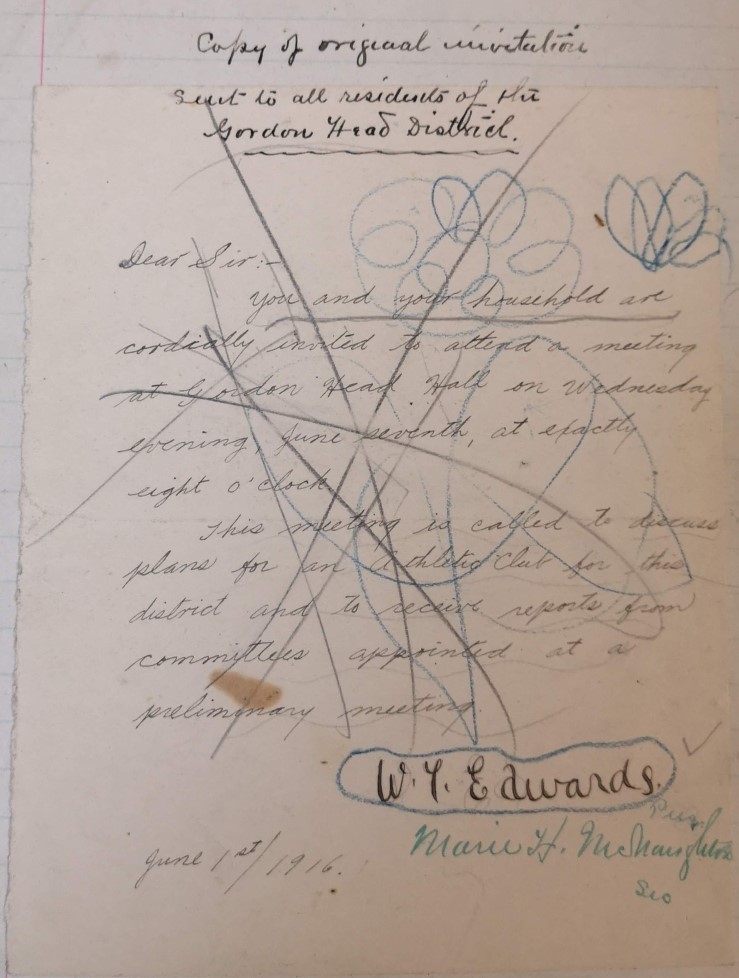
The first meeting
“….the notice they sent out for that first meeting. It says, I think it is right inside the front cover, it says “at exactly 8 o’clock.” My father was very precise about the time … he found that meetings and so on were frequently late in getting started whereas in his youth and homeland he’d been used to them being precisely on time. So it’s rather amusing to see that “exactly 8 o’clock.” Ursula Jupp, 1977
“A general meeting of the G.H.A.C. met on this date, the President calling the meeting to order at eight o’clock, promptness being one of the things aimed at all of our gatherings.” (January 2nd 1917)
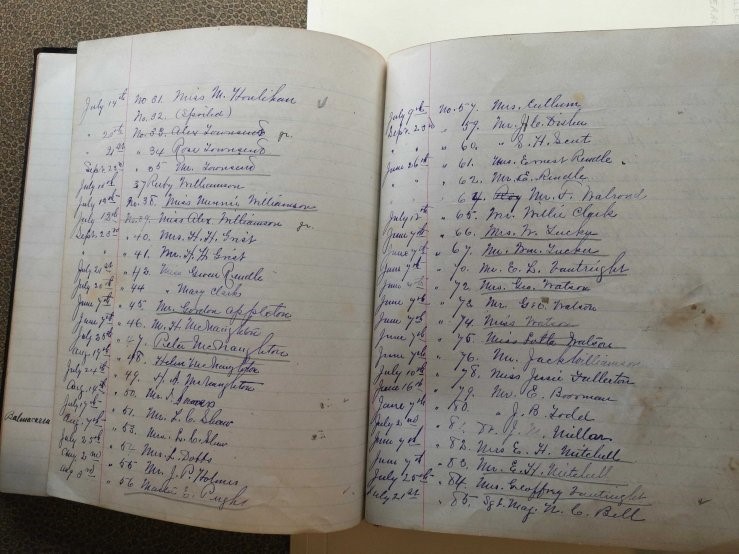
The Club now needed members. Annual membership was $1 for “seniors” and 50 cents for “juniors” (from 14 to 18 years). The back of the minute book lists the original members, showing a wide section of the Gordon Head community. While the list of names was being written “an informal chat occupied the members until called to order by the President.”
But it looks like most people didn’t bring any money to pay — on July 7 1918 “the secretary and treasurer were asked to interview prospective members re fees.” At the July 25 1918 meeting, the treasurer reported there were 45 senior members ($45) and 14 junior members ($7) “Upon motion of Mr. Tucker, seconded by Mr. Watson, it was agreed to have membership cards printed and given to all members in good standing.”
“All for Each and Each for All”
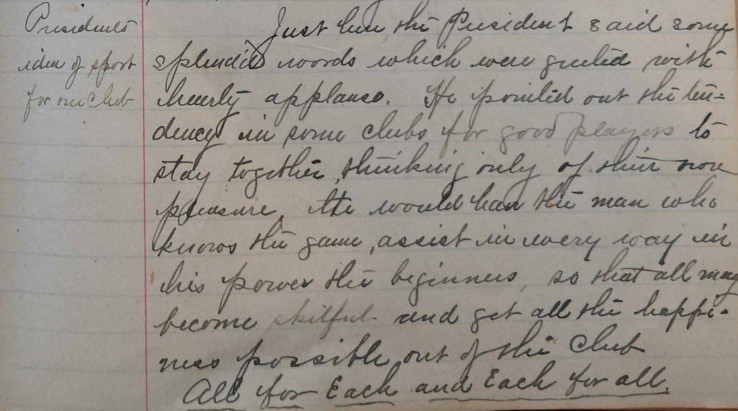
On July 25 1916, a General Meeting was held at the Gordon Head Hall. “It was announced through notices held in public places and through announcements given at Sunday services. There were very few absentees on this occasion. The night was damp and cold, this making it out of the question to hold the meeting at the tennis courts as planned. The members gathered first at the courts to see their condition then adjourned to the hall. The meeting was called to order by the President who made a statement describing our progress since the last general meeting…” Much discussion and “expression of opinion” came from members about how the new tennis courts should be run. Just here, President Edwards stepped in and “said some splendid words which were greeted with hearty applause.” Edward’s idea of sport became the philosophy of the Gordon Head Athletic Club:
He pointed out the tendency in some clubs for the good players to stay together, thinking of their own pleasure. He would have the man who knows the game assist in every way in his power the beginners so that all may become skillful and get all the happiness possible out of the club. All for Each and Each for all.
President W.T. Edwards, July 25 1916
Community Supporters
We are indebted to Mr. Eberts for a good speech on the value of sport in the individual and the community.
Gordon Head Athletic Club concert August 25 1916
Prominent community members gave moral and financial support to the newly-formed Gordon Head Athletic Club.
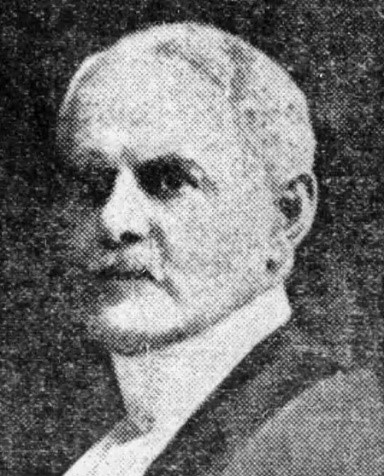
Saanich Member of Provincial Parliament, The Hon. David McEwan Eberts K.C. (Speaker of the House) agreed to have the Club incorporated under the Benevolent Societies Act and to give a cheque for $15 which would pay the government fee for incorporation, if the Club decided to apply it to this purpose. (They accepted his kind offer). “Mr. Eberts was much interested and will gladly speak to his constituents re the value of such an organization in this neighbourhood. He will assist in any he can to ensure the success of the club.” Mr. Eberts made good on his promise. He donated four tennis racquets to the Club, so that they were able to use the money saved to buy racquets for the school children.
Eberts gave a speech at the Club’s August 25 1916 concert: “Athletics developed not only the physique but the character. It gave confidence to the young man and fitted him to take a place with credit in the world. There was much truth in that ancient and oft quoted saw “All work and no play makes Jack a dull boy”. He could not say that his play had entirely eliminated the “dullness”, but he knew that a certain amount of it was good for everyone…..Mr. Eberts concluded by expressing the hope that all would co-operate in making the club a real factor in the life of the community.” (TheDaily Colonist August 26 1916)
Rev. Dr. J.M. Miller, of the Theological College in Edmonton was spending the summer in Gordon Head. At the Club’s first general meeting on June 7 1916 Miller was called upon to say a few words on the value of sport in the community and “he cheerfully did so, assuring the club of his sympathy and support while with us. He said he knew of nothing that would do more than stimulate a community spirit than such an organization as this.”
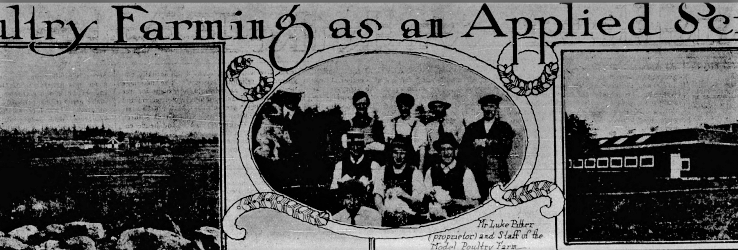
The Club’s honorary president was Mr. Luke Pither, a local businessman — Pither and Leiser Importers and Wholesale Wines Liquors and Cigars — who retired to run a “Model Poultry Farm” in Gordon Head. [Pither and his “famous milk-bred boilers” appear often in The Daily Colonist in the pre-war period: “Mr. Luke Pither is not a scientific and experienced poultryman — he is a businessman, and a very good one, as almost everyone in British Columbia knows!” (Poultry Farming as an Applied Science, The Daily Colonist December 15 1912)] As we’ll see, almost as soon as the Club was formed, Pither helped the young members in a very practical way.
Mr. Pither’s Play Field
“….one man, mindful of his own boyhood days, and knowing a boy’s need of sports, gave free use of a big play field for games.”
Gordon Head is an Active Community, The Daily Colonist August 13 1916
In Spring 1916, just a few months after his wife’s death, Mr. Luke Pither was approached by Mrs. Peter McNaughton about sharing part of his field so the boys of Gordon Head would have somewhere to play.
“Mrs. McNaughton reported an interview with Mr. Luke Pither who most generously agreed to allow the use of a field at the corner of his farm for a play field for Gordon Head, the only stipulation being that the gates be closed and the place be respected…” (Gordon Head Athletic Club minutes, May 31 1916)
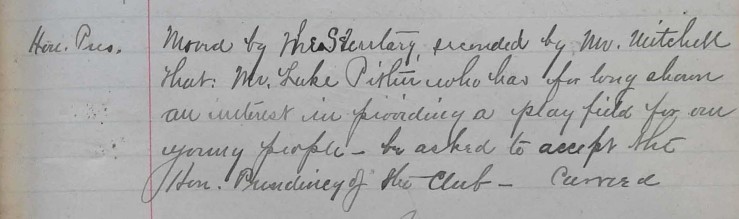
The Pither Play Field (as it was always referred to in the Club minutes) was the scene of many happy football and lacrosse games among the young men of Gordon Head. At the July 7 1916 executive meeting, plans were made to get the field ready for use. “Moved by Mrs. Mitchell, seconded by Mr. Watson that we secure a football for the Pither Playfield, a first class ball, carried…..Mr. Rendell generously offered to equip [play field] with full posts etc.” The Play Field appears to have opened for use on Wednesday night, July 12 1916. “Great enthusiasm over the game and the posts were placed according to promise at Mr. Rendell’s expense. The best thanks of the club are tendered to Mr. Rendell for this work.”
By mid August, “The playfield is open every night under voluntary supervision, and lively games are arranged by seniors and juniors. Football seems to be the most popular game among the men and boys, who have elected their officers and are planning much for the future. (The Daily Colonist August 13 1916)
At the Club’s end of summer season dinner and meeting, “Mr. Pither was given three hearty cheers for his help in this work, the Pither playing field being the scene of the action.” (The Daily Colonist September 26 1916)
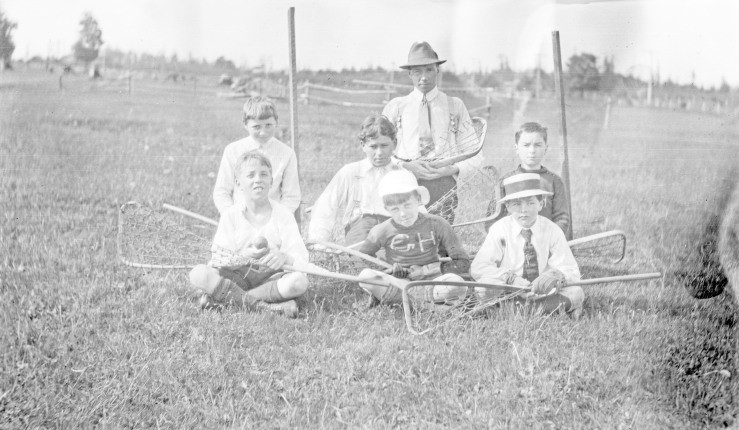
The Club members continued to use the Pither Play Field all winter, and at the Club’s first Annual Meeting on April 30 1917, “Mr. Tucker reported for the football section, particularly mentioning Mr. Pither’s continued kindness to the club in allowing it the use of the Play Field.” Pither continued to give the Club access to his field, as the minutes from the Annual Meeting of May 19 1919 show: “Agreed that letters of thanks go out to our Hon. President Mr. Luke Pither for the use of the Play Field”. Today the site of the “Pither Play Field” forms part of Gordon Head’s Lambrick Park.
Courts worthy of this district
Our earnest and energetic representative upon the school board secured the use of the school grounds for tennis courts….
Gordon Head is an Active Community, The Daily Colonist August 13 1916
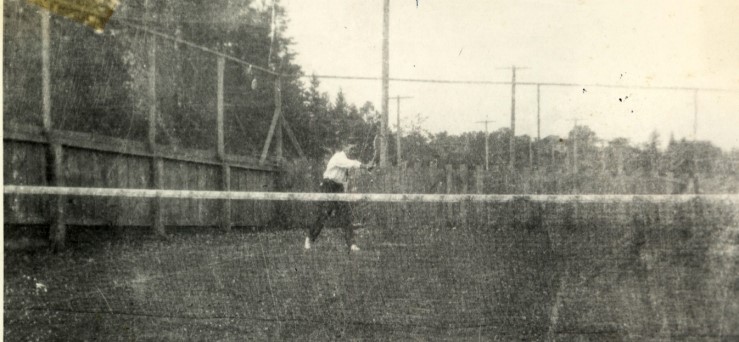
Tennis was a popular pastime in early 1900s Saanich, so one of the first objects of the Gordon Head Athletic Club was to build tennis courts. There was extra land on the school grounds. Club member George F. Watson, Saanich School Trustee, won the Saanich School Board’s approval: “The board will gladly consent to tennis courts on school grounds provided only that they are put to no expense in the arrangements for same and that property holders on either side are protected from intrusion or inconvenience because of the granting of this privilege.”
Building the courts was a group effort. These were earth courts, so the ground had to be prepared. Thanks to Club member and Saanich Councillor Mr. William Somers, the Municipality of Saanich’s grader and their team and a man were furnished for a Saturday afternoon in early July 1916, “and did very much toward making the courts worthy of this district. Willing hands among the club members had taken hold of the work with a will and the President was able to announce that the lines of the court were all in place and all was in readiness for the nets and posts.” Heavy rain in mid July made it possible to roll the new courts and put them in first-class shape. “There had been little hope of this until the autumn but now our tennis courts are certain to be satisfactory and the work of many willing members was freely given in making them just right.”
The Club spent $3 on tape to line the courts, but the staples for the first court (presumably for the nets?) “were made of wire that was gathered up here and there about the Head.” The net and posts cost $21.35. Club friend and local Member of Provincial Parliament The Hon. D.M. Eberts donated four racquets. The Club executive decided “to dispose of same to members and to use money realized in purchase of racquets for school children of the club.”
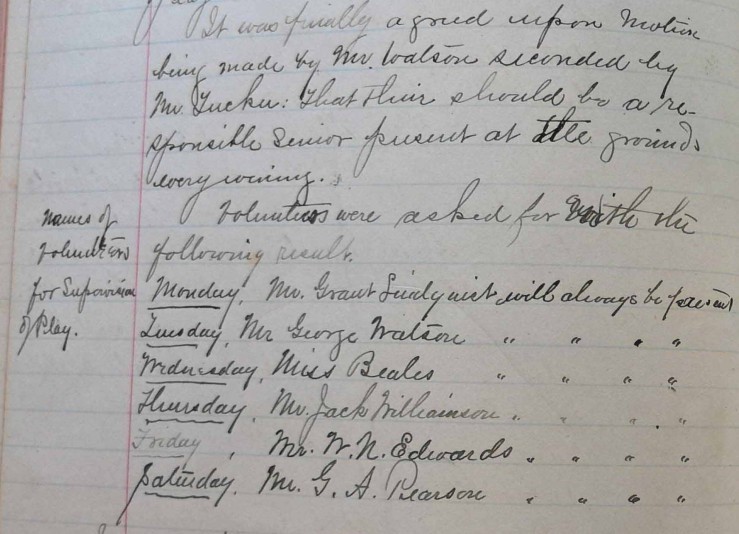
Here’s how the courts operated — the result of much discussion among the members! School children could use the courts on weekdays until 4 p.m. and on Saturdays by arrangement. A responsible senior person was to be present at the grounds every Monday – Saturday evening. When members arrived, they were to register for play on an old blackboard taken from the old school house. The court gates were to close at 9 p.m. And of course…everyone must wear tennis shoes!
“The Secretary was asked to have posted a notice on the grounds asking all players to wear tennis shoes, no one to be allowed to use court otherwise”.
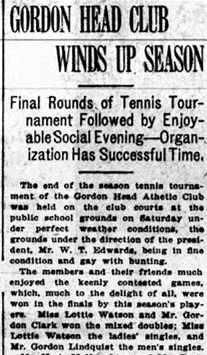
At the close of play all adjourned to the Gordon Head Hall, where the ladies had arranged a simple supper which was beautifully served by ten young ladies of the club under the direction of Mrs. H.H. Grist and Mrs. W. Tucker. The tables were decorated with great taste in the colors of the club, purple and white, these colors being worn by the assistants.
Gordon Head Club Winds Up Season, The Daily Colonist September 26 1916
“The end of the season tennis tournament of the Gordon Head Athletic Club was held on the club courts at the public school grounds on Saturday under perfect weather conditions, the grounds under the direction of the president, Mr. W.T. Edwards, being in fine condition and gay with bunting.”
The members and their friends much enjoyed the keenly contested games, which, much to the delight of all, were won in the finals by this season’s players. Miss Lottie Watson and Mr. Gordon Clark won the mixed doubles; Miss Lottie Watson the ladies’ singles, and Mr. Gordon Lindquist the men’s singles. Mr. H.A. McNaughton and Mr. G.A. Pearson acted as referees.
The tennis courts were closed during the Fall and Winter, but soon as Spring came, “the courts were reported to be in good condition for season’s play, the President having personally seen the work through with a band of willing assistants.” (April 30 1917) The executive decided “to put into effect rules governing last year’s play on tennis courts as given on page 16 and page 20 of minute book. Courts to be closed at 9.30.” A new roster of responsible seniors to supervise was made, and the treasurer was asked to purchase a dozen balls to be available for members. The tennis courts continued to be popular every Spring and Summer. We last hear about the courts on May 19 1919: “A tennis tournament arranged by Miss Ursula Edwards was a distinct success.”
The Art of Swimming
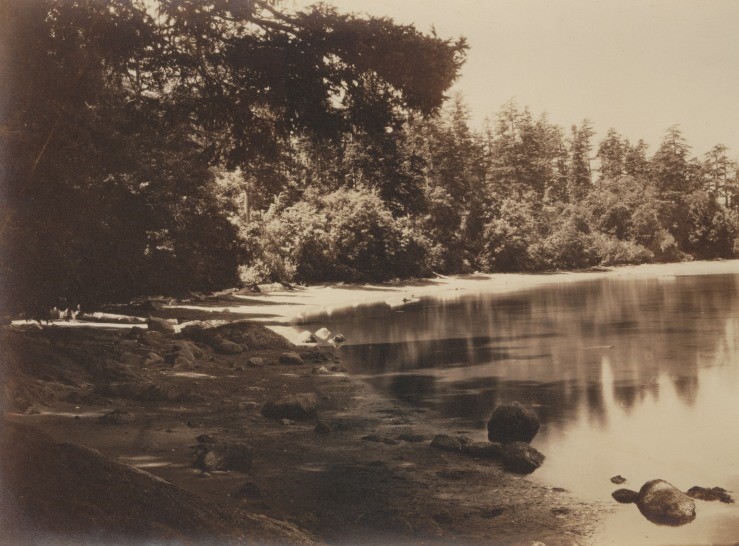
They now have a large swimming section under the expert direction of the Club’s president, a busy and successful farmer, who meets his class three times a week at St. Margaret’s Beach. This class has grown so rapidly that it was necessary to secure an assistant. So contagious is the spirit of the community welfare that another busy man immediately volunteered his services. It is indeed a pretty sight to see some fifty bathers in gay caps and suits prepared for the leader’s signal to take their first cold dip of the swimming day.
Gordon Head is an Active Community, The Daily Colonist August 13 1916
The children of Gordon Head were surrounded by the waters of the Haro Strait, yet many of them did not know how to swim. Gordon Head Athletic Club President W.T. Edwards was soon to change that. On May 31 1916, at the Club’s first planning meeting, “Mrs. Mitchell stated that Mr. Edwards was willing to teach any of the young people in Gordon Head to swim.” Swimming lessons started as soon as the Gordon Head children started their summer holidays (and Edwards was finished the busy strawberry season). Lessons were held three afternoons a week at Margaret’s Bay, “a slightly warmer, slightly flatter beach,” recalled Ursula Jupp.
The Secretary, Mrs. McNaughton, wrote about the first swimming lesson: “all very enthusiastic and a pretty group they made on June 24th as gathered about their instructors all ready for that first cold dip and shiver arrayed in bathing suits of many colours and the girls little and big in their gay bathing caps standing for a moment at attention while Miss Airlie Watson photographed them.” Sadly, no record of this momentous occasion has been found, but this contemporary snapshot of Gordon Head residents shows the typical bathing suits and swimming caps of the time.
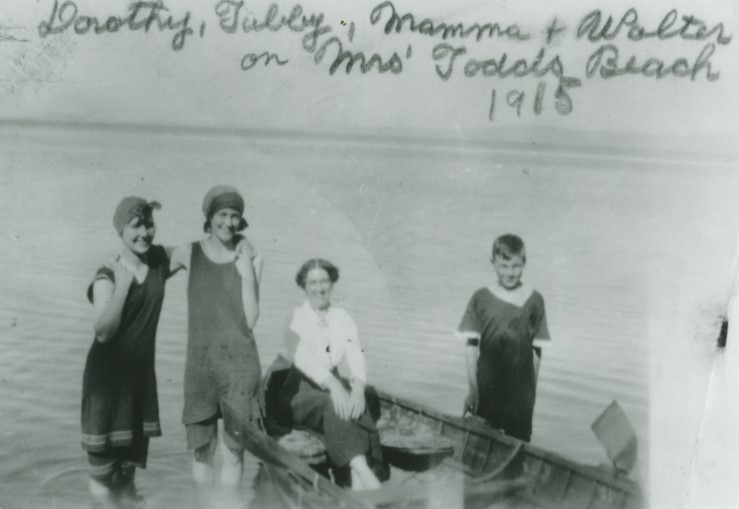
Mrs. McNaughton continued her enthusiasm: “Perhaps these young people scarcely realize what a privilege it is to have, here in this Country district, such expert attention in the art of swimming. Their fathers can tell them many a tale of how they sought the old ‘swimming hole’, of the bathing suits they wore on these occasions – little dreaming at the time that their children would one day dip into the broad Pacific Ocean and learn from experts how to battle with its waters, unafraid.”
The day was very fine and all members and their friends appeared on time at Scarboro Heights, flags decorated the entrance and at the end of the walk, where a winding path leads down by many a step to the Beach, we passed a Union Jack as it flung its folds to the breeze above our heads.
Report of Basket Picnic and Swimming Contest on August 23rd 1916
Lessons started with nine students, and proved so popular by mid July 1916 there were twenty-four students. W.T. Edwards got an assistant swimming instructor, Mr. George A. Pearson of ‘Scarboro Heights’ near Margaret’s Bay. The lessons were going so well that the President called a meeting to discuss plans for a swimming contest. “It was decided hold a basket picnic and swimming contest at Scarboro Heights Beach on August 23rd at 3 P.M….The secretary was instructed to post notices of this event in several prominent places, to insert a notice in the daily paper of Victoria and to have announcements made at Sunday services.”
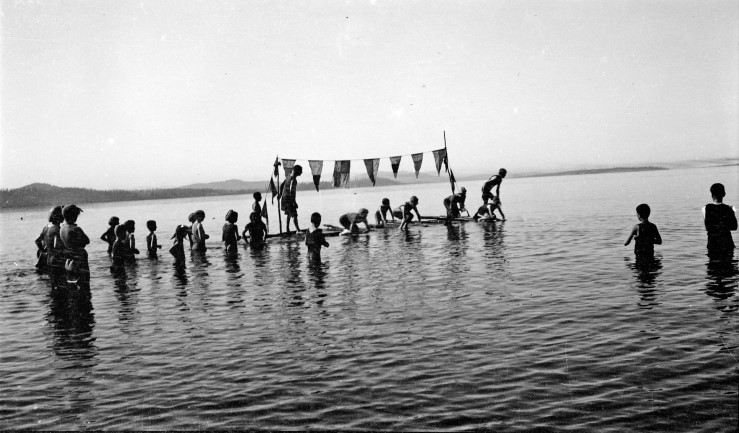
The officers of the day were: Judge, Mr. G.A. Pearson; Referees, Miss Dunnett and Miss Somers; Official Starter, Mr. W.T. Edwards. These are the races:
3.15 – No I – 10 yard race open to bona fide beginners
3.30 – No II – 25 yard race open to all club members
3.50 – No III – 25 yard race open to all club members breast stroke only
4.00 – No IV – 50 yard handicap race (this was substituted by an exhibition of swimming by some who had much training and experience)
4.15 – No V – race for juniors 8 years or under to go after apples and bring back over course as many as possible, one at a time in a given number of minutes
4.30 – Apple scramble for all juniors
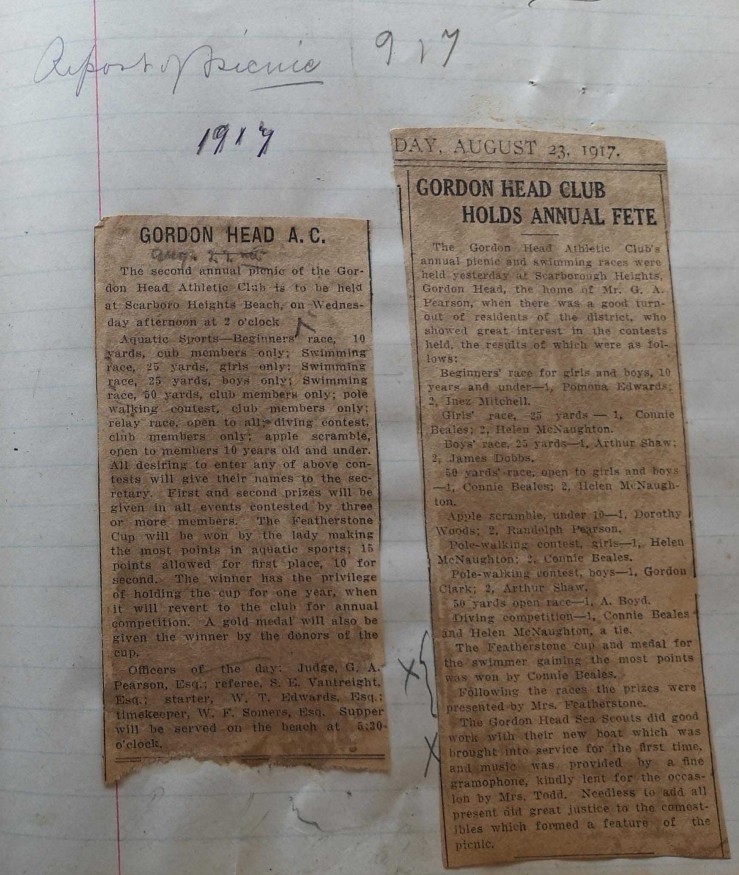
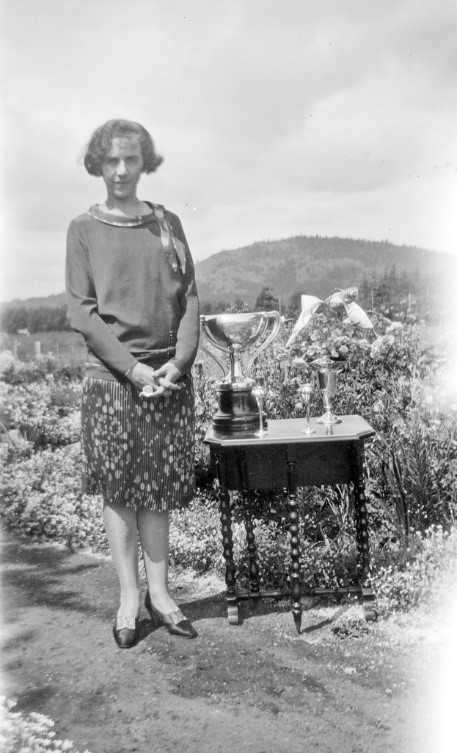
Gordon Head Athletic Club made their basket picnic and swimming galas an annual event, and expanded their activities to include pole walking, diving and fancy dress competitions. In 1916, prizes were not to exceed $2.50, and a special “second” prize was offered by Mr. G.A. Pearson — a trip to the city! In 1917, swimmers had a new prize — the Featherston Cup. Stanley Featherston, one of the young Gordon Head men serving in France, had sent a cup “to be competed for by lady members in any way thought best by the Executive.” They decided that “the Featherston cup will be awarded to the young lady member who makes the greatest number of points in aquatic sports and may be held for one year and then again it reverts to the club for annual competition. 15 points will be awarded for each first place in races. 10 points will be awarded for each second place in races.” The first winner was Connie Beales.
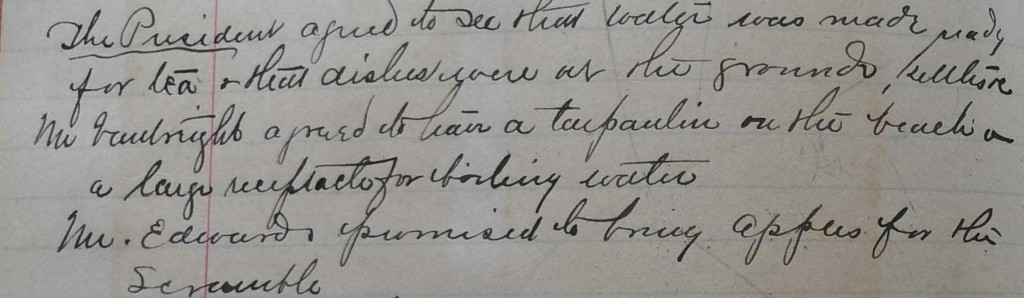
“Supper spread upon the beach was quite a feature of the afternoon,” reported Secretary McNaughton. The 1917 picnic planning shows some detail: “The president agreed to see that water was made ready for tea and that dishes were at the grounds, kettles etc. Mr. Vantreight agreed to leave a tarpaulin on the beach and a large receptacle for boiling water.” (There was no piped water in Gordon Head until the 1920s — it came from local wells) A 1917 newspaper report of that picnic notes: “…music was provided by a fine gramophone, kindly lent for the occasion by Mrs. Todd. Needless to add, all present did great justice to the comestibles which formed a feature of the picnic.”
They told Mr. Edwards just how much his work for them in teaching them to swim three afternoons every week of vacation had meant to the young people of the neighbourhood…
Report of Basket Picnic and Swimming Contest on August 23rd 1916
The awards were about to be presented at the first Gordon Head Athletic Club annual swimming gala when “two young girls slipped forward and in a few words clearly spoken so that the whole company could hear” thanked their swimming instructor Mr. W.T. Edwards for his lessons. They presented Edwards with “a small token of this appreciation in the form of a bathing suit with monogram embroidered by one of the club members in purple and white, which they hoped to see him wear often.”
Edwards claimed to be fully repaid for any time spent in club work by the happiness the children had shown throughout the season in the different sports planned for their benefit. Next, assistant instructor Mr. G.A. Pearson was called to the front and a young man presented to him “a pillow in purple and white work cut monogram filled with rose leaves redolent of a summer at Gordon Head when each member of the club strove to make better and happier the lives of all the rest.”
“A huge bonfire was now blazing and games and songs and stories put to an end a day to be remembered. After singing cheers for our host and his wife at Scarboro Heights, the national anthem was lustily sung and all turned their faces homeward.”
The Winter Season
“All members were asked to keep in mind the long winter evenings and to think of plans for same in which the G.H.A.C. may be of use.”
Gordon Head Athletic Club minutes September 30 1916
Once the Summer tennis and swimming season had ended, Gordon Head Athletic Club members needed something to do in Fall and Winter months. At the September 30 1916 meeting, the Club started to plan indoor recreational activities. These included: an indoor gymnasium, singing lessons and monthly dances.
An indoor gymnasium
“The original school…equipped with a few ropes and bars and the addition of a sawdust floor was used as a gymnasium, giving pleasure to many, crude though it would look today.” (Ursula Jupp, The Daily Colonist May 29 1960)
An indoor gymnasium could be a good way to spend long winter evenings. In 1914 a new two room school building had been built, and the old building moved to the back of the property. In Fall 1916 a committee investigated the possibilities of using the old schoolhouse for gymnasium purposes. Permission was granted to spend money as needed on lighting and equipment. By January 1917 the gym was ready to use. “A simple strong equipment had been put into place consisting of rings, bars, ladders etc.…It was arranged that Mr. Tucker meet the boys and men every Wednesday night and that Captain Todd should meet the women and girls every Monday from 7 to 9 P.M.”
“Captain Todd… spoke very briefly to the club regarding the uses and abuses of a gym. He pointed out the need of unselfishness on the part of the big people in dealing with the younger children. The big boy should help the little chap and teach him to be cautious while learning the various stunts. The same advice applies to the girls.”
At the first Annual Meeting on April 30 1917, Mr. Tucker and Captain Todd said much had been accomplished by the youngsters. They suggested an improvement of putting in a floor. “The saw dust proved very dirty. Someone wondered if the school board would furnish lumber for the floor if club members agreed to place it. The question was left over.” (We don’t know what happened, it’s not further mentioned) On September 20 1917 “Moved by Mr. Somers, seconded by Miss Dunnett, that an amount of $2.10 be paid to Capt. Todd for money he had paid out for rope for the gym.” There is one last mention on April 29 1918, “The Gymnasium is still popular.”
Mr. Watson’s singing classes
“Well, there were, of course, Mr. Watson’s singing classes in the Wintertime which were very nice…”
Ursula Jupp, 1977
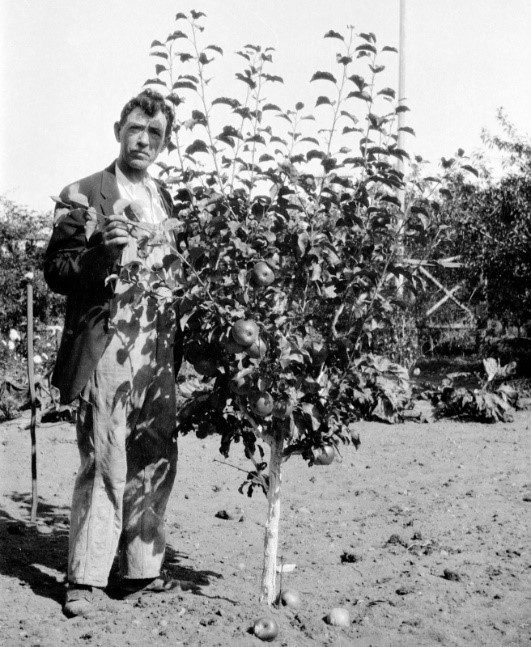
President W.T. Edwards “suggested that a very important branch should be teaching of music to our young people. Mr. Watson, who is known widely and well as a choir leader and singer, was asked to accept the convenorship of the club’s committee on music and he very kindly agreed to give each and every Friday evening to this work.” The first singing practice took place on Friday October 6th at 7.30 P.M. (Gordon Head Athletic Club minutes September 30 1916)
George Fraser Watson, fruit-grower and Saanich School Trustee, was a well-known singer and choir master. Here is a good overview of Watson’s musical career: “Mr. Watson had been a familiar figure in the musical world of this city for a generation. He was conductor of the choir of Calvary Baptist Church for thirteen years, and for many years past had been associated with the choir of First United Church. He was a member of the Victoria Male Choir… (The Daily Colonist February 22 1930) Watson first met his wife Elizabeth at a choir practice in 1890s Victoria. They were still singing together many years later, at the July 15 1916 South Saanich Women’s Institute Flower Show “Mr. and Mrs. Watson of Gordon Head gave a concert in the evening.” At a 1917 Empire Day concert at Gordon Head Hall, Miss Marjorie Watson (soprano) performed “The Song The Kettle Is Singing” and a piano duet.
Club minutes show the continued success of the singing classes:
“Mr. Watson gave a good report of the work in his department and felt that there was much reason for encouragement from the manner in which the young people were attending to their singing.” (November 20 1916)
“Mr. Edwards reported for the music committee in the absence of the convenor. He reported an ever increasing interest as shown by attention and attendance.” (January 2nd 1917)
“Mr. Edwards reported for Mr. Watson on the music committee, telling just how much this work has meant in the community and sincerely hoping the classes might open in the autumn under the same leadership.” (Annual Meeting)
Dances at Gordon Head Hall
Dances and parties were a key part of the Gordon Head Athletic Club’s social programme. Dances were held at the Gordon Head Hall, built in 1898 and located at the top of Tyndall Avenue near present day Ash Road and Grandview Drive. Gordon Head historian Ursula Jupp has noted “During the years of the First World War, Red Cross work and the fundraising concerts and dances connected with it meant frequent gatherings [at the Gordon Head Hall].” While the Club’s dances had a primary social function, their secondary purpose was to raise money for patriotic purposes like the Red Cross.
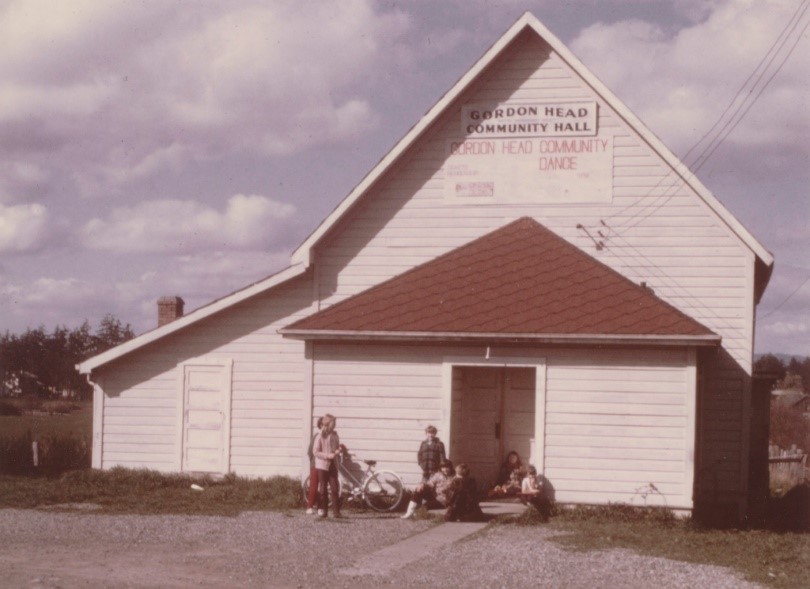
The Club minutes show the level of planning that went into having a dance, almost in a comical level of minutiae!
“Mr. G.A. Pearson was asked to take charge of a committee on dancing and accepted. Mr. Pearson moved, seconded by Mrs. Aitkens, that members be allowed the privilege of inviting their friends to these functions. Carried.” (September 30 1916)
“The president to see that the room was made ready. Tickets to be prepared. Miss Flo Dunnett to write them. Mr. Edwards to secure a door keeper. Music to be given by H.A. and R. McNaughton. Decorations committee, Miss Somers and a group of her choosing.” (May 1919)
Committees were formed to write and sell tickets (usually twenty-five cents), take charge of music and prepare refreshments. “Ice cream to be served. Arrangements to be in hands of the social committee.”
And of course — the “clean up committee”. It was not a matter of just showing up. The Gordon Head Hall was used for multiple purposes such as meetings and church services. So, some work had to be done. Dorothy (Poulton) Ramsay, who lived in Gordon Head during the WWI years, said: “when we had a dance we had to haul all the benches out and we had to take them back in after the dance was over, which was hard work.”
It was even harder work to get the Hall ready for the Club’s first 1916 dance. On October 13 1916, “It was decided that the Hall required a thorough cleaning out before the dancing committee put on their proposed Halloween party. Mr. Tucker, Mr. William Edwards, Mrs. Aitkens and the Secretary agreed to attend to this task. Five dollars was allowed for expenses.” On November 20 1916, “Mr. Tucker reported that the ‘clean up committee’ had done the work assigned to them for supervision…They had purchased transparent paper for the windows of the Hall, a pair of hinges for the front door, and some glass panes to take the place of broken windows. The amount this expended was ordered paid. It totalled $3.10. The committee was commended for its interest and efforts on behalf of the club.”
A pillow case Hallowe’en party
The first dance of the newly formed Gordon Head Athletic Club was a Halloween “sheet or pillow case party”. “Young and old alike came robed in ghostly costumes, manufactured of sheets and pillow cases, with white masks, gloves and shoes” (Victoria Daily Times November 1 1916) “The decorations were thoroughly in keeping with the occasion, and the successful character of these was due to the energy and enterprise of G.A. Pearson and his committee.” Here’s Secretary McNaughton’s wonderful description of the party: “Following an old custom, the children cut Jack o lanterns from pumpkins and oranges. In the oranges were tiny candles and they were placed on the window sills. The pumpkins were suspended from greenery here and there about the room.”
The party went well: “Good music and an excellent supper provided by the ladies. A good attendance and the sum of $5.10 handed to the Sec’ty for Red Cross.” The Club’s “juniors” (14-18 year olds) had their Halloween festivities on the same night as the adults. The juniors were allowed to share the fun until nine thirty and they were very happy in their play.” The juniors (and those younger) may have stayed and gone to sleep while their parents partied. Dorothy (Poulton) Ramsay, Gordon Head resident during WWI, recalled “When they used to give dances, you know, people would bring their children and make them comfortable on a bench with a pillow, blanket and other things.”
A club dance for Mr Fullerton
The Club’s next dance (November 24 1917) was not so well attended, “probably because of several counter attractions and in addition to this the weather was bad, very bad.” The Club only received $6.00 was received, but this was all required to pay expenses. There was nothing left to donate to the Red Cross.
At the beginning of January, the Club held a much better attended “farewell” dance for a member who had enlisted for overseas service. Lieutenant James Thornton Fullerton was son of fruit grower John Fullerton and sister of Miss Fullerton of the Club executive. (See my feature on Analysis of an Artillery Draft about the Divisional Ammunition Column draft that J.T. Fullerton lead as conducting officer in 1917).
The members discussed when to hold the dance. “Capt. Todd volunteered to interview the convener of the music committee in order to get his consent to hold the dance after the singing class on Friday evening, Jan. 5th, provided it would in no way interfere with his work. Captain Todd agreed to inform the Secretary of Mr. Watson’s reply so that notices might be sent out as necessary. This arrangement satisfied the Club and was agreed to upon a show of hands.”
“The plans agreed upon were carried out to the letter,” wrote Secretary McNaughton in ‘Report of the Club Dance in honour of Mr. Fullerton’. In addition to the Gordon Head residents, a number of guests came from the City, Cedar Hill and surrounding communities, “all adding their share to a very successful evening.”
The minutes describe the evening: “The children’s games in which young and old participated began at eight o’clock. At nine the floor was made ready for dancing and a jolly evening was spent by all. A simple supper was served at eleven o’clock and dancing was resumed with added zest.”
The dance was a success, but the Club minutes also show some failings: “In arranging our committee we made two mistakes which should be guarded against in future. We made no one responsible for the lighting and heating of the hall and we failed to arrange a clean up committee. Perhaps these two committees might be arranged alphabetically among our membership. It would a plan worth trying among the young men of the singing class as an experiment.” (Report of the Club Dance for Mr. Fullerton, 1917)
White shoes to match a white dress!
At that time, a white dress required white stockings and white shoes. Here’s how Ursula (Edwards) Jupp managed to get dressed for a dance: “Things were not all that loose money wise, and my mother’s sister in England used to send out…I had a first cousin some years old and these dresses used to come out. I had a dress that would now be considered smashing. A white crepe de Chine, lovely heavy stuff. There was a dance at the Gordon Head Hall and I had no white shoes to wear with this, and Mrs. McNaughton…her daughter Helen had a pair of white elk skin brogues about two sizes two big for me which she gave me, which I wore to the dance with my crepe de Chine dress.”
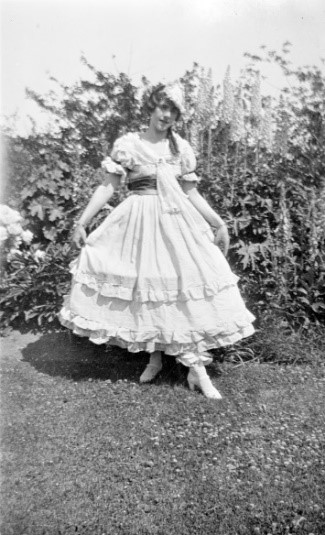
Darts and Hearts being very much in evidence
Next up was the St. Valentine’s Day dance. Every family was asked to pay fifty cents and to send something for supper. A friend of the club was to provide the music at his own expense. All proceeds were to be donated to the Red Cross or some patriotic purpose.
Here is a report of the dance: “The Gordon Head Athletic Club excelled all its previous efforts in entertaining on St. Valentine’s Night, when its dance committee, whose convener is Mr. G.A. Pearson of Scarboro Heights, welcomed the whole community to a well arranged and capably managed dance at Gordon Head Hall. The room was effectively decorated in St. Valentine’s emblems: darts and hearts being very much in evidence in the scheme. An orchestra of three pieces added in no small measure to the success of the event, and the supper was also much enjoyed by all.”
The dance was a decided success: “The entire proceeds, totally over $50 will be given to the Red Cross funds.” (The Daily Colonist February 18 1917) See the Red Cross report for February 1917 – Gordon Head Athletic Club, $57 (Victoria Daily Times March 3 1917)
A few other Club dances followed that spring. At the first Annual Meeting on April 30 1917, Mr. Pearson reported for the Dance Committee, showing that “all money over and above expenses had been handed to the Red Cross Society, and that the best of good feeling had characterized the work of his committee.”
“All were pleased and grateful for our interest”
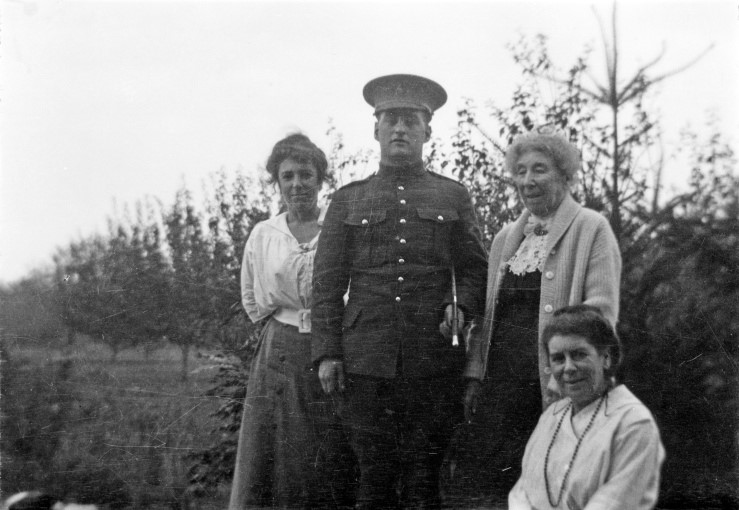
“Mrs. Aitkens’ report for the parcel committee was then made. It told of the packing of parcels for our men at the front and was most interesting.”
Gordon Head Athletic Club minutes January 2 1917
At the Gordon Head Athletic Club’s end of tennis season dinner in September 1916, President W.T. Edwards made a stirring speech “regarding those who are absent from us fighting the Empire’s battles in all earnestness on far-off battlefields, and the hope was expressed that all might lend a hand in some way in the near future as evidence of the Club’s interest.”
The Club immediately showed their interest. On September 30 1916, upon a motion of Mrs. Aitkens, seconded by Mrs. Pearson, “It was decided to send a Christmas parcel to the men of the district now serving the Empire.” The Club appointed a committee consisting of Mrs. Aitkens, convenor, Mrs. Watson, Miss Watson, Miss Fullerton and the Secretary to attend to the purchasing and packaging of gifts. They had $20 to spend, the proceeds of their Thanksgiving musical concert.
“Thanksgiving night, when a varied musical programme was given before a big audience, the proceeds being devoted to the sending of a Christmas remembrance to men from the district who are now serving overseas.” (Victoria Daily Times November 1 1916)
The Parcel committee met on Thursday October 19 1916: “all goods packed carefully by committee and others interested. A personal message sent to each man. Boxes contained good eats and smokes only. Committee names and a copy of Victoria papers enclosed.” Minutes, November 20 1916: “Miss Somers moved, seconded by Miss Dunnett, that this committee receive the thanks of the Club and that a slight shortage on account of postage rate change be made right.”
These are the Gordon Head men who received parcels from the Gordon Head Athletic Club (first names given where known): Bert Beales, Ebenezer Boorman, Mr. Edwards, Stanley Featherston, James Thornton Fullerton, Arthur Mallett, Mr. Murray, Mik Roberts, George Rosson, Thomas Todd, Mr. Wallace, Jack Williamson.
At the first Annual Meeting on April 30 1917, “The correspondence was then gone into and consisted mostly of letters of thanks from our fighting men at the front, who had been remembered by the Club during the year.” One of the men, young Stanley Featherston, sent the Club a silver cup from France, to be competed for by the “lady members” of the Club. (This became the Featherston Cup at the annual swimming galas). His parents presented the cup and were made honorary members.
The Gordon Head Athletic Club continued to send parcels to the men overseas. The Treasurer’s Report for 1917-1918 year showed: “a balance of Twenty-Dollars, on hand, after defraying all expenses including a donation to Red Cross amounting to $47.70 and amt. of $20.00 for parcels to our men overseas at the war.”
On September 30 1918, “An executive meeting of the G.H.A.C. was held in the Gordon Head Hall on Monday at eight p.m. to arrange for our yearly Christmas remembrances to members of the Club now overseas on Active Service. All present were desirous of sending parcels as usual and $30.00 was allowed to cover the expense of same. Moved by H.A. McNaughton, seconded by Miss Somers, that Mrs. Aitkens should be Convener of parcel committee with power to select her helpers. Carried.”
Finally, at the third Annual Meeting on May 9 1919, “the Committee on Parcels gave their report and received the hearty thanks of Executive. At this point letters of thanks from the soldiers who had been remembered were presented. All were pleased and grateful for our interest.”
“There was only about six years I suppose…”
Q. What happened to the Gordon Head Athletic Club?
U.J. It just gradually, when Mrs. McNaughton and my father let it go really….
Q. What time would that be?
U.J. That would be in the early 1920s. There was only about six years I suppose…
Ursula Jupp speaks to Sharon Manson, August 1977
The Gordon Head Athletic Club’s first year ended with the first Annual Meeting on April 30 1917. “There were a few appropriate remarks from the President who gave a short resume of the outstanding features of the Club’s first year and then called for a report from the Secretary. The report given was a condensed outline of our work as a club from its organization to the present and it was received and approved as read.” Reports were read showing a very satisfactory year in tennis, swimming, football, dances, singing lessons and the gymnasium.
Officers were elected for the ensuing year, as follows: Honorary President, Mr. Luke Pither, president, Mr. W.T. Edwards, re-elected by acclimation; vice-president, Mr. G.A. Pearson, secretary, Mrs. Peter McNaughton, re-elected by acclimation, treasurer, Miss Annie Somers.
“Very hearty votes of thanks were given to all the retiring officers. All joined in singing of the National Anthem and the meeting adjourned to meet at the call of the President.”
Thus ended the first year of the Gordon Head Athletic Club and began its second, which proceeded much like the first: the tennis courts were made ready and manned by volunteers; Mr. Edwards taught swimming; there was the annual basket picnic and swimming gala at the end of August and the Halloween and Christmas parties at Gordon Head Hall. Parcels continued to be sent to the men overseas. This pattern of events repeated itself over the next few years, with a few small changes.
The meeting was opened by a short speech from Mr. Edwards dealing with the past, present and future of the club. He placed the responsibility for its usefulness upon the shoulders of each member and suggested that all should help, each in his own way.
Gordon Head Athletic Club Annual Meeting, April 29 1918
One change was the annual membership fee. By Spring 1918, the Club had 111 members — 23 juniors, 88 seniors and 4 honorary members — but it had not collected membership fees. By this point, the war had been going for almost four years, and Gordon Head was pressed to give its money to patriotic purposes. At the executive meeting on April 22 1918, “Much discussion took place over the question of collecting the annual fee for the club as it had been omitted since our organization because of innumerable demands for war work.”
The executive decided to collect a reduced fee. At the April 29 1918 Annual Meeting, “It was moved by Miss Beales and seconded by Mrs. W. Tucker that we pay our annual fee of 50 cents for seniors and 25 cents for juniors.”
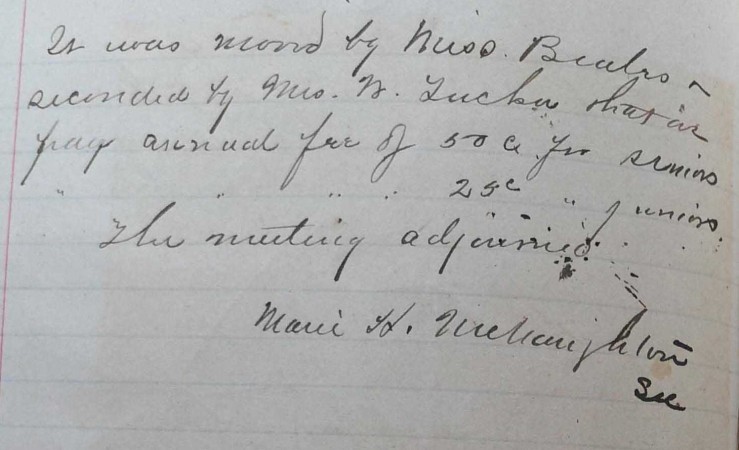
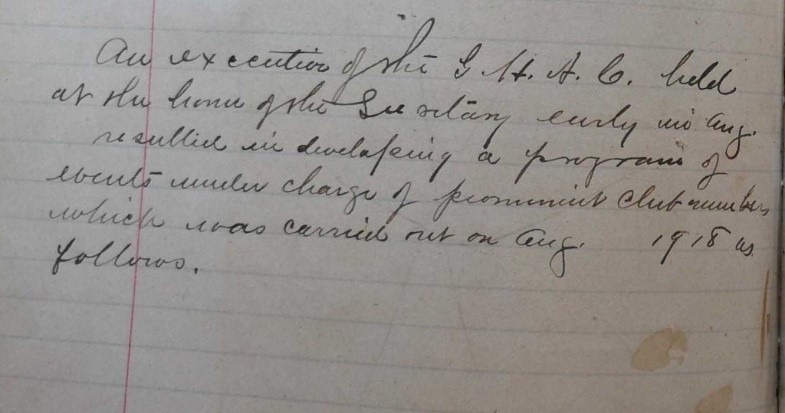
Mrs. Peter McNaughton continued to be the Club’s Secretary. Back in summer 1916, the minutes were full of Secretary McNaughton’s enthusiastic descriptions of events and various inspirational speeches. By August 1918, her enthusiasm had waned. This entry from the minute book is a clear example: “An executive of the G.H.A.C. held at the home of the Secretary in early August resulted in developing a program of events under charge of prominent club members which was carried out on August [blank] 1918 as follows….and no further information is written…
All work during Autumn and Winter of 1918 was seriously affected by the Flu Ban.
The Gordon Head Athletic Club’s programme of singing lessons, dances and the gymnasium helped fill the long Winter nights in this rural community. But the “Spanish Flu” put an end to all that. On October 8 1918, the Municipality of Saanich imposed the “Flu Ban”. Written in the minutes: “On account of Influenza the committee program was interrupted. The Health Authorities placed a ban upon dancing and all public assembly.” The Municipality of Saanich lifted most of its ban by mid-January, but Gordon Head School — closed since October 8 1918 — had been hit by the ‘flu (half the school was ill) and the school did not re-open until the beginning of February 1919.
In the meantime, the War had ended and Gordon Head men began to return. The Club decided to host a “Welcome Home Dance” on May 23 1919 at 8 p.m. “The Secretary was instructed to write invitations to our returned soldiers asking their presence, and was asked to send a note of congratulation to Mr. Arthur Mallett who was fortunate enough to receive a Military medal for courage under trying circumstances.”
Unlike the delightful descriptions of the Club dances in the 1916-1917 season, we hear nothing of this Welcome Home Dance. In fact, there are no more minutes until this last entry:
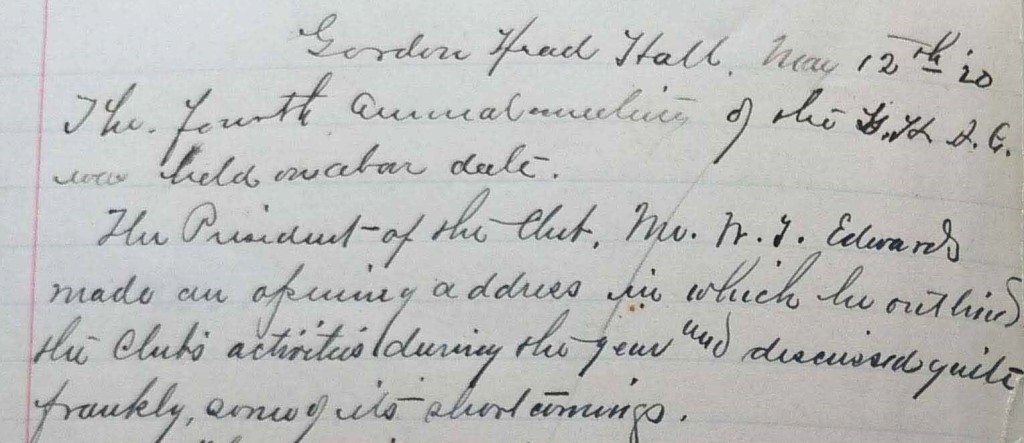
The fourth Annual Meeting of the Gordon Head Athletic Club was held in Gordon Head Hall on May 12 1920. There was a somewhat dour tone: “The president of the club Mr. W.T. Edwards made an opening address in which he outlined the club’s activities during the year and discussed quite frankly some of its shortcomings. The minutes of last annual meeting were read and approved. The treasurer was complimented upon her ability to find funds to keep pace with expenses.”
This last comment is telling — the world was now in a post-war economic depression (The Daily Colonist has constant references to the “high” / “increased” cost of living). The Gordon Head strawberry growers also had a difficult time — not only were they fighting an ever-losing battle with the dreaded strawberry weevil, but “a great deal of injury was done to strawberry plants in December 1919, when a week of very severe weather was experienced. This freeze injured the young plants and accounted for the great shortage which existed at planting time in 1920 and the resulting high prices which were asked for plants.” (Fifteenth Annual Report of the Department of Agriculture for the year 1920)
We hear one last thing of the Gordon Head Athletic Club in The Daily Colonist on May 21 1921: “The fifth Annual Meeting of the Gordon Head Athletic Association took place last Tuesday night in the Gordon Head Hall, with the president, Mr. W.T. Edwards occupying the chair. About 75 members of the organization attended the gathering…The election of officials for the following season resulted as follows: Hon. President, Mr. Luke Pither; President, Mr. W. Ley; vice-president, Mr. W.T. Edwards (who refused nomination for the presidency); secretary, Miss Ursula Edwards; treasurer, Miss Marjorie Watson. The conveners of the following committees struck were: tennis, Mr. Ley; social, Miss Neary Clarke; swimming, Mr. W.T. Edwards; while conveners of the boxing and basketball activities will be elected at the next gathering.”
The Club was branching out into new sports (boxing and basketball) and, after five years at the helm, Mr. W.T. Edwards had stepped down as President…and his daughter Ursula was now the Secretary. The Gordon Head Athletic Club’s executive had now passed to the new generation — the “promising young people” for whom the Club first had been created.
What happened next?
The Gordon Head Athletic Club faded away into the 1920s, but it’s no surprise as many of its original supporters became busy with other activities. Let’s check in and see what happened next. First, our “interested residents” who had formed the club, Mr. Watson, Mrs. McNaughton and Mr. Edwards.
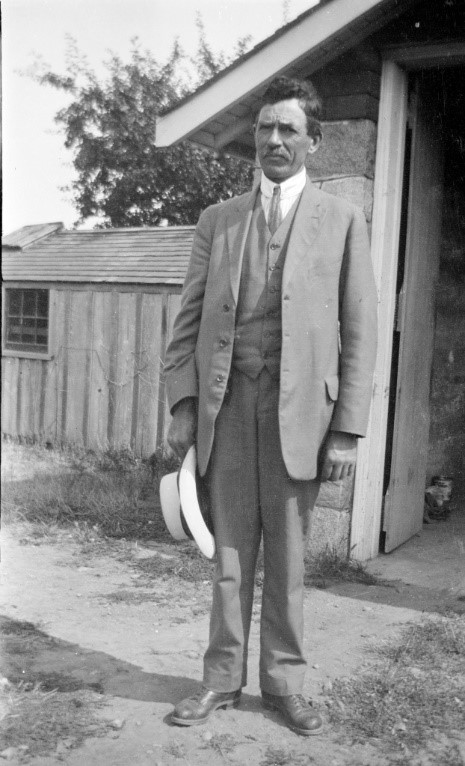
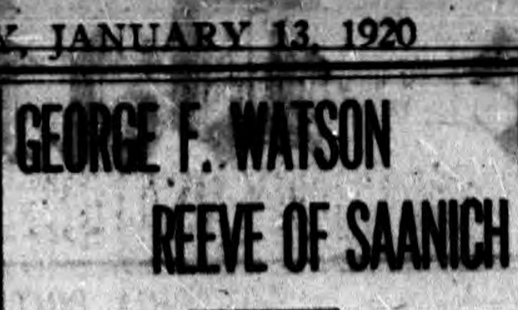
Singing instructor George Fraser Watson served several terms as Saanich School trustee. In 1919, Watson became Ward 3 Councillor and was Reeve of Saanich in 1920, 1921, 1922 and 1923. Watson was instrumental in getting water piped to Gordon Head. Watson also kept busy in the musical world as President of the Victoria Musical Festival Association. “To that latter body he gave the most indefatigable service, and, active since its organization, his term in the chair was marked by vigorous forward policy.” (The Daily Colonist February 22 1930)
Mrs. Peter McNaughton continued to be active in public life. At the July 1928 Gordon Head School Sports Day, “Mrs. McNaughton, President of the Women’s Canadian Club, presented to the school a framed copy of the Canadian Coat-of-Arms. Mrs. McNaughton was the recipient of a charming bouquet of cream and pink roses, delphiniums and buff lilies…” In the 1930s, Mrs. McNaughton was organizer and chairman of the Gordon Head Current Events Club, meetings attended by many former members of the Gordon Head Athletic Club.
W.T. Edwards continued to teach swimming and lead the Gordon Head Sea Scouts. On land, he was beginning — finally — to have some financial success in the form of his daffodils. “Mr. Edwards has no less than 1,000,000 bulbs under the ground, covering some five acres. There are twenty commercial varieties and fifty varieties altogether. Besides daffodils, he also grows tulips and narcissus.” (Daffodils are Rolling East, The Daily Colonist April 2 1929)
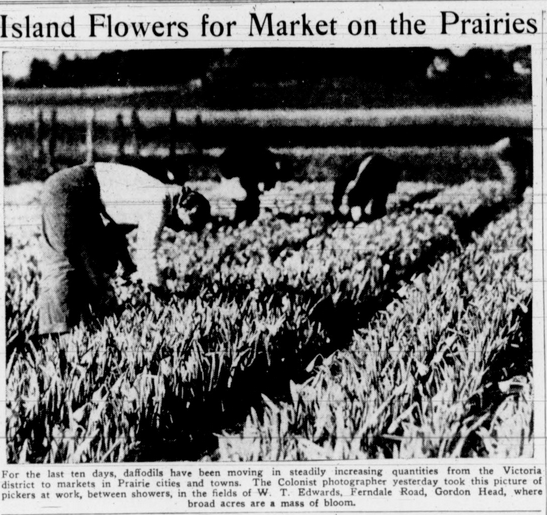
And what about the “young people of the district?” The Gordon Head Athletic Club lasted for a short period of time, but it had long-term impacts. The Club’s values of community collaboration and support for young people helped these people to build strong future lives and they themselves helped the young people of the next generation.
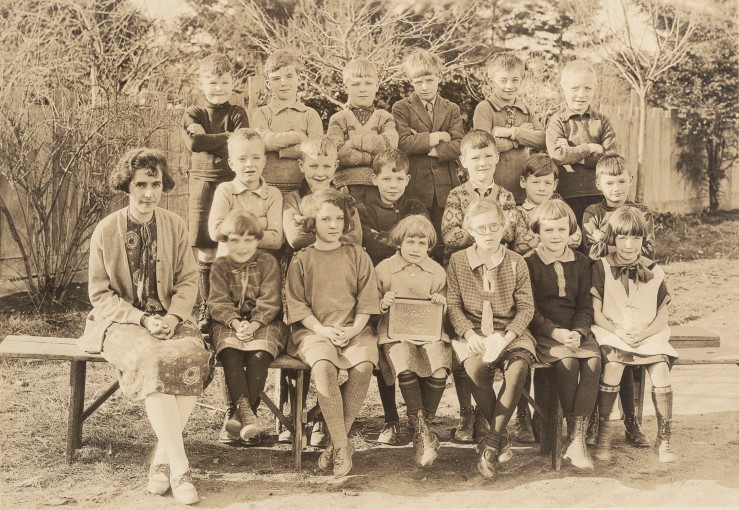
Marjorie Watson became a teacher and eventually returned to teach at Gordon Head School. Here’s Marjorie with a new group of “promising young people” of Gordon Head.
Bee Williamson had a long career with B.C. Telephone. In retirement, she played an active part in the Gordon Head community. Bee was a trustee in the Gordon Head Mutual Improvement Society and a Girl Guide leader. Ursula Jupp profiled Bee in this April 19 1964 article.
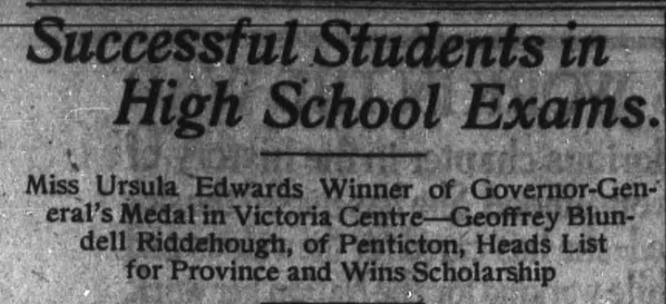
Ursula Edwards was Gordon Head’s star student at Victoria High School. Ursula was editor of the school newspaper and a member of the school debating club (and still walking six miles home every day!) In 1918, Ursula Edwards had the highest Junior Matriculation results in all of Victoria and won the Governor General’s Silver Medal. In 1919, Ursula again had the highest marks for Senior Matriculation and won the Governor General’s Medal.
Ursula next attended the Provincial Normal School and qualified as a teacher. But she was Burnt Out. In a 1977 interview, Ursula noted that her health was bad at the end of her school days (too thin) and she attributed it to all the walking back and forth she had to do. Ursula took a year off — the year she was Gordon Head Athletic Club Secretary — before teaching for two years, then got married. (All this happened by the time she was 21 years old!) Ursula later returned to teaching — history and geography, which she loved, because it was about people and places. She also became President of the Friends of the Greater Victoria Public Library and promoted children’s literature and Young Canada Book Week.
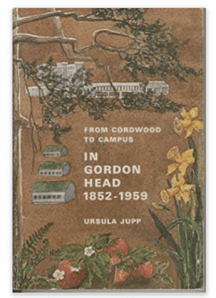
In the 1950s, Ursula Jupp took a journalism course and started writing about the history of Gordon Head. Her stories appeared in The Daily Colonist’s “Islander” magazine throughout the 1960s and many of these stories formed the basis for her 1975 book From Cordwood to Campus. Ursula’s 1977 candid oral history interviews (now in Saanich Archives) tell us even more about early life in Gordon Head.
Promising young people of this district…then…
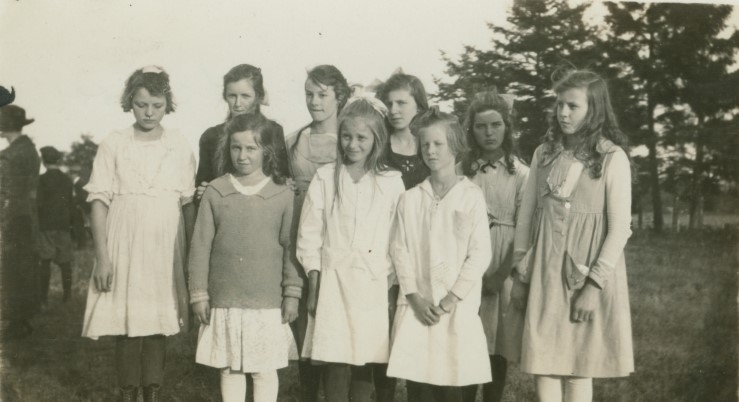
Here’s a snapshot of the young people of Gordon Head at the 1919 Saanich Fair, when they won a prize for school garden produce.
…..and many years later….
Here they are in 1978, still active in Gordon Head, when they worked on getting the historic Dodd House moved to Lambrick Park.
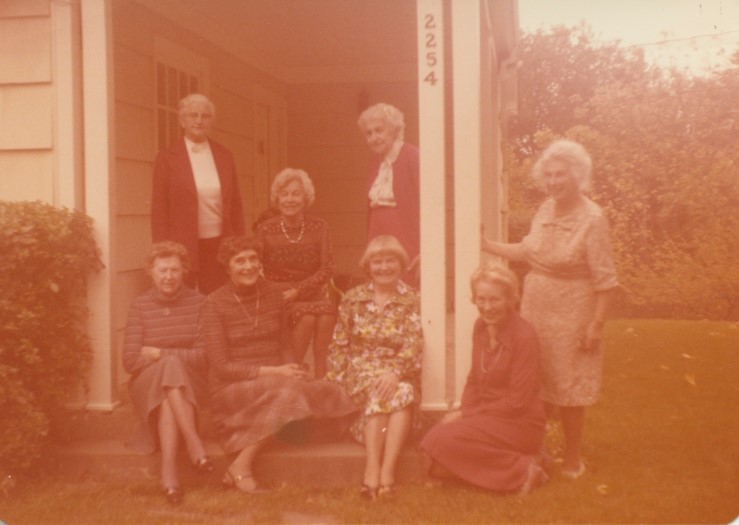
What was a short period seemed to me very interesting, and to anyone in Gordon Head. And it made good community.
Ursula Jupp, August 1977
Sources and acknowledgements
I first came across the Gordon Head Athletic Club in 2017 when I was searching newspapers for the name Lieutenant J.T. Fullerton, a club member, who had been conducting officer of the artillery draft my grandpa had enlisted in. I learned about the minute book when Saanich Archives, as part of “Saanich Remembers WWI”, shared on their website selections about the Club’s WWI fundraising activities.
The minute book of the Gordon Head Athletic Club was found by the son-in-law of President W.T. Edwards while he was tearing down an old barn on the family property. The minute book was in the possession of Edwards’ daughter, historian Ursula Jupp, in the 1970s, and eventually, arrived in the Saanich Archives in 2007.
In Spring 2020, Saanich Archives gave me the opportunity to read scanned pages of the entire Gordon Head Athletic Club minute book. I began to read and transcribe the early 1900s handwriting to discover a whole world of tennis court rules, “basket picnics” and swimming galas!
The Gordon Head Athletic Club’s activities were often reported in Victoria’s newspapers. These contemporary news items gave context to the Club minutes, as did a series of 1977 oral history interviews with Gordon Head residents, most who had been school children in the WWI years and members of the Gordon Head Athletic Club. Also very important were Ursula Jupp’s many articles on Gordon Head people and places that appeared in The Daily Colonist’s Sunday “Islander” magazine in the 1960s and 1970s, and her book Cordwood to Campus.
Finally, I was able to illustrate this project through the extensive collection of early 1900 Gordon Head photographs, donated to the Saanich Archives by former Gordon Head residents and their families. Key families are the Aitkens, Watsons, and Williamsons.
A very big thank you to those people who shared their personal stories with the Saanich Archives by donating photographs, documents and memories. Also a very big thank you to Saanich Archives for initially transcribing some of the minutes and making them publicly available online. A special thank you to Suzanne Hervieux, at the time Saanich Archives Specialist, for her continued enthusiasm in scanning documents and sharing information. In doing so, everyone demonstrated the Gordon Head Athletic Club’s collaborative motto “All for Each and Each for All”.
 Stephanie Ann Warner