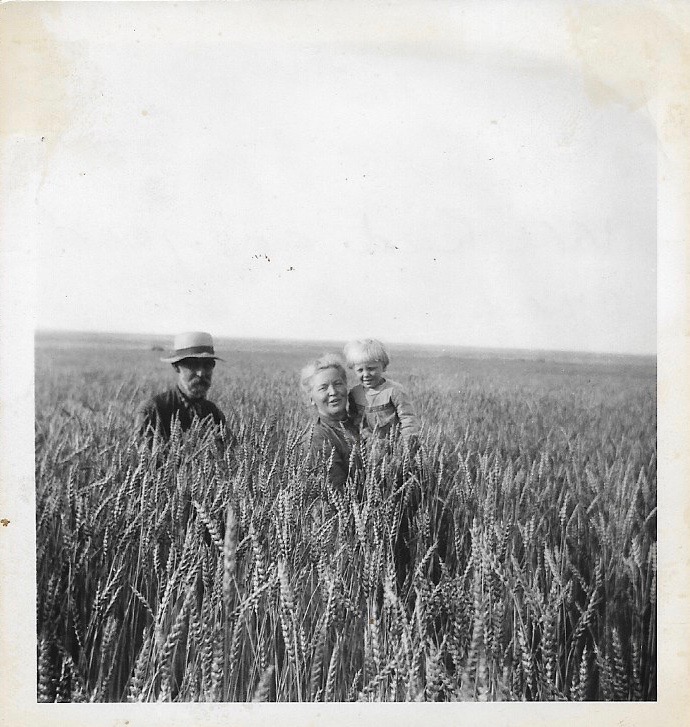
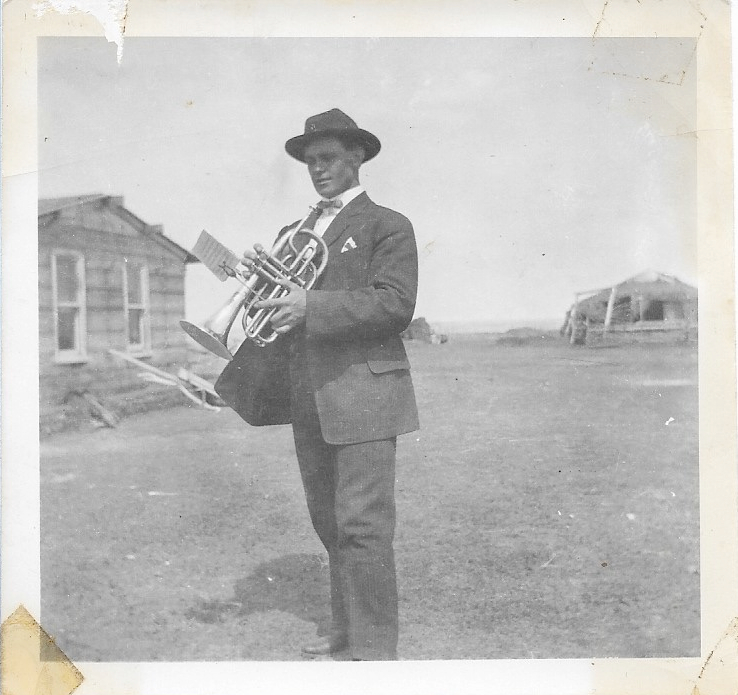
Bessie Raye (Thompson) Green (1890-1989) grew up on the Canadian Prairies. Raye’s father John Thompson (a builder, grain elevator operator and Justice of the Peace) decided to take out a homestead of 140 acres near Battleford in the new province of Saskatchewan. In Spring 1906, Raye moved to the family farm near Tako and was soon taking snapshots of family, friends and neighbours.
Raye developed and printed her own photos and sold these to get money for camera supplies. Raye often mentioned photography in letters to her “beau”, neighbour Walter Glendenning Green, who worked winters in U.S. logging camps. Raye’s letters and photographs are in her family collection, which I had the opportunity of editing.
Raye’s words and snapshots from over 100 years ago still provide a fresh and fun look at some of the prairie pioneer experience. This feature puts Raye’s photography in context with contemporary early 1900s advertisements and Kodak camera manuals. We’ll look at contemporary studio portraits from Raye’s family and friends, Raye’s process in taking and developing photos, Raye’s photo “business”, and family snaps from the 1910s and 1920s.
Pictures of Raye
…be sure and send me a picture. I want to see how you look. I dont think you will change so I will not know you. I would like to get a picture all the same.
Walter Green, February 21 1909 Minnesota Woods
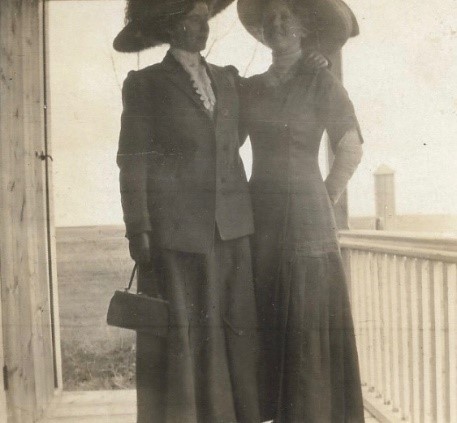
Walter Green, December 28 1907 — I must thank you for sending them pictures I like the one ware you are standing best. altho you look quite natural on Maggies back. They made me a little lonesome for the time being. I was very glad to get them all the same. [Note — Walter’s spelling and punctuation appears here as originally written]
Raye Thompson, April 25 1908 — I am sending you a couple of snapshots. Gordon says that the Salvation Army girl has a mouth like a cow but she can’t help that. In the other one I had on mother’s clothes and no one who looks at it knows who it is.
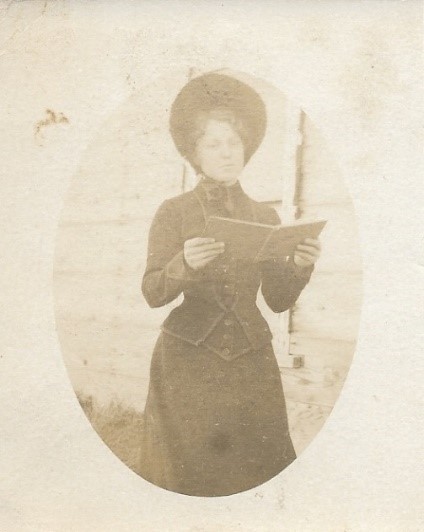
Raye Thompson, January 20 1909 — I have not had any more of myself taken yet but mother says she is going to take one of Gordon and me tomorrow.
Raye Thompson, February 2 1909 — I don’t think they will be much good as Uncle Gid was in when they were being taken and I know I did not look right.
Walter Green, March 4 1909 — them of yourself are good. I was glad you sent them. I wanted to see how you looked. It seems a long time since I came down almost three months…
Studio Portraits in the Big City
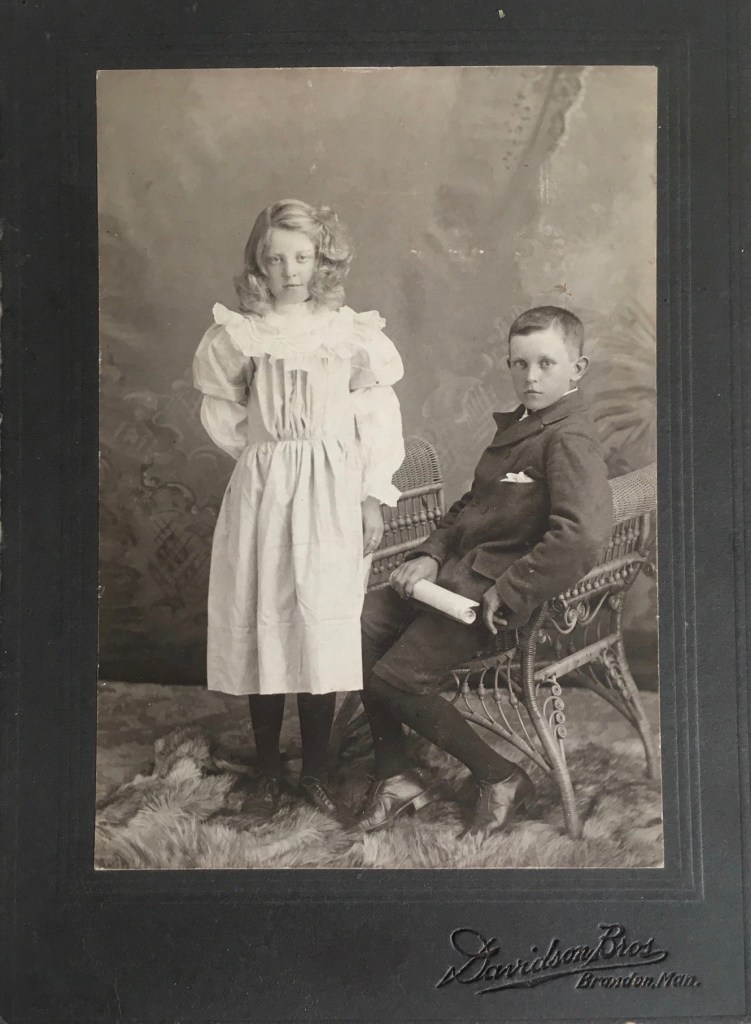
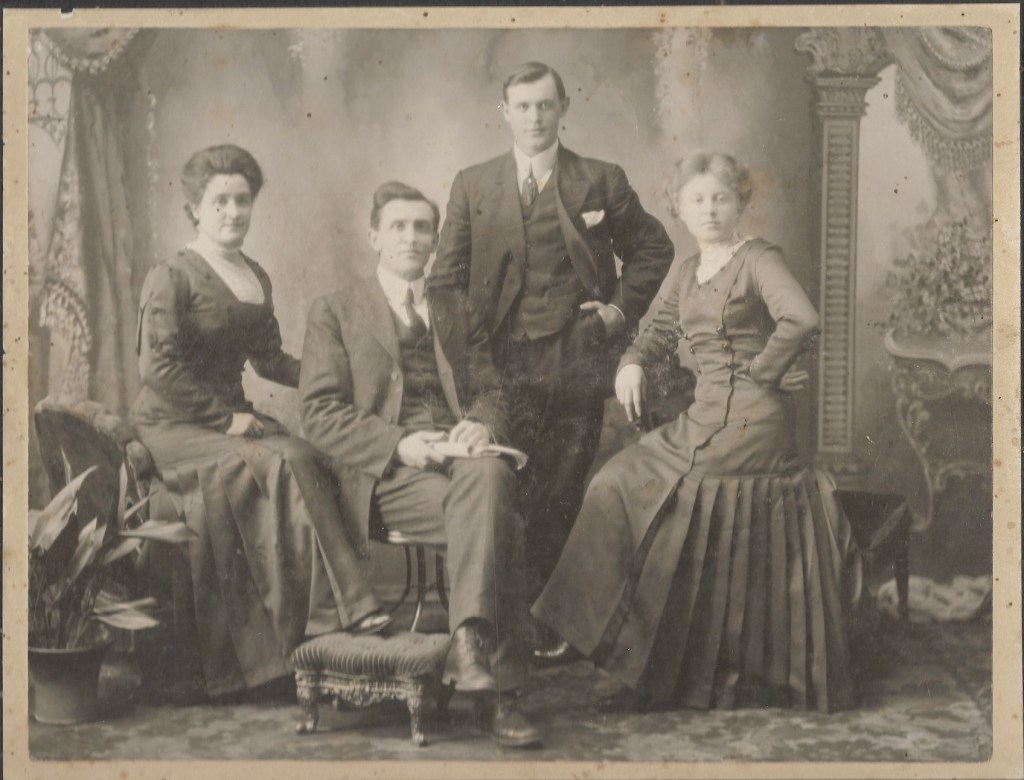
First, as a contrast to the snapshots of amateur photographers like Raye, let’s look at some Edwardian-era portraits from photo studios. Studio portraits were available to Raye and Walter when they went to a town or city. Because of the cost and quality of a studio portrait, it’s more likely for people to have saved these photographs. Raye’s collection has a lot of studio portraits from 1900 onward. It’s interesting to see the contrast between these posed photographs and the informal snapshots.
Walter’s portraits
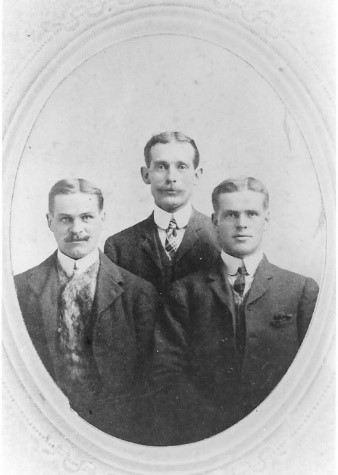
The Stewart Boys and I had sum Photos taken in Winnipeg will send you one when I get them
Walter Green, November 1907
I got some photoes last week of the Stewart Boys and myself. I may send you one. I don’t like them. my left shoulder is near to the top of my head but thats the same as the original so I don’t suppose I got any kicke coming. Billy Stewart asked me not to let anyone see them as he said he always took a bad picture. I think he looks fine.
Walter Green, January 19 1908
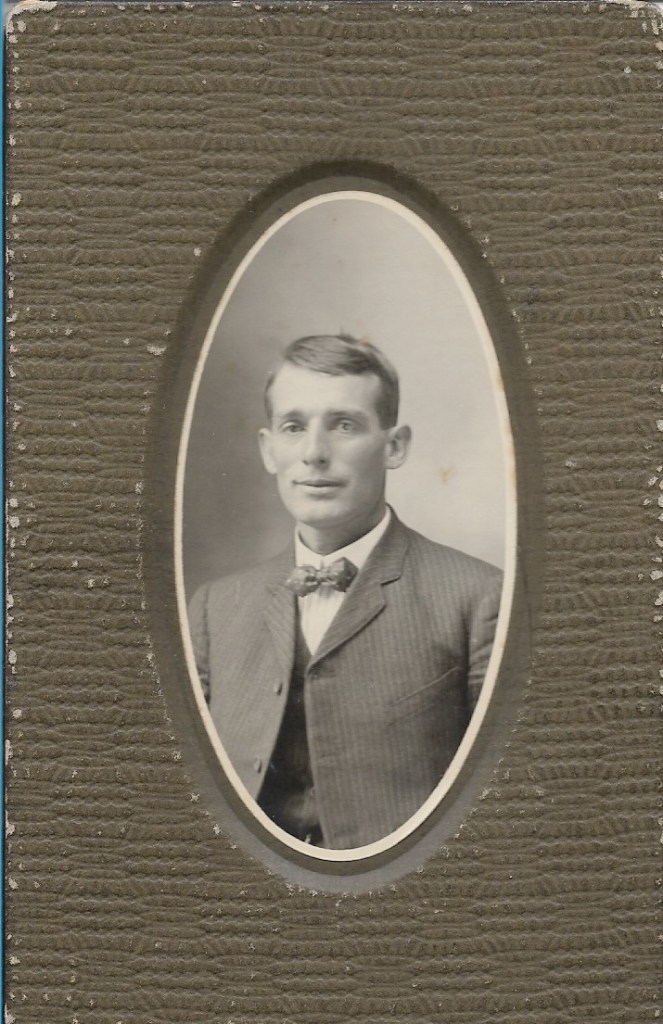
“A Swell Dish”
Portraits were used for long-distance courting. See what happened to Gordon Thompson.
Raye Thompson March 9 1909 — Oh! say, Gordon has received a letter from a girl in Scotland. He wrote one to “Dark Eyed Betty” in the Western Home Monthly. She wrote a letter of four small pages and it took the whole family to read it. But then she says, she is suffering from a stiff hand so we will hope for better things. She sent her photo and I tell you she is a “swell dish”. She is rather pretty and is dressed very stylishly, looks as though she was well off. She is coming to Canada in the spring and will write to him again then. We are having a lot of fun with him about her but Gordon does not mind. [They never did meet “Dark Eyed Betty”]
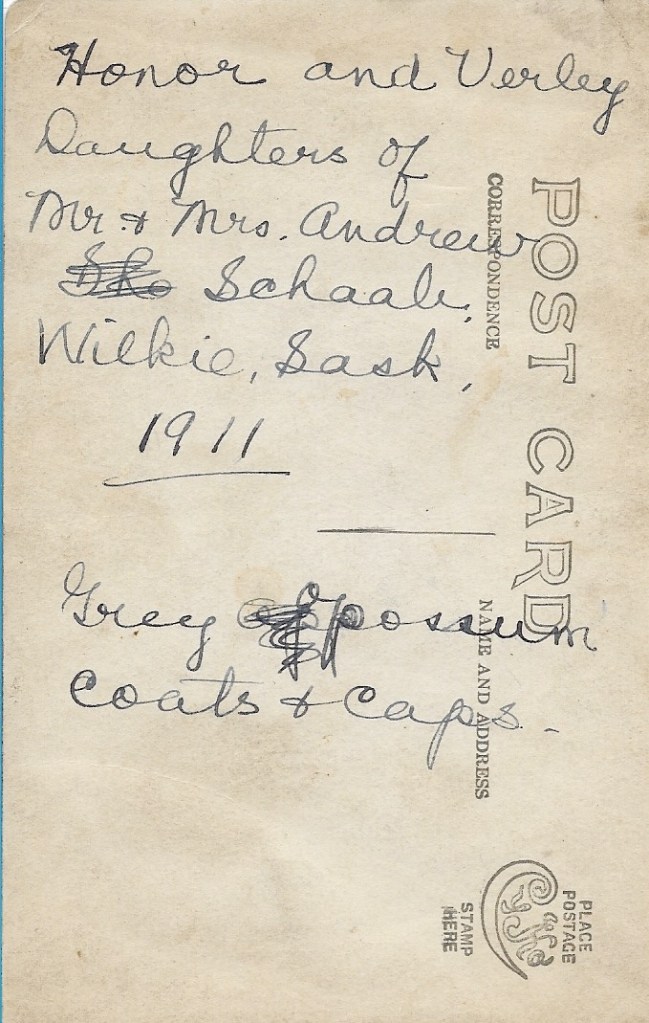
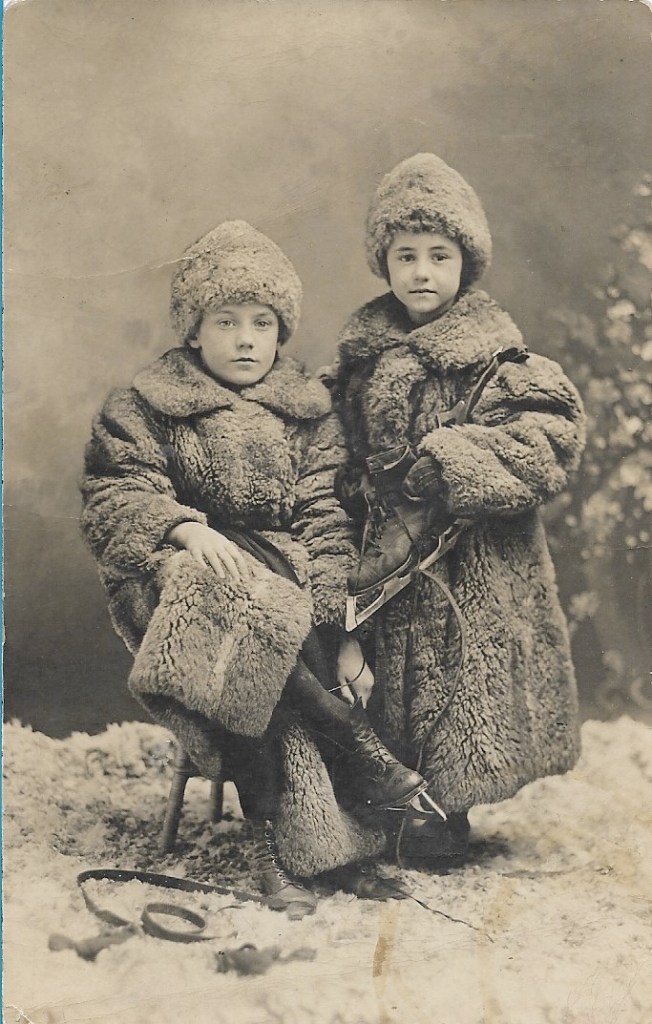
Grey Possum Coats and Caps
Raye briefly worked for the Schaabs, who ran the store in Wilkie, Saskatchewan. Here’s a picture of Honor (9) and Verley (7). This studio portrait was printed on a postcard, a popular format for the time to share with friends. Note the fake snow background and the ice skates! The Schaabs were originally from Ontario, so the postcards were probably made to send back to friends and family to show the “cold” Saskatchewan winters!
Next, we’ll look at the photography process, as described in Raye’s letters, and illustrated with images from contemporary publications.
Camera and Film
P.S. You can have my camera or anything else that will be of use to you, any time. Raye
Raye Thompson to Walter Green, June 19 1910
The portable camera and film were a much more practical way for homesteaders like Raye to take photos, plus also a chance for more candid shots. What kind of camera did Raye have? She doesn’t mention the camera, but it was probably a folding camera made in Canada by the Canadian Kodak Company.
These are images of the No. 3 Folding Pocket Kodak used by early 1900s Saanich B.C. amateur photographer Annie Girling. (I went to visit the Saanich Archives to see her cameras and operation manuals).
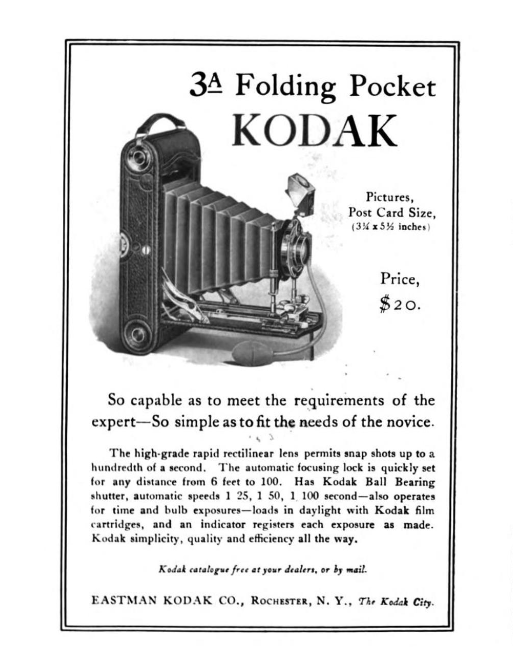
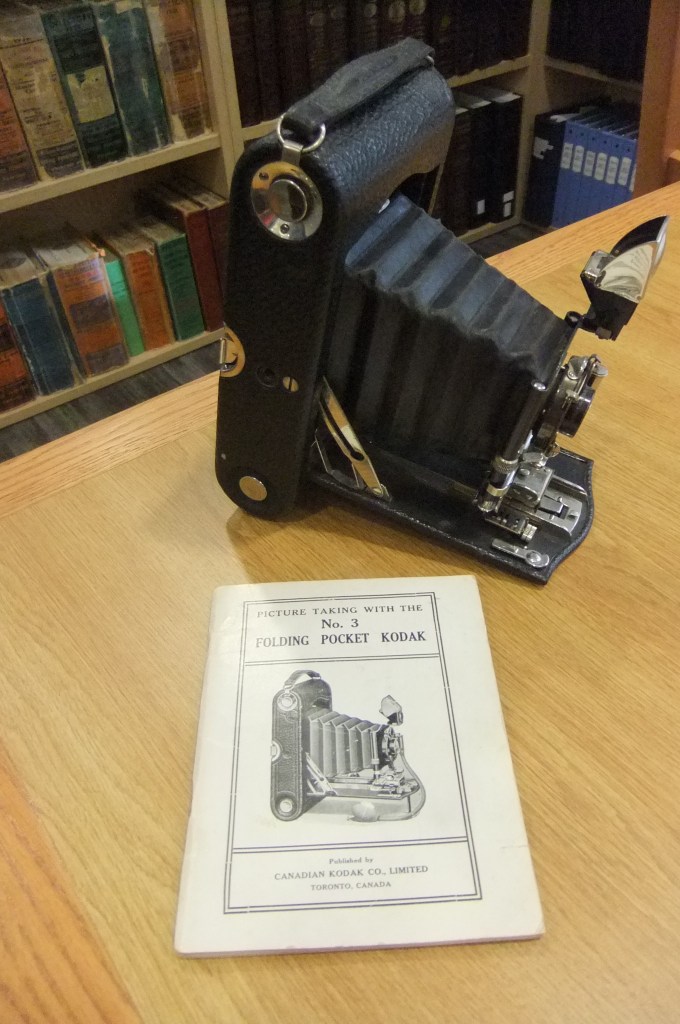
Here are pages from Picture Taking with the Folding Pocket Kodak No. 3, published December 1912 by the Canadian Kodak Company
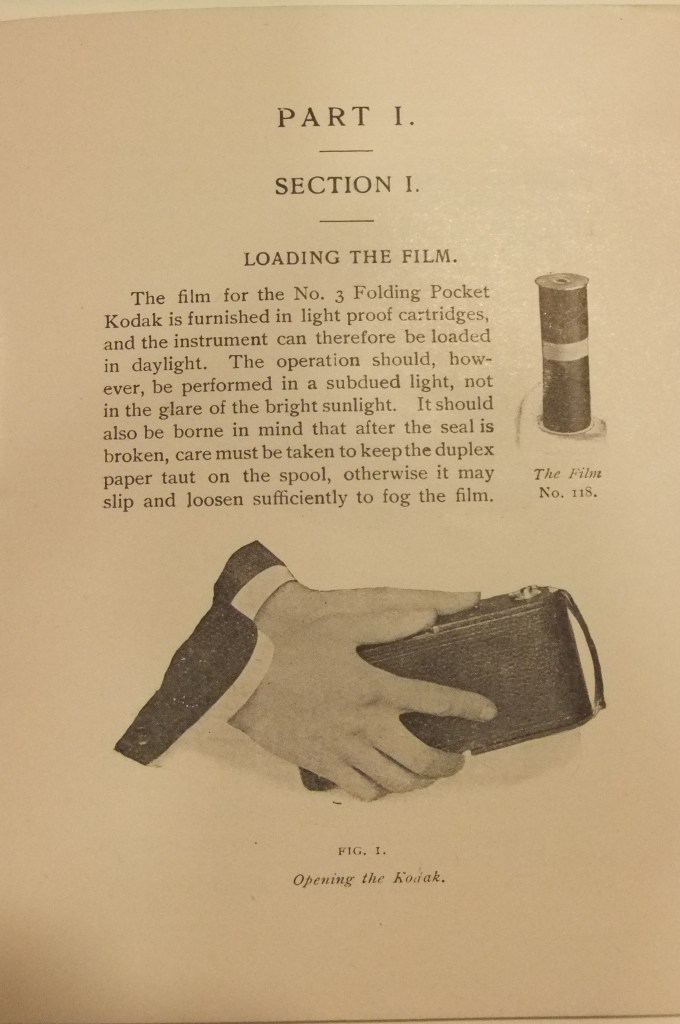
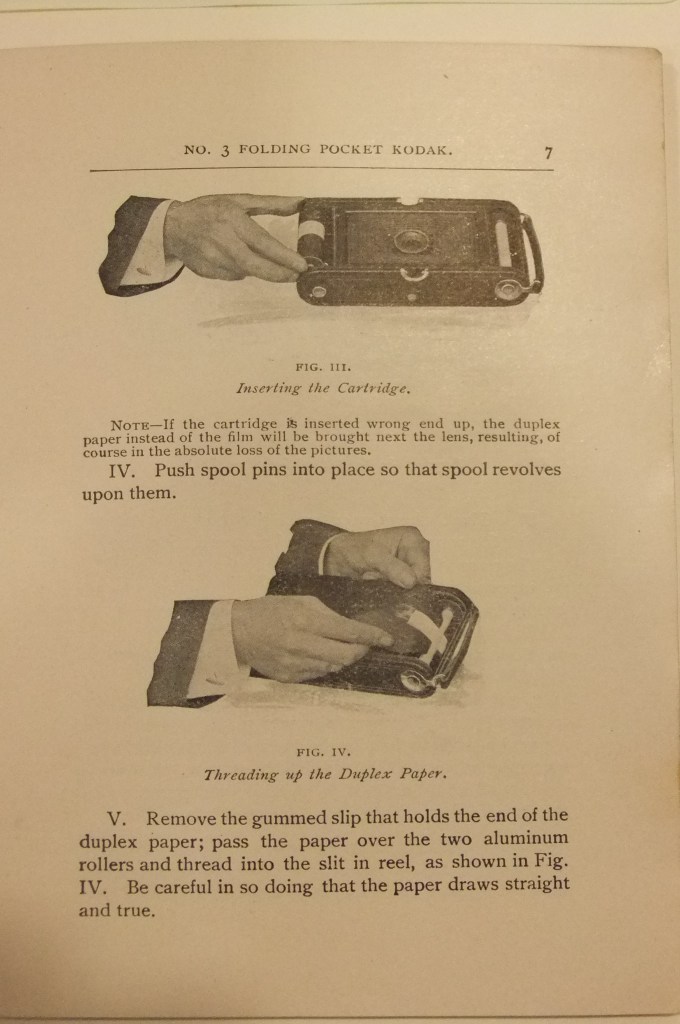
Walter Green left for work in the Minnesota Woods and was picking up some film en route – clearly film was not available in the local stores.
Walter Green December 16 1908 Saskatoon — took a look around town called in all the drugg stores that last one was the only that keeps camra suplys got all the film he had – only one. I will send some from Winnipeg if I have time.
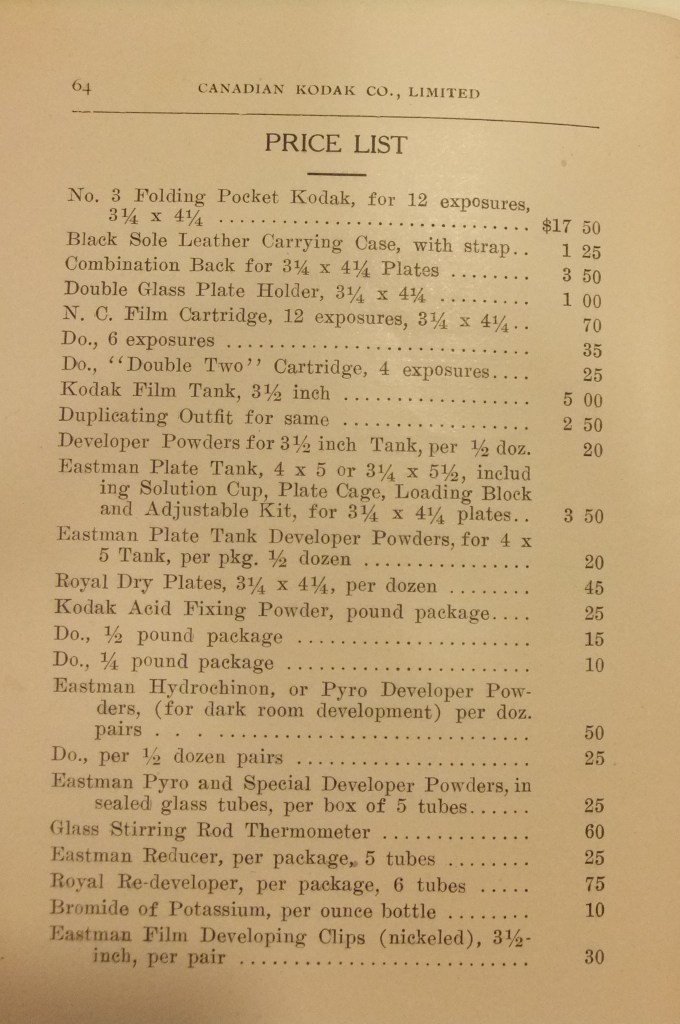
Raye Thompson December 18 1908 — I was rather excited or rattled or something else, down at Scott that day and I forgot to give you any money to pay for the films which you would send from Winnipeg. It was thoughtless of me but I will send it when I get the films (or when I get the money). [What did film cost? The 1912 Canadian Kodak price list shows a film cartridge of 12 exposures was 70 cents.]
Walter Green December 27 1908 — I forgot to send you them films from Winnipeg. I thought of them lots of times but intended to get a camera and get sum for myself at the same time. I sent one from Saskatoon.
Developing Photos
How do you get your pictures finished up since I came away?
Walter Green, January 31 1909
It made me lonesome tonight to think that I had no one to help me to run the films through when my arms got tired.
Raye Thompson, February 2 1909
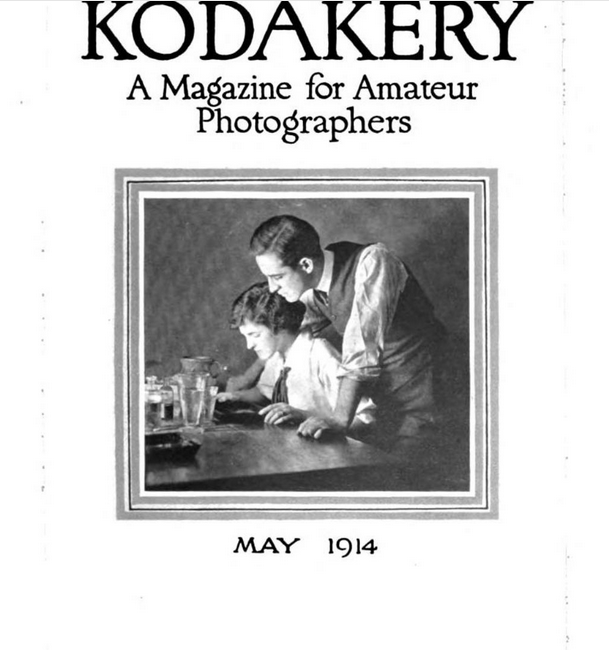
Dark Room Developing
“To start with do not go and waste a lot of money on purchasing a large supply of chemicals. Rather be content to get only those that are really necessary and add to them as time and occasion may demand.”
A.V. Kenah, The Amateur Photographer, Victoria Daily Colonist September 8 1907
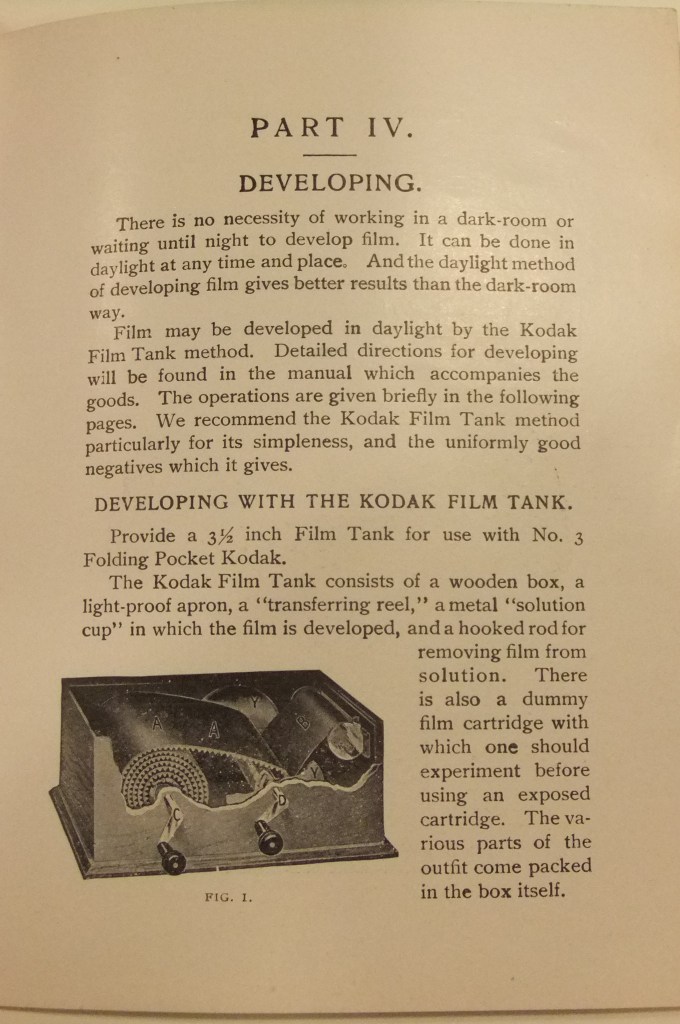
This image from the 1912 Kodak manual shows all the materials required – all packaged for $1.50, which gives an idea of prices (probably cheaper than this in 1907-08) and how much the money Raye made from her photo clients could pay for supplies.
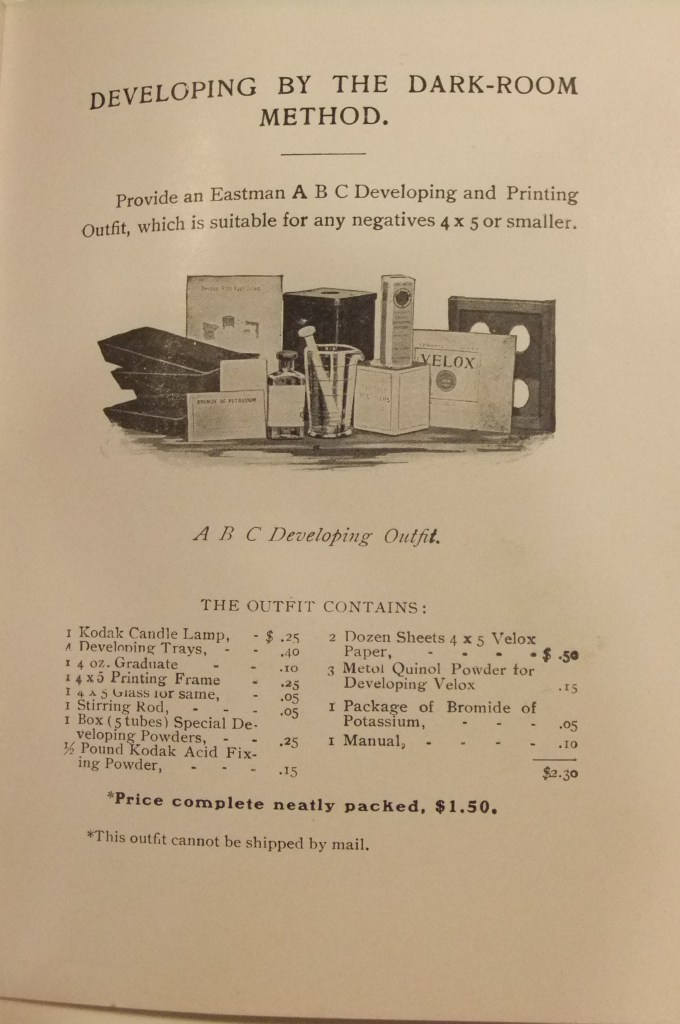
(Note – as the outfit cannot be shipped by mail, someone would have to live in a city to be able to access it, and it’s likely that the local stores like Wheatland’s or Shephard’s wouldn’t be carrying all these supplies – perhaps they may have been available in North Battleford at a drug store?)
Here’s a sketch of a “serviceable dark room” in The Amateur Photographer – Dark Rooms and the Equipment by A.V. Kenah in the Victoria Daily Colonist, September 8 1907
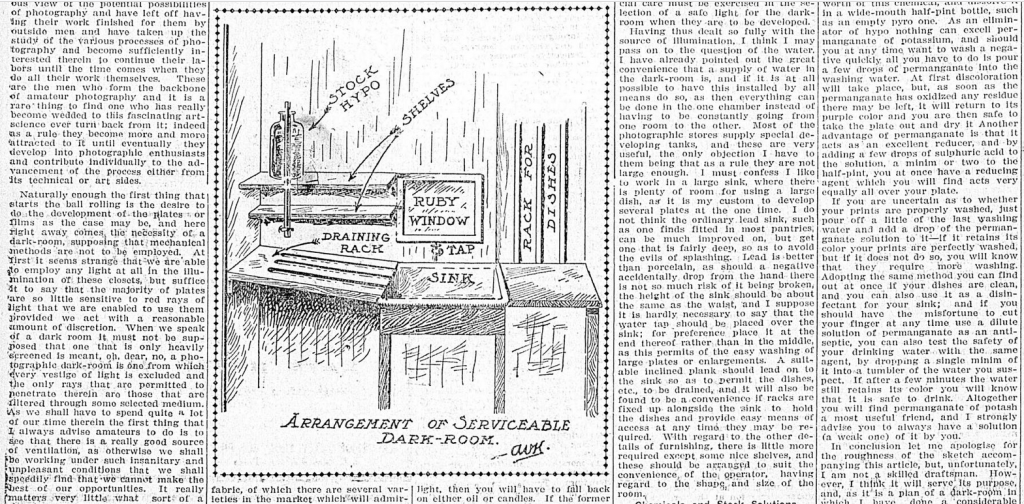
On the U.S. Prairies, an amateur photographer in Butte Montana had his dark-room in a cellar: “My dark room consists of the cellar under my home, which is very convenient for several reasons: First, chemicals and everything else is practically out of the way; second, it is dark, and third, the temperature is nearly the same all the time…in the cellar I have a table on which to develop, and in the top, I cut out a hole 15X24 inches and had a tinner fit into the space a galvanized iron pan, 4 inches deep, with a slope, and at the lower end solder ¾ inch gas pipe, which allows the water to drain into a bucket …” A letter to The Camera and Dark-Room photography magazine in 1904
The Kodak Film Tank
“if only mere amateurs would use these machines instead of experimenting with different sorts of developing agents about which they know nothing, they would get a very much larger percentage of success”
A.V. Kenah, Victoria Daily Colonist August 18 1907
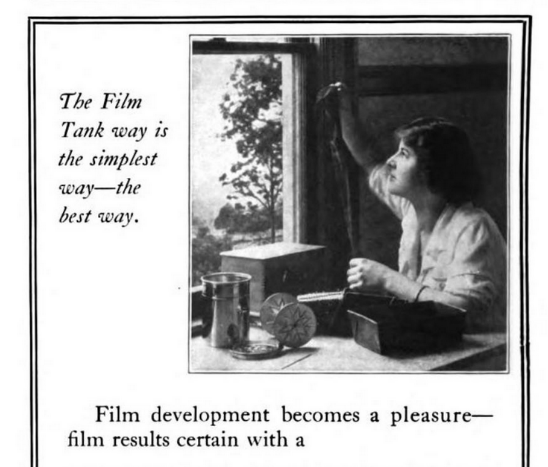
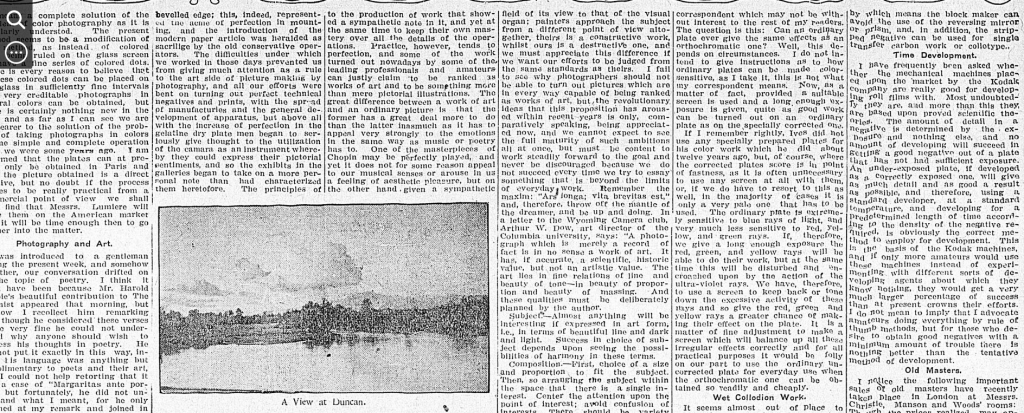
Raye mentioned “run the films through” – She may have had the Kodak Film Tank (it has a rolling motion to run films). The Film Tank was the recommended method for amateurs. Most often the ads for the Film Tank were of women using it. [Suggesting that women were not capable of running a dark room?]
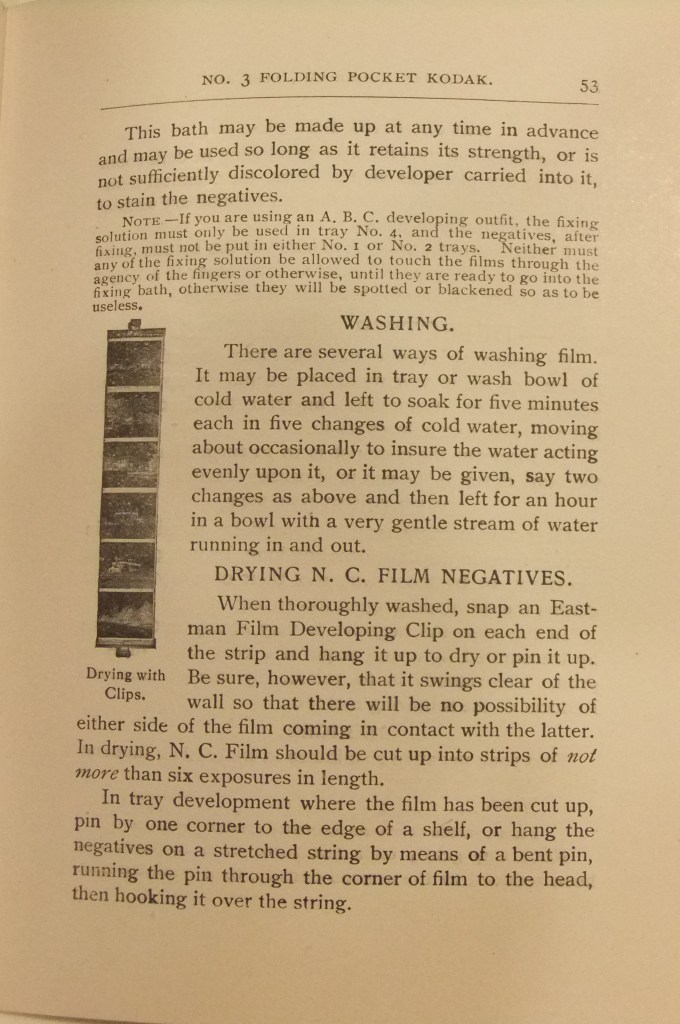
Toning and Washing
I am combining work and pleasure this evening, toning and washing some pictures and writing to you…
Raye Thompson, January 20 1909
Printing the pictures
I have just finished developing a roll of films, the most of them look alright. There is a couple of myself and I am anxiously waiting for the sun tomorrow, so I can print some.
Raye Thompson, February 2 1909
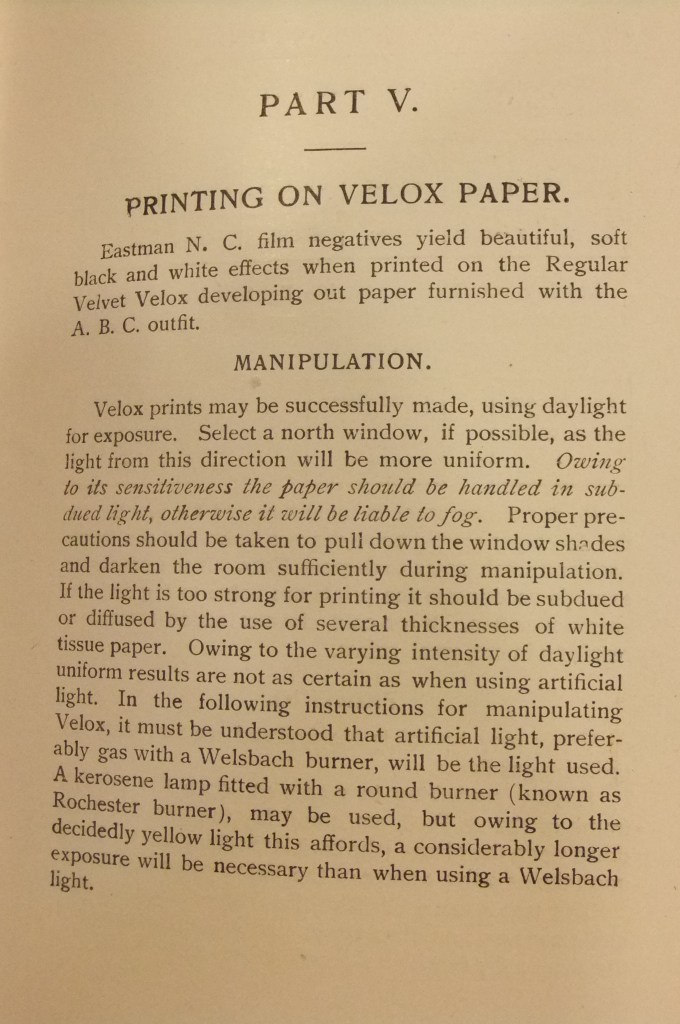
Raye’s letters mention printing pictures in the day time or at night: “I have been printing pictures most of the day, have made about two dozen and a half, of one kind or another.” (January 20 1909) “I printed a few pictures tonight but none of them are much good, a couple of yourself are the best ones.” (January 26 1909). It’s unclear how Raye was printing her photos, but note — the Kodak Film Tank advertisement says it is “a simple, all by daylight process”. The 1912 Kodak manual states “Velox prints may be successfully made, using daylight for exposure. Select a north window, if possible, as the light from this direction will be more uniform.”
Mounting the pictures
I have done those of yourself that you asked for but they are not dry or mounted yet so I will have to wait until next mail to send them.
Raye Thompson, January 20 1909
There are no two of the mounts alike but they are all I had on hand. … If you want more pictures than are there, you might cut that folder containing two photos in two and so have two separate pictures.
Raye Thompson, January 21 1909
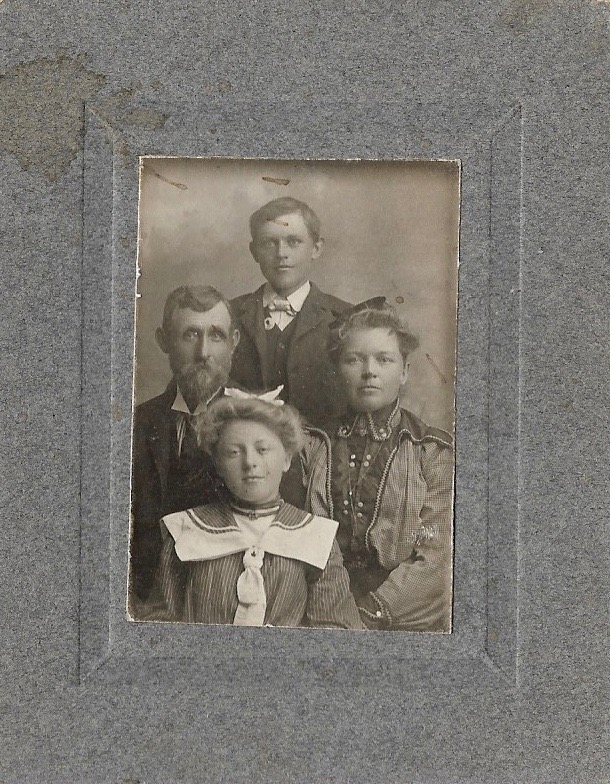
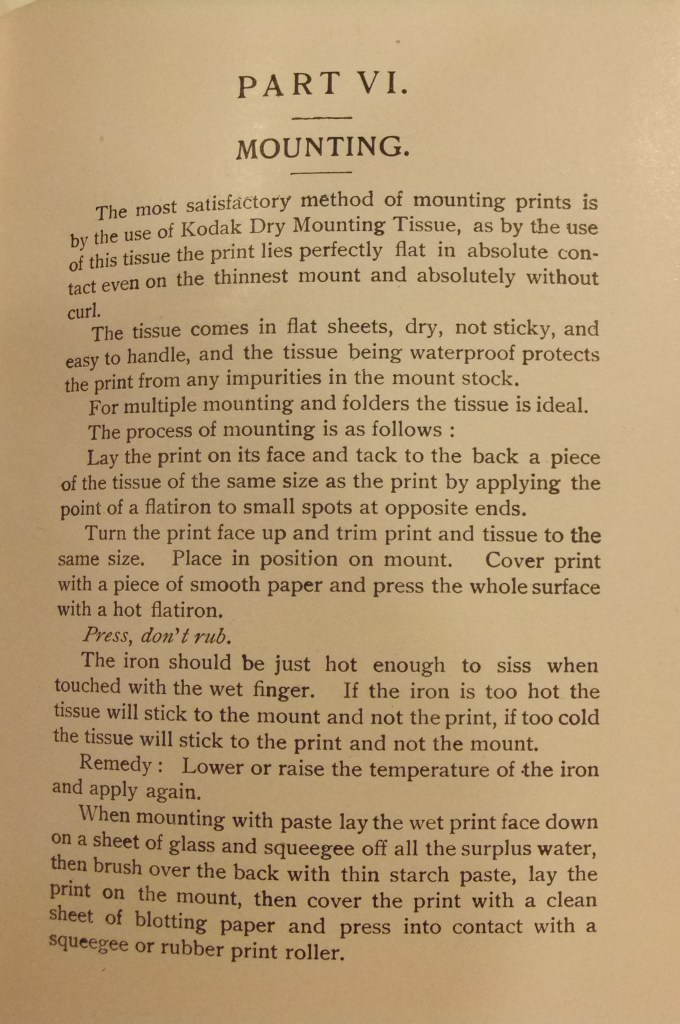
Mounting pictures means to put the print onto some kind of card backing for framing. This photo of Raye (around 13 years old) with her family (probably taken when they lived in Carievale, Saskatchewan) was “mounted” on a piece of cardstock – and not very expertly, as the angle is all off.
This contemporary article discusses many ways to trim and mount photos for the best artistic effects. The article was part of the Victoria Daily Colonist’s series “The Amateur Photographer” in Summer 1907 by A.V. Kenah, formerly with Kodak in London.
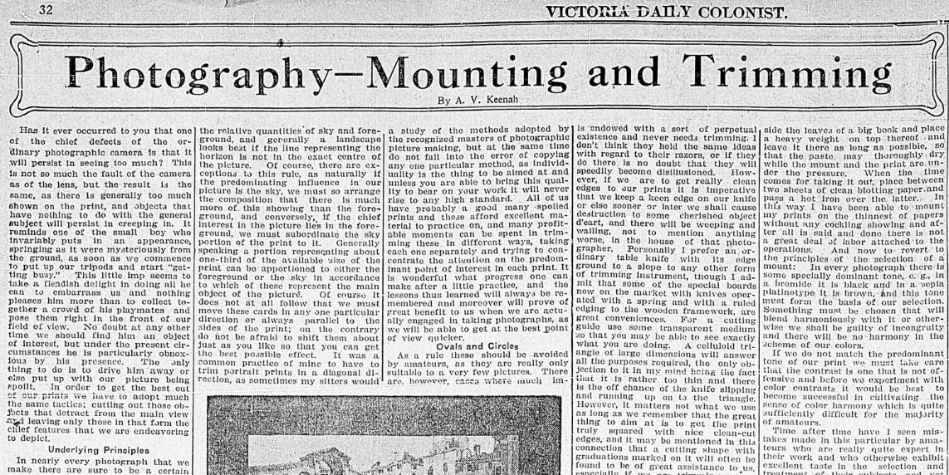
Here is a method that Raye may have been using to mount her pictures:
“if we are rich enough to launch out into a dry mounting apparatus well and good but the majority of us cannot afford such luxuries and to these the following method which I have adopted for some time with considerable success may be interesting. Use a good strong plate, i.e. Higgin’s Photo Mountant, and apply a very thin coating of it all over the back of the print; lay it in the required position on the paper mount and press it gently at first and afterwards more firmly on to the mount. Then place it between clean sheets of white paper inside the leaves of a big book and place a heavy weight on top thereof and leave it there as long as possible, so the paste may thoroughly dry while the mount and the print are under pressure. When the time comes for taking it out, place between two sheets of clean blotting paper and pass a hot iron over the latter.” (A.V. Kenah, Photography Mounting and Trimming)
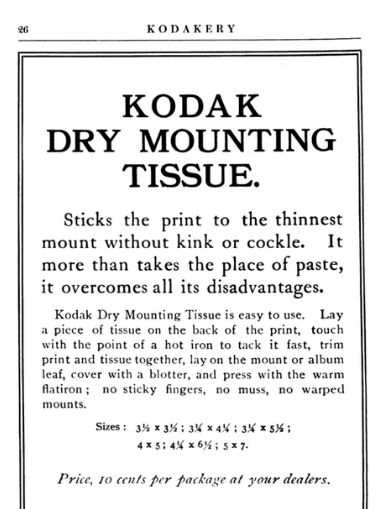
Kodak was promoting its own “easy to use” product,”Kodak Dry Mounting Tissue” at 10 cents per package.
Taking pictures for friends and neighbours
Thanks for them postcards. I would like to have four of them pictures to send away.
Walter Green December 27 1908
I got the pictures ok they are nicely finished up many thanks. I will send sum of them home when I write again. I like the ones with the dog and cat best
Walter Green February 7 1909
Raye took snapshots for friends and neighbours. Some were reminders of home for friends working away (like Walter in the Minnesota Woods). Others were images to send to family in the East or in the “Old Country”. Most often, the pictures were of the homesteader’s shacks!
Walter Green, January 19 1908 — Thanks for that picture of my shack. it looks as natural as life only them turkeys looked to near for comfort.
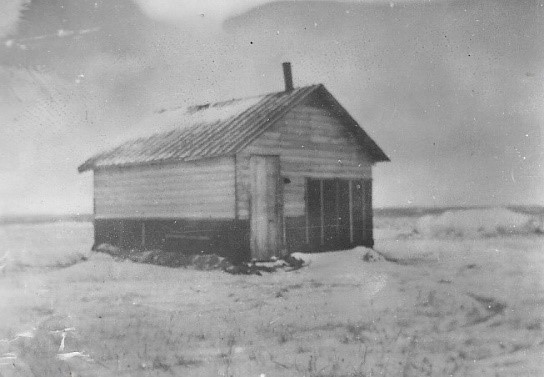
Walter Green, March 21 1909 — I was looking at that picture of Gordon on the stabble that looks like it did two years ago. I hope the snow will not stay on so long. [Background to the photo — Gordon was standing on the stable roof because the snow was so high. See this comment from January 1909 — “The big red steer, with the help of a snow drift about this steep ⁄ [she draws an angle] surveyed the surrounding country from the top of the new stable today. He walked all over the cow and horse stables and at last Gordon had to get up and shove him off to make him come down.”]
“Did you take that order for Wm Rockwood I suppose he will send me one of his place,” asked Walter in February 1908. Their friend Billy Rockwood wanted Raye to take some snapshots. Raye and her friend Christina Martin went up to Billy’s. “He made us very welcome and we stayed for dinner. He gave us the best he had, opened two cans of fruit, we tried to eat all of both but had to leave a little. I took pictures of his shack, his stable, and himself and I think they will all turn out pretty well.” (February 26 1908) A week later, “I printed quite a few postcards last night…some of Billy’s shack and stable. He has ordered some more.” (March 1 1908) Later, Walter wrote on March 29 1908 “Billy sent me the picture of his shack. I showed it to some of the boys and told them that he would soon marry the girl standing beside him.” [a joke! They thought Billy was a fool]
In January 1909, Raye took photos of her uncle Charlie Delong and his “shack-mate”, the Anglican minister, Mr Davis. “I had supper the last night at Uncle Charlie’s and Mr Davis’ shack. I made their bed for them and I guess Mr Davis and I looked pretty nice washing the dishes together. I also took a picture of the interior of the shack.” (January 2 1909) “I have orders for two half dozens of Mr Davis and Uncle Charlie when I get some more films I am to go up and take the interior and exterior of the Adanac English Church.” (February 16 1909) Raye sent photos to Walter: “I am enclosing five postcards, the remainder of the dozen for which I was paid… I took a picture of the interior and exterior of the English Church at Adanac, and Harry, Arthur and Gordon in their hockey togs.” (February 23 1909)
Walter replied on March 4 1909 “…many thanks for the pictures. I let the men in the office look at them…they think they are fine. I was looking again at the pictures you sent before the last lot. I sent one of Mr Davis home [to his family in the East]. I think thats as good of him as it could be.” Raye sent a photo of Uncle Charlie and Mr Davis’ shack to her friend, Margaret Muxlow in North Battleford, Saskatchewan, who replied on April 2 1909 “I think that is a fine picture of your Uncle and the minister. They certainly have a model Batchelors Hall. A model is a small imitation of the real thing ha! ha! ” [The Bachelor Halls were residences for single homesteaders]
In Minnesota, fellow Saskatchewan homesteader Peter Cain ordered some photos via Walter. He wanted quite a variety: “I will name some that you can send – the Kill Squaw Rangers, Scott, the Steel laying machine, thresher, Rockwoods shack, Davis house. you can make up the rest he wants them to hang in the shack you can put them on post cards if you got them and if not eney way will do.” (Walter Green, January 24 1909)
The Martin’s Ruins
Did you take a picture of Martins ruins yet dont forget to send me one.
Walter Green, February 9 1908
I will send you a picture of Martins’ house next week I think as I am going to finish some this week.
Raye Thompson, February 17 1908
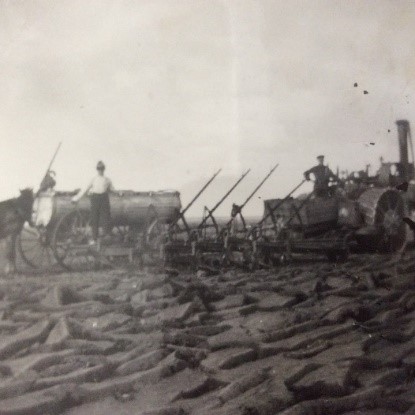
One set of photos were not of shacks on homesteads, but rather their ruins — On New Years Day 1908, Bob, Jack, Jeanie and Christina Martin lost their sod house to fire.
Raye Thompson, January 2 1908 — The Martins came home from the dance New Year’s morning, Hans and Billy Dempster were with the two girls and they stayed for breakfast. They were preparing to go home when a spark fell from above onto Jack’s knee and he rushed outside and saw the roof on fire. He yelled to the others and by that time there were a few flames inside….We do not think we can attribute their accident to their carelessness as the pipe was well protected from the hay and sods of the roof. There must have been a spark came from the pipe outside and lit in the roof, they think it must have been smoldering all night while they were away as there was a large portion of the sods burned all around the pipe before the fire broke through.
Jack Martin’s later memories in Grassland and Grainland — …we started to take stuff out, the piano first when we got to the door, we could not get it out as the door was too small. It being a sod house, we pushed and dragged until we knocked the door frame out…we lost the seventeen boxes of effects brought from Scotland. And we also lost our dog, Tiny, who always slept under the bed…
Raye Thompson, January 2 1908 — There is going to be a subscription taken up, not to give them money, but to buy them some furniture, clothes, etc. because they have only what is on their backs and some of them badly scorched. They say they would rather have their mother and father’s photographs than anything else, but they are gone too. [Mr. and Mrs. Martin were both dead, Mrs. Martin died just after arriving in Canada]
In the Photo “bis”
I expect to get about $1.25 out of [Billy] and 50 cents or so out of Martins. That will help me buy my photographic supplies.
Raye Thompson, March 1 1908
Raye was charging money for her snapshots, often for the homesteaders Walter was working with in the logging camps. “…Peter Cain [a fellow homesteader] is working here and wants a few snapshots if you will finish up sum I will send you $1.00* thats all the paper money we can find – we have a lot of silver I cant put that in a letter.” (Walter Green, January 24 1909) Raye replied, “I was very glad to get that $1.00. Things like that always come in handy here.” (February 9 1909)
Raye wasn’t a fan of Clara Shephard (who was a figure of fun amongst the girls) but she was happy to take her photograph for money. “On Monday afternoon I walked over to Shephard’s and spent the afternoon with Clara, she was there alone. I took a couple of pictures of her, one painting and one playing the organ. If you would like some I will send you a couple when they are finished. I am going to make $1.25 out of her anyway.” (Raye Thompson, March 3 1909) Raye sent the photograph down to Minnesota, where it ended up on Peter Cain’s shack wall! Walter replied, “If you will send me Clara’s picture I’ll give it to Cain in place of the one I am taking.”
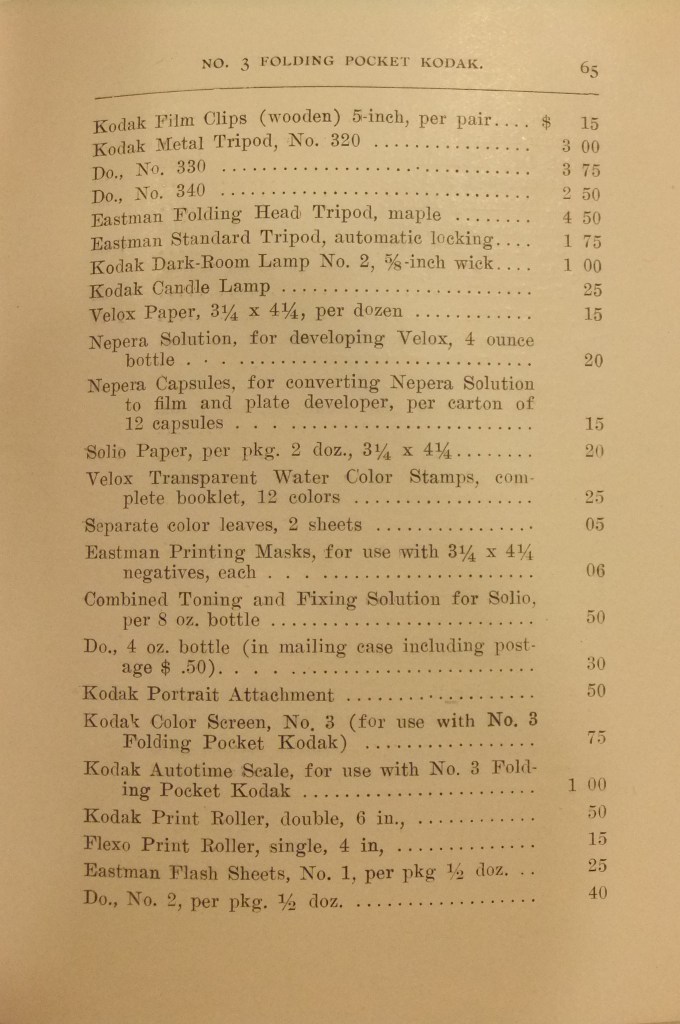
Raye used the money she made from selling photographs to buy more supplies. Here’s how much camera supplies cost at the time – from the Canadian Kodak Co. list of 1912 (so probably a little bit cheaper circa 1908-09)
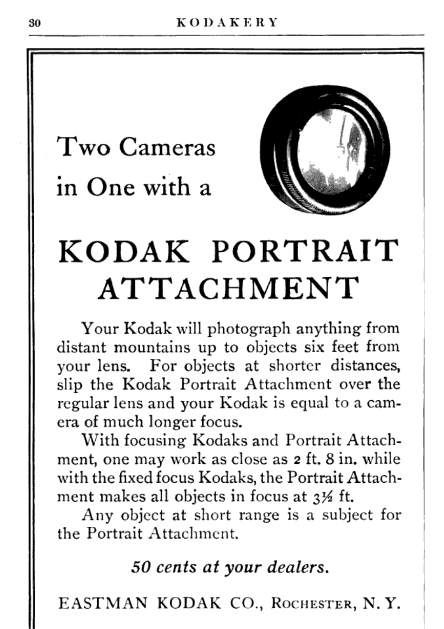
Jack Delong, Raye’s cousin and friend in Strathcona Alberta, was also in the photography business. “P.S. Thanks very much for pictures. I have rather gone out of the bis myself.” (February 26 1909) But a couple weeks later, Jack was back in “bis”. “I got some more working materials for my Kodac so you see I am going to do some more pictures if I can find time. I am going to purchase a portrait attachment to day to see what I can do in that line of pictures. I have an order now for few pictures I was going to have taken yesterday but the parties were not ready when I called so I came home without taking them but I arranged to have them taken next Sunday.” (March 15 1909)
Raye’ sister Gertie McKerroll also got in the “bis” — she made picture frames to sell for Christmas presents. On November 27 1910 “…after supper Bert McRoberts came in…He bought a couple of photo frames from Gertie” On December 10 1910, Raye and Gertie went to a local town “…reached Scott about 1 pm. … Gertie took most of her Xmas things down to Mrs Aked to sell.” After Christmas, Gertie went back to get paid. “Gertie waited until the coldest day had come and then made the boys bring her over here to go on the train to Scott to square up with Mrs Aked over her Xmas fancy work. Gordon says “she is the limit!” (January 12 1911)
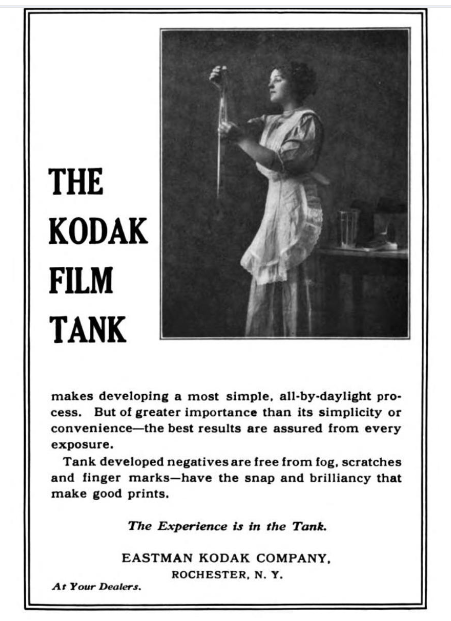
To put Raye’s activities in context, Kodak was keen to get young women involved in photography. Many advertisements featured young women developing photos, like this one from 1912. At the same time Raye was making her snapshots, another prairie girl was taking photographs (for much more profit). Annie Rutley (the same age as Raye) lived a little bit north in Cutknife, Saskatchewan. As a girl, she was an invalid. “Since I was unable to attend school or do much work Father and Mother encouraged me to take up photography as a hobby. There were no photographers here at the time, so I took photos of friends and relatives as far north as Maidstone, where my sister lived at the time. I made enough money to buy a table and chairs, and a twenty-two piece set of cut glass and other things for my hope chest.” (Annie Rutley Martin, Grassland to Grainland. Note – Annie married Raye’s friend Jack Martin)
The Wedding March
I had taken a couple of snapshots of the bridal party, if they turn out well, will send you some.
Raye Thompson, November 19 1910
In November 1910, Raye was bridesmaid at her friend Marion Lockerbie’s wedding – the social event of the season! (Her letters contain a soap opera-ish account of all the drama) Raye took photos of the wedding, but didn’t mention of sending any photos, so perhaps they didn’t turn out well?
In Spring 1911, Geils Muxlow, the sister of Raye’s friend Margaret, got married near Wilkie, Saskatchewan. Raye attended and played the “Wedding March”. The Muxlows got their prints developed at a local drug store: “Margaret and I got some of the wedding snapshots developed at Warburtons, hers are better than mine so I am going to buy some from her. She gave him eleven rolls to develop, at once, there will be some pictures there.” (May 2 1911) Later Raye wrote: “I was down visiting Margaret…M. and I sorted over all those snapshots last night. No doubt you will see the ones she sent to Mother or Gordon, they are all good.” (May 16 1911)
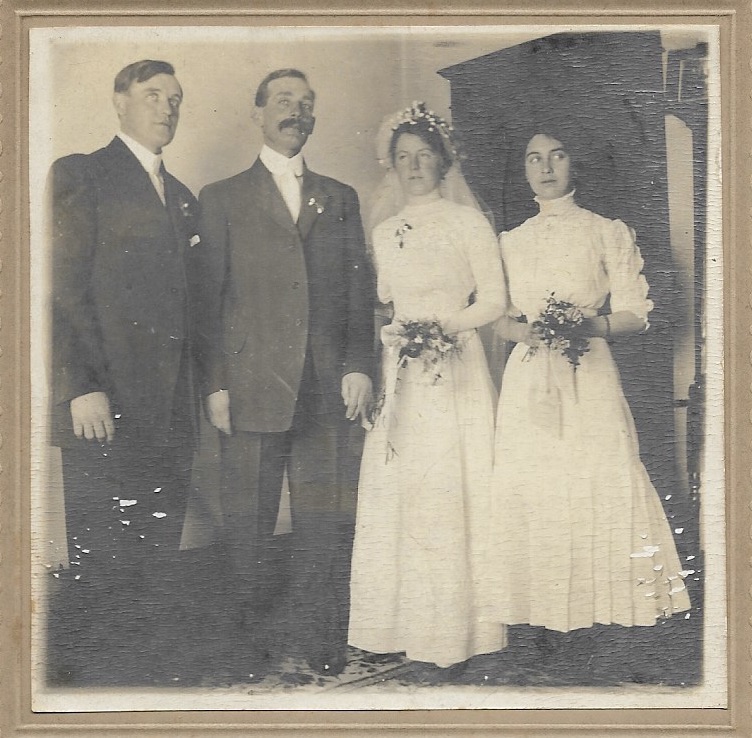
Raye and Walter’s wedding photo was not that “good”. On January 2 1912, after four years of courtship, Raye married Walter. Here’s an amateur snapshot. The photographer was clearly not as skilled as Raye, and held the camera at the wrong angle (too low). Raye does not look thrilled. Brother Gordon and cousin Lizzie look like they wish they were somewhere else!
Family Photos
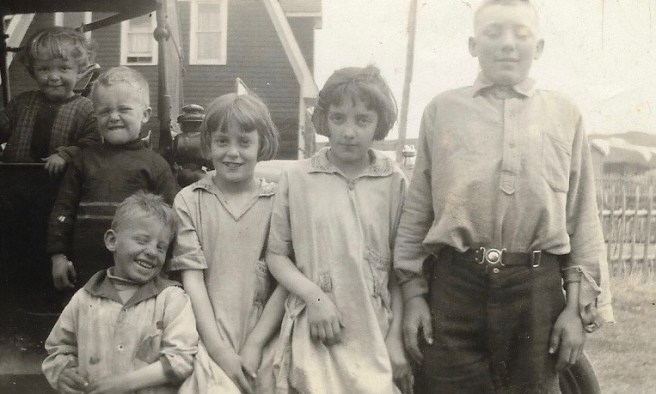
The following years were eventful. Raye and Walter’s crops failed, they lost the farm, moved into Unity, Saskatchewan. Raye’s brother Gordon left Saskatchewan for a more successful life in the U.S., and Raye’s parents left for a few years to become “truck gardeners” in California. “We begged them to let us come”, Raye recalled. But after a couple of years, John and Maggie Thompson returned to the Prairies. Raye and Walter found a home in Cando, Saskatchewan, where they raised seven children. Walter took a job as a travelling salesman for health care products, in the poorest and most unprofitable district. The family relied on neighbours and church donations to get through the Depression years. In 1943, Raye’s sons, now stationed with the Royal Canadian Air Force at Jericho Beach in Vancouver, encouraged the Greens to come West. They sold off their mattresses and left the Prairies.
Raye kept all of her snapshots and letters from the Prairie Pioneer years, and later wrote up her memories of the Unity and Adanac area, published in Grassland to Grainland (Historical Seven Book Committee, Unity, Saskatchewan, 1985). Raye died in 1989, at 99 years old. Raye and Walter’s headstone at Vancouver’s Mountain View Cemetery has a carved image of a covered prairie wagon, as a memento to their prairie years.
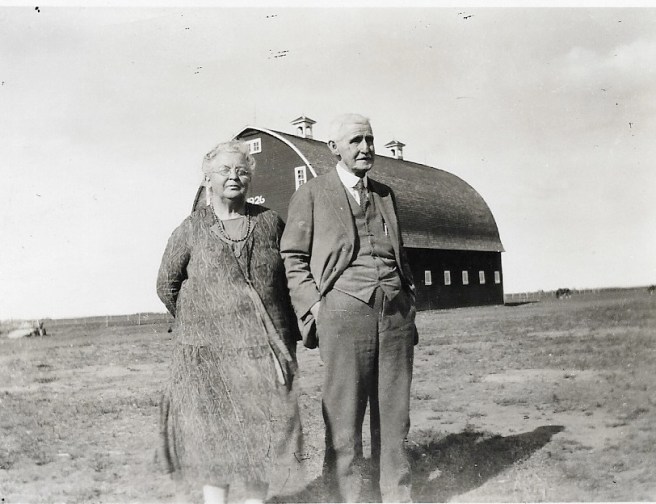
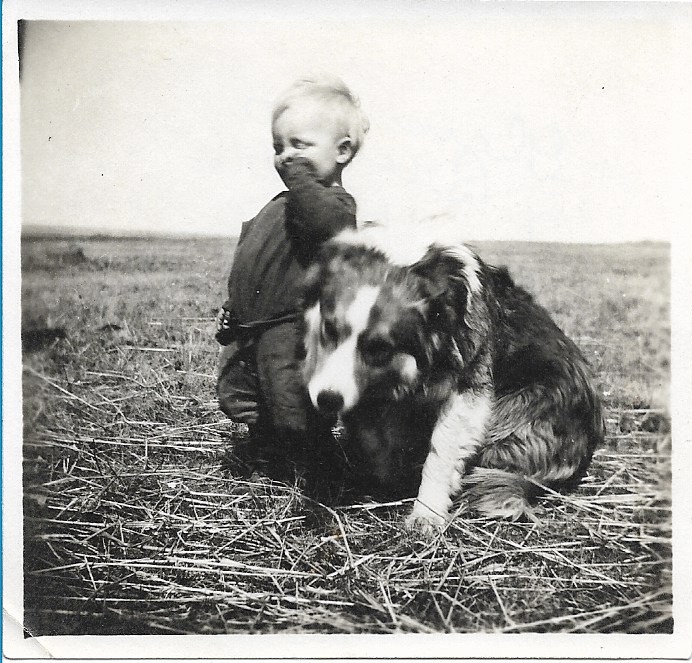
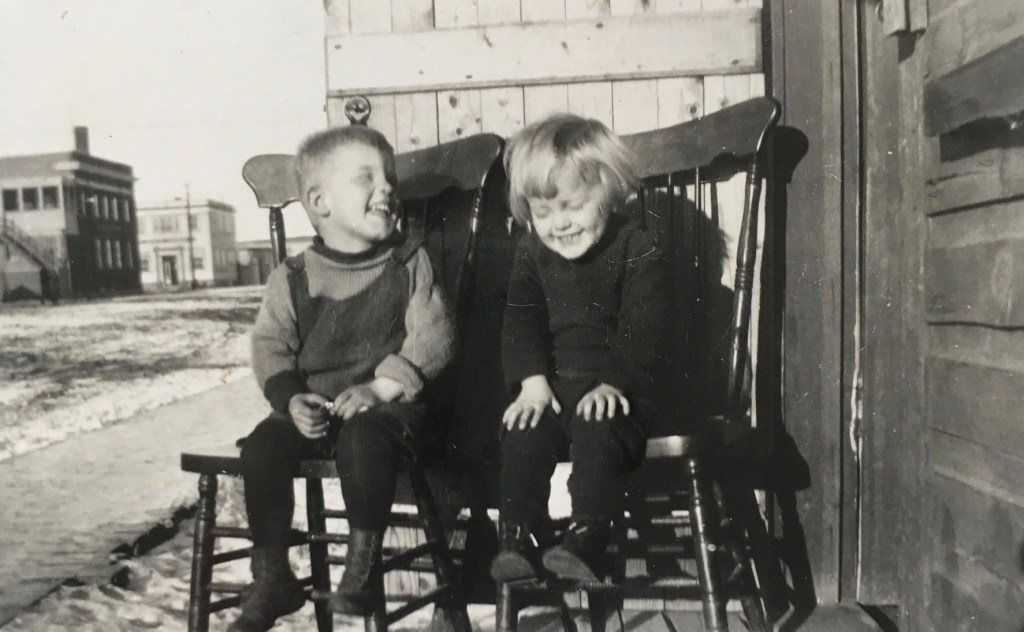
Images from the Kodak manuals come from the Annie Girling collection in Saanich Archives. Annie Girling was a talented amateur photographer in rural Saanich at the same time Raye Thompson was taking photographs on the Prairies. Annie Girling’s photography can be seen on the Saanich Archives website.
Thank you to Raye’s family for sharing Raye’s photographs and letters. Read more about Raye’s letters and memoirs in Editing Raye Green’s Writing
 Stephanie Ann Warner