Now showing, a four-reel melodrama of adversity against all odds…
Victoria B.C., Fall 1918, the fourth year of the Great War...
On the Western Front, Allied troops are fighting to the finish. On the Home Front, Victorians are going to the theatre. Far from the trenches, it’s a world of high-class vaudeville, stage plays and photo plays replete with numerous thrills. Our heroes and heroines are exquisitely costumed trapeze artists, capricious and lovable tenement girls, Rocky Mountain cowboys and German spies. The exploits of the troops match those of Charlie Chaplin, Douglas Fairbanks, Mary Pickford and Baby Marie Osborne, whose adventures appear daily from 1 o’clock – 11 o’clock p.m. on Victoria screens. A widowed mother, Mrs M, waiting for a son to return, escapes from daily chores to the moving picture shows. Two plucky young girls, Ethel and Edith, work as theatre ushers to help support the family while Dad is somewhere in France.
Suddenly, in the face of an epidemic of world-wide proportions, the theatres go dark. What will happen?
At the Playhouses

In Fall 1918, there were several theatres and “places of amusement” in downtown Victoria, a mix of cozy (small) early 1900s former vaudeville theatres and modern glamorous picture palaces. Almost all the theatres were showing the “movies”. Fire insurance plans surveyed in 1911, updated in 1913, show all the “moving picture houses” that were in Victoria in Fall 1918 (though some under different names). So this shows a well-established motion picture business in Victoria – had been popular with the public in the early 1910s.
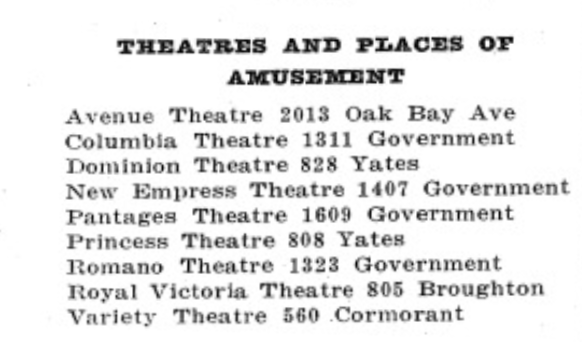
The Royal Victoria Theatre (still standing today as the Royal Theatre) was considered “the” theatre of the city. “The Royal Victoria is a theatre of which Victorians are justly proud. From an architectural viewpoint, its structural plan is splendid, while its artistic interior design and the harmonious furnishings are equal to those in any other city on the Coast. Its facilities for the proper presentation of legitimate dramatic offerings have won encomiums from distinguished actors and theatre folk who have appeared here.” (The Daily Colonist November 24 1918) The Royal Theatre had 1558 seats, a full orchestra pit and an ornate interior composed of marble, blue brocade wall panels and murals and frescoes (Read more about the interior on the Royal Theatre website)
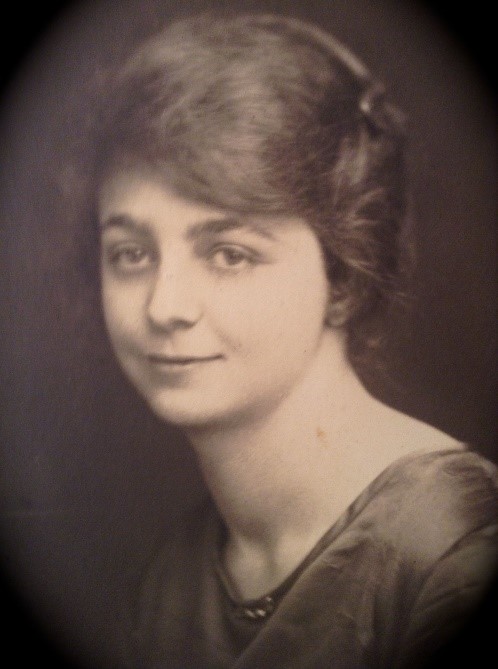
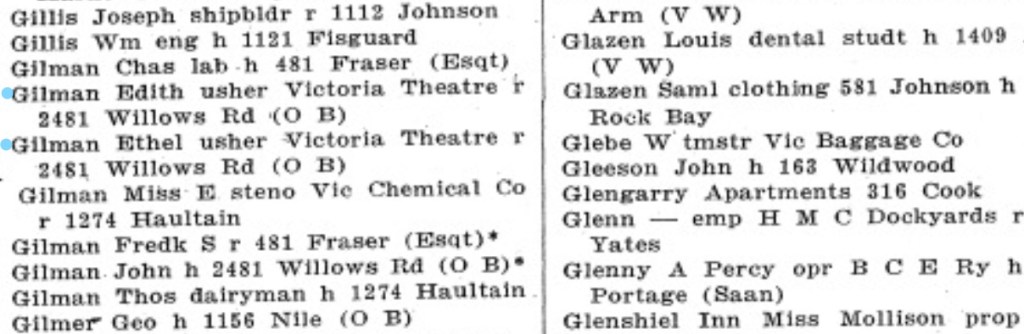
A pretty nice place to work? In 1918, my great-grandma and her sister Ethel (17) and Edith (15) Gilman were ushers at the Royal Victoria Theatre. While the theatre had opened with “legitimate” drama, by 1918 it was showing movies.
The Royal Victoria’s “rival” in terms of size and sumptuousness was the Pantages Theatre (now the McPherson Playhouse). The Pantages Theatre, opened in May 1914, was purpose-built for the “illegitimate” vaudeville performances as part of the Alexander Pantages’ vaudeville circuit. The theatre had a fabulous Baroque Revival interior and was completely fire-proof – a fire curtain between stage and screen was painted with a view of Shawnigan Lake, a then-popular tourist destination. The theatre had 1000 seats, 450 below and 550 in the balcony.
“The aisles are wide, the seats are large and well upholstered, and there is roominess between the rows that will commend itself to all patrons who have ever, anywhere, had to sit with their knees jammed up against the back of the seat in front.” (Victoria Daily Times May 19 1914).
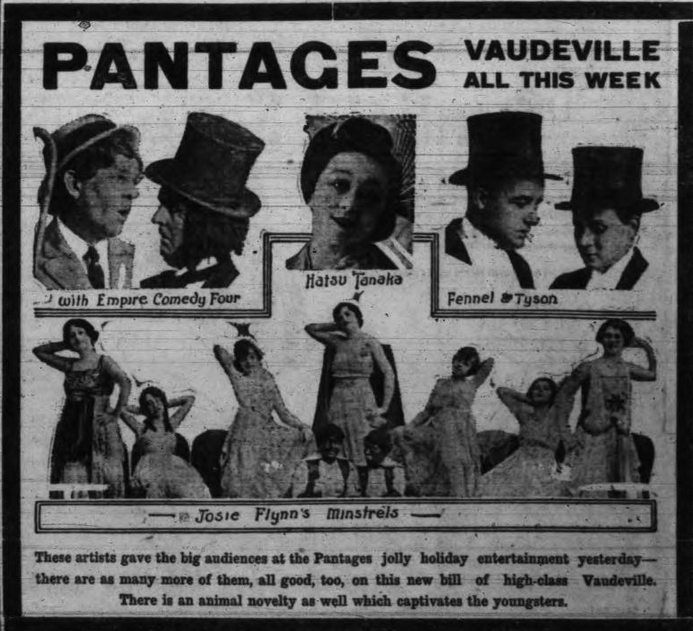
On Labour Day Weekend 1918, the Pantages was showing jolly holiday entertainment with headliners Josie Flynn and her Minstrels in “a revue of songs, dances and comedy, combining beauty with talent.”
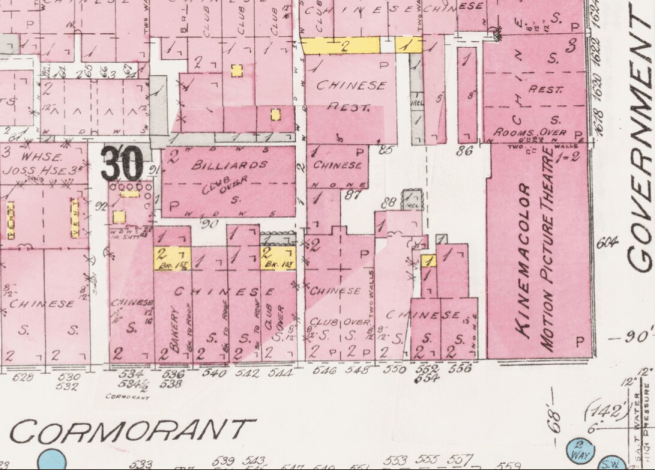
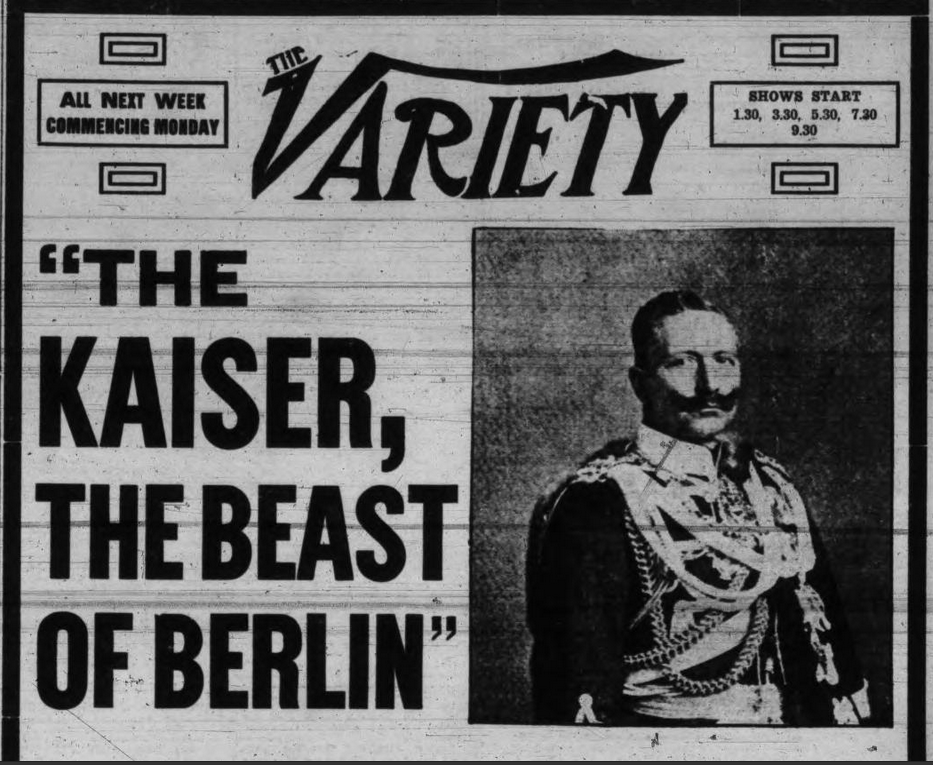
Across the street from the Pantages was the Variety Theatre, originally the Kinemacolor Motion Picture Theatre (pictured on fire insurance maps in 1913). The Daily Colonist November 15 1913 reported: “This luxurious picture theatre will open under entirely new management with two acts of up-to-date vaudeville and four reels of first-run motion pictures.” The Variety was the “Home of Paramount Pictures”. In September 1918 the Variety drew crowded houses for “The Kaiser, the Beast of Berlin”.
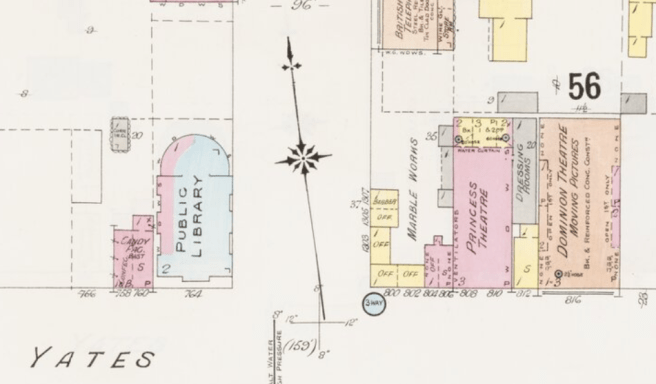
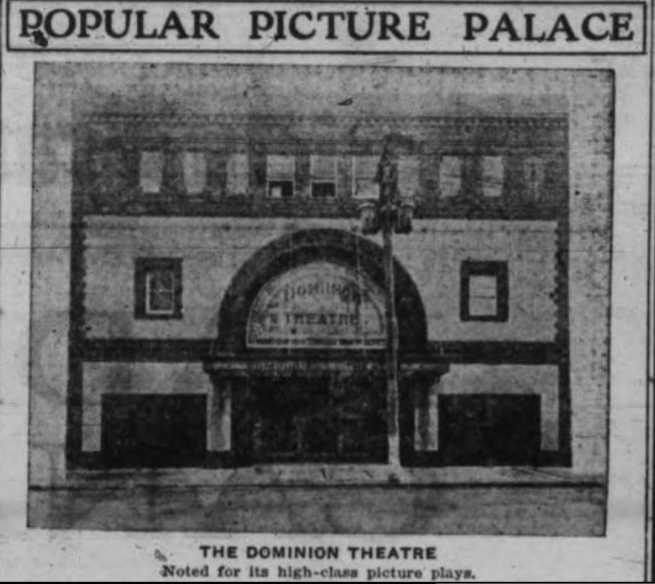
Up on Yates Street was the “Dominion De Lux” Theatre, purpose-built in 1913 as a movie theatre. The Victoria Daily Times May 16 1913 describes the sumptuous surroundings: The floors and aisles (made of “fireproof” concrete) were covered with rich regal blue Wilton carpeting. The upholstering of the (960) seats was in old rose velvet, in the walls the prevailing tones was sepia. The walls were panelled with a landscape view. There was dull gold in the capitals of the columns and ornaments in the friezes running around the walls…“the whole color effect is most artistic.” A couple of other features of note at the Dominion — Karn-Morris organ and an “innovation,” a ladies rest room with tables and facilities for writing.
The Dominion was “noted for its high-class picture plays” (the terms “photo plays” and “picture plays” seem to be used at this time to denote more dramatic, artistic type of shows, sometimes adapted from stage plays).
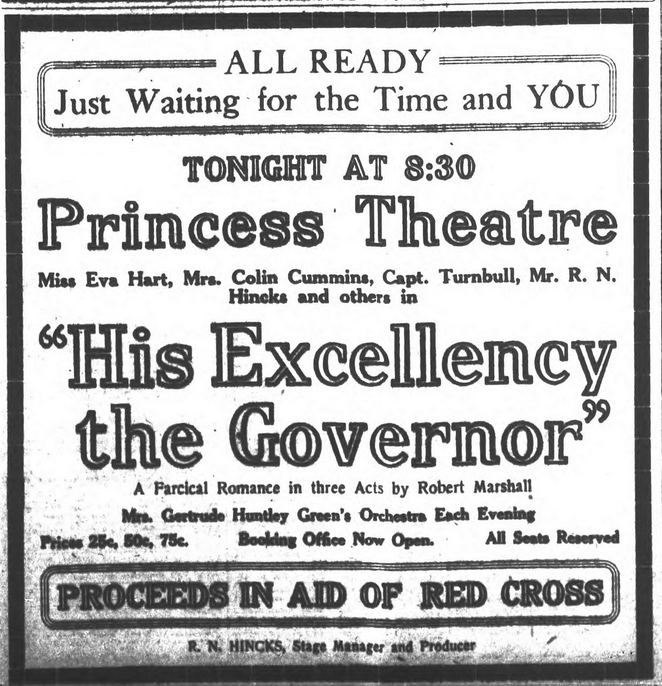
Next door on Yates Street was the Princess Theatre, “a cosy family theatre” created from the turn-of-the century A.O.U.W. Hall. The Ancient Order of United Workmen (A.O.U.W.) was a fraternal organization providing social and financial support to its “brothers” (My grandfather’s family were members and often acted on the A.O.U.W. Hall’s stage in early 1900s amateur dramatic productions) During the War, the Princess Theatre was used for patriotic fundraising shows. In September 1918, the popular R.N. Hincks and the Red Cross Players, “a galaxy of talented artists,” performed the farcical romance in three acts, “His Excellency the Governor.” They were accompanied by Mrs. Gertrude Huntly Green and her splendid orchestra.
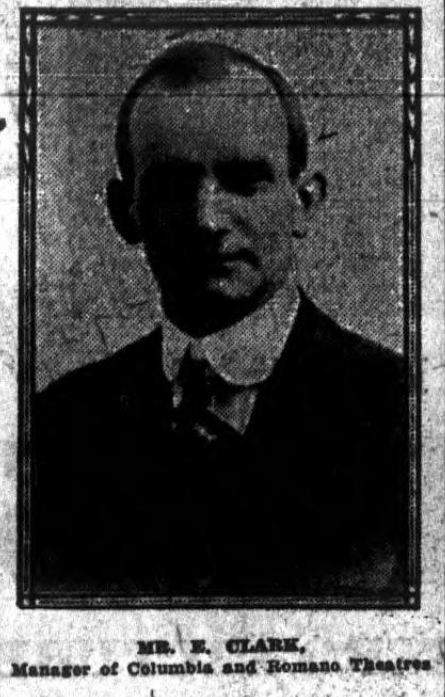
The “cosiest” (a.k.a. smallest) movie theatres were the Columbia and Romano Theatres on Government Street, managed by Eugene Clarke. The Columbia Theatre building appears to have had several earlier 1900s incarnations at the Grand Theatre and the Empress. When it opened as the Columbia in December 1914, the theatre was showing vaudeville but by March 1915, “Charlie Chaplin was drawing big crowds” as the theatre mixed singing acts and films. By 1918, the Columbia showed movies: “almost exclusively Vitagraph, Metro and Jewel productions.”
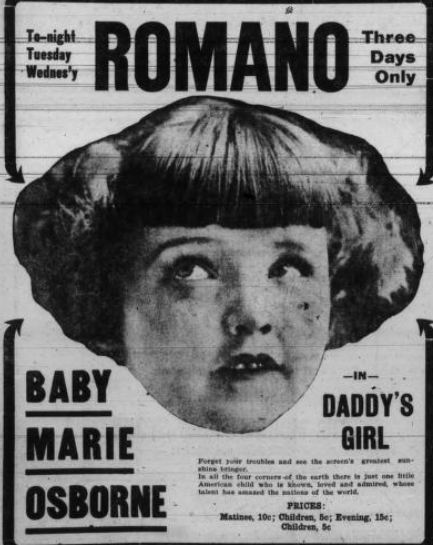
The Romano Theatre, “Victoria’s Family Theatre”, opened in June 1909 had a specially-designed Italian style frontage, a special upstairs gallery and “up to date seating”. In 1918, the Romano was described as “a cosy little theatre and enjoys regular patronage of film fans, to whom its features are most attractive.” (The Daily Colonist April 21 1918) In September 1918, the Romano was showing the screen’s greatest sunshine bringer, “Baby Marie Osborne”.
How did the playhouses advertise the shows?
The Victoria daily newspapers carried regular features on the latest shows. The pages were filled with advertisements for movies and vivid descriptions of the movies’ plots. The placement of advertising in the entertainment section also gives us some ideas about who was going to shows.
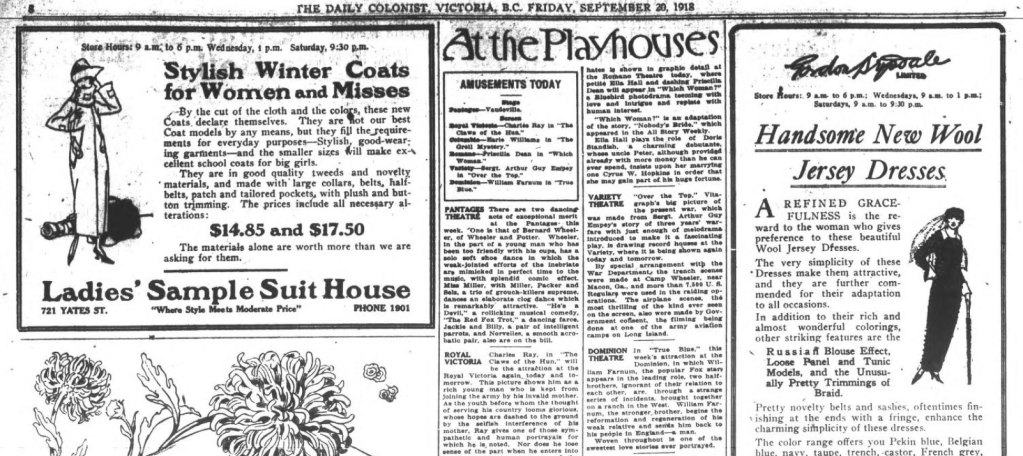
The Daily Colonist, a Tuesday – Sunday morning paper, had a section called “At the Playhouses”. Here is September 20 1918, nestled amongst ads for stylish coats and handsome new wool jersey dresses, suggesting the main newspaper readers (and movie goers) were women with leisure and disposable income.
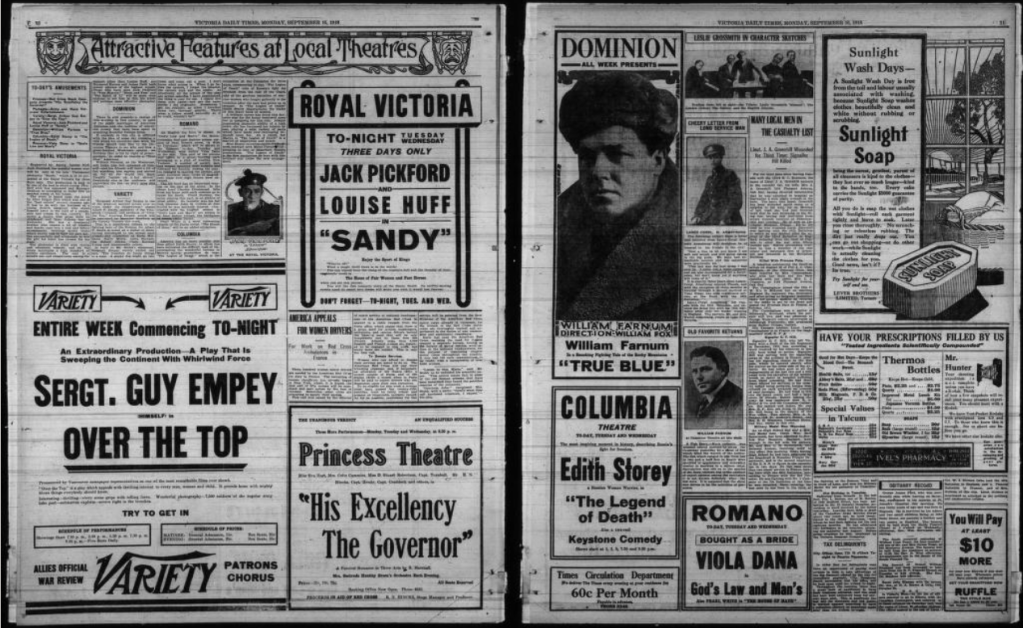
The Victoria Daily Times, published every afternoon (except Sunday), showcased “Attractive Features at Local Theatres”. The Times was a more “popular” paper with a focus on human interest stories, entertainment and has larger picture advertisements for films. Note the front page of the Times with heading box “Where to go to-night”

See this double page in the Times from September 16 1918. It’s a totally different look for the same shows featured in The Daily Colonist but the usually florid descriptions were the same as they came from the movie companies. Notice also the advertisement “A Sunlight Wash Day is free from the toil and labour usually associated with washing….” suggesting the potential audience were using the movies as escapes from reality) Given the amount of space offered to the movies, it’s probable that the Times readers made a large number of the Victoria audiences (and was a good money maker, advertising-wise for the newspapers).
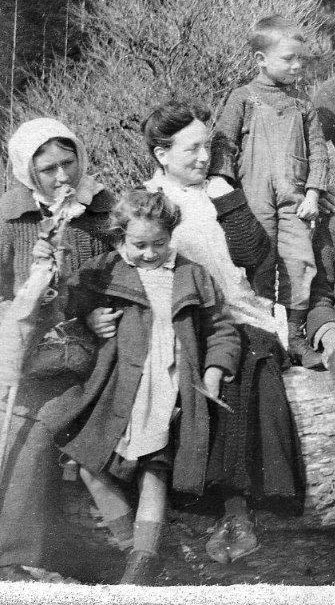
Meet the audience, The Malon Family
Let’s meet our “audience”, a middle-aged, middle-income mother of two school-aged children. In August 1918, Mrs. Helen Malon and children Yvonne (12) and Pierre (11) moved to 68 Burnside Road in Saanich, an easy walk or streetcar ride into the city’s many theatres. Mrs. Malon kept a diary of events from her daily life – cooking, cleaning, shopping and going to “shows.” (As adults, Pierre and Yvonne Malon were friends with my grandparents. Mrs. Malon’s diary has been shared Pierre’s daughter Joan Nicholson.)
Mrs. Malon’s diaries start in 1912 when she and the “babies” [Yvonne barely 6 and Pierre nearly 5] were about to move to Canada. On June 13 1912, the day before they sailed from Liverpool, the Malons went shopping, “then we went to the “cinema” show, much to the joy of the babies. We were very glad to sit down and rest and rather enjoyed some of the pictures. Yvonne made a running commentary of questions, much to the amusement of people round as some of the pictures were rather “broad”, they were hard to answer sometimes!”
Later, Mrs. Malon’s diaries give us an opportunity to explore what was showing in Victoria in the WWI era. Here are a couple of notable entries that specifically mention the names of shows.
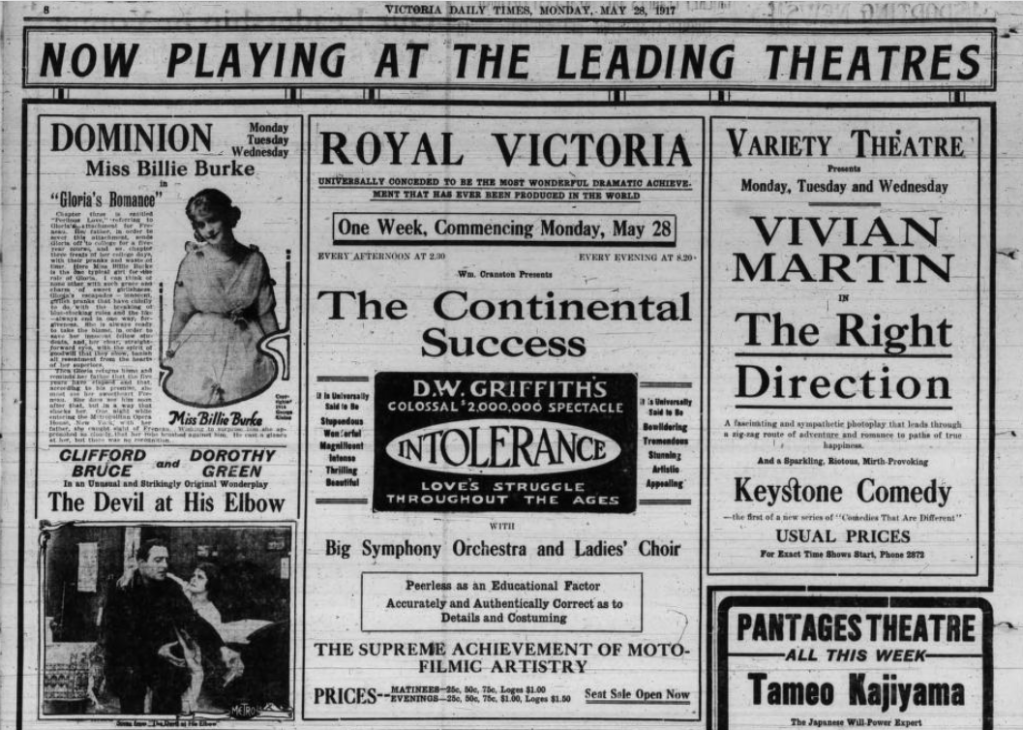
June 2 1917 – In the evening Mrs. Warren and I went to the theatre to see “Intolerance”. Got back very late. (Advertisements in the local Victoria papers show that “Intolerance”, D.W. Griffith’s “Colossal Spectacle”, was showing at the Royal Victoria Theatre “All this week” twice daily at 2.30 and 8.15 with big symphonic orchestra and ladies’ choir.)
February 26 1918 – Went to see the doctor and then saw “Aladdin”. The Dominion Theatre was showing the wonderful photodramatic production of “Aladdin and the Wonderful Lamp” — “It would appear that magic was used in making this picture. The opening scene, displaying the city of Baghdad at sunset, is beautiful in itself. Men are seen praying and salaaming with their faces towards Mecca….(The Daily Colonist February 26 1918)
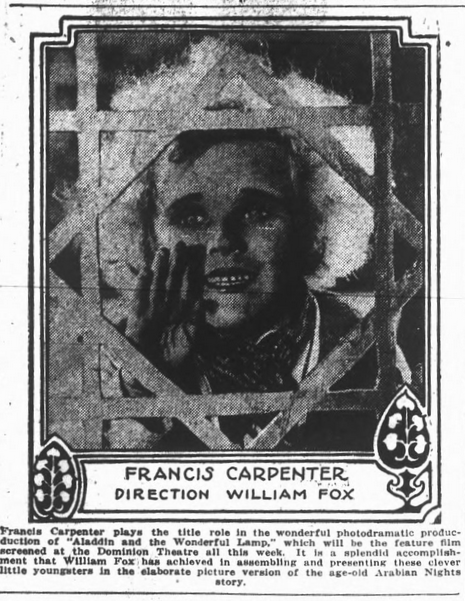
What was showing in Victoria in the weeks leading up to the “Flu”? Mrs. Malon mentions two incidents of going to “shows”. Note – She doesn’t always give the name of the show or the theatre, so we have to guess what might be attractive to children.
Tuesday September 10 1918- Fog early and chilly, turning hot later. Went down town in the morning. In the afternoon went to a picture show.
They may have been to the Variety Theatre to see “Twenty Thousand Leagues Under the Sea”. It was very popular in Victoria. On opening night (Monday September 9 1918), “every available seat was taken long before 8 o’clock and a large crowd waited patiently in the theatre lobby to gain admittance”. (The Daily Colonist September 10 1918.) “There is a terrifying combat fathoms deep, between Captain Nemo and a giant octopus crushing a pearl diver in its monster tentacles; positively the most thrilling spectacle ever photographed.” (The Daily Colonist September 8 1918) “While the submarine features are the ones which will create the most widespread interest, they are epoch-making in the realm of public entertainment, this celluloid drama will attract many for its beauty of sky and landscape.” (The Daily Colonist September 10 1918)
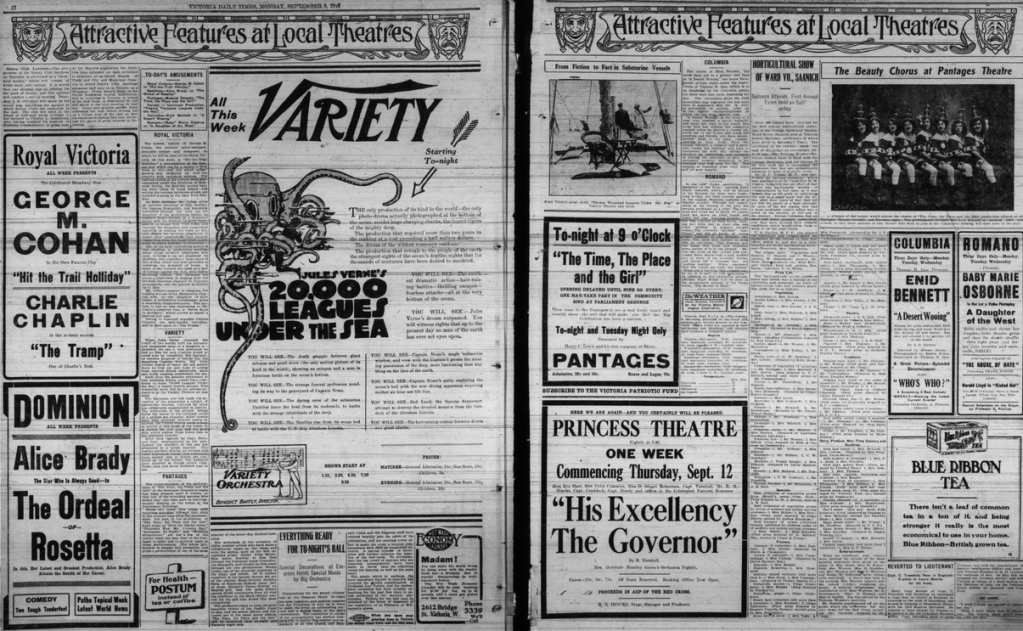
Friday September 20 1918- Went down town in the morning. Also in the afternoon. Took children to see Dr. Raynor and to a picture show afterwards.
The Malon family may have gone to the Dominion Theatre, where William Farnum (“a popular Fox Star”) was starring in “True Blue”, “A Smashing Fighting Tale of the Rocky Mountains” where “two half brothers, ignorant of their relation to each other, are, through a strange series of incidents, brought together on a ranch in the West.”
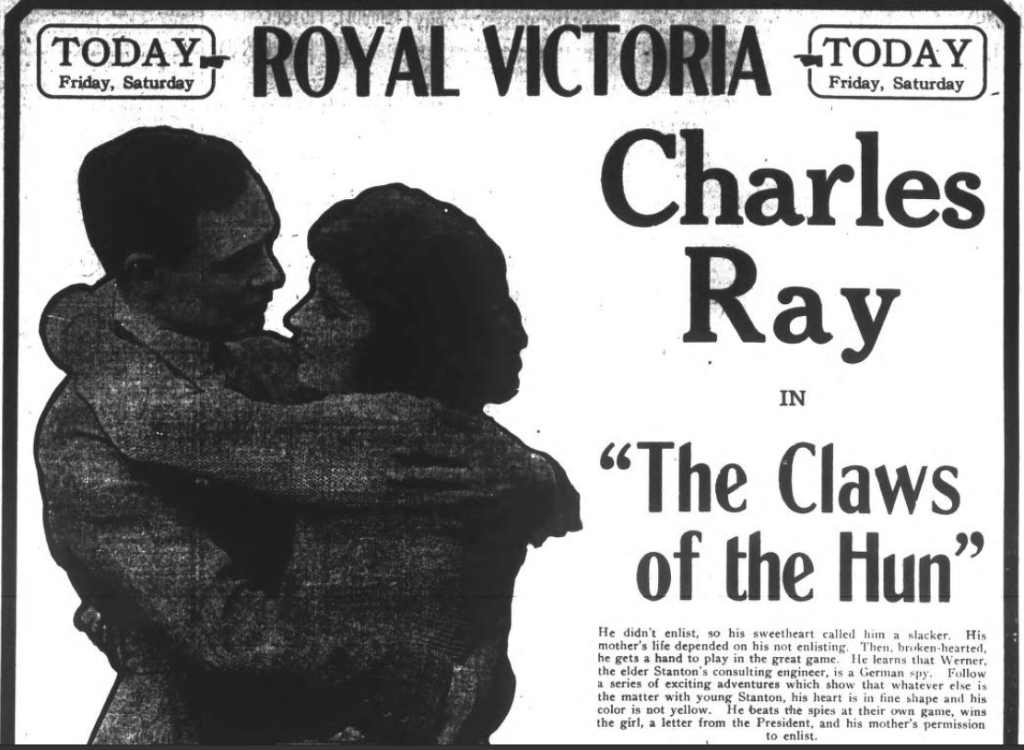
Or maybe they went to Royal Victoria Theatre to see “The Claws of the Hun”, “A Series of Exciting Adventures which show how German Spies are Beat at Their Own Game” — Charles Ray plays a rich young man who is kept from joining the army by his invalid mother. “Then, broken-hearted, he gets a hand to play in the great game” when he learns about a German spy. “He beats the spies at their own game, wins the girl, a letter from the President and his mother’s permission to enlist.”
The Theatres Go Dark
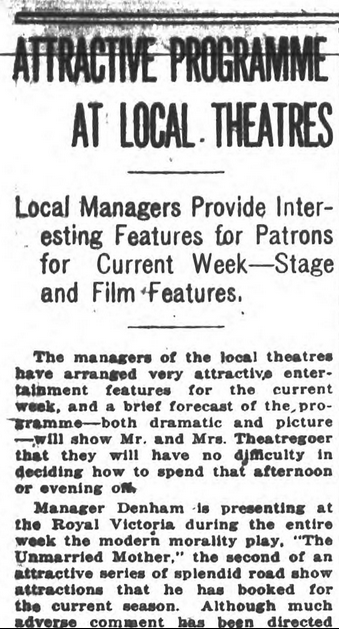
On Sunday October 6 1918, The Daily Colonist predicted that “Mr. and Mrs. Theatregoer would have no difficulty deciding how to spend an afternoon or evening off in the coming week.” (Ironically, they were right, in a way they didn’t expect!)
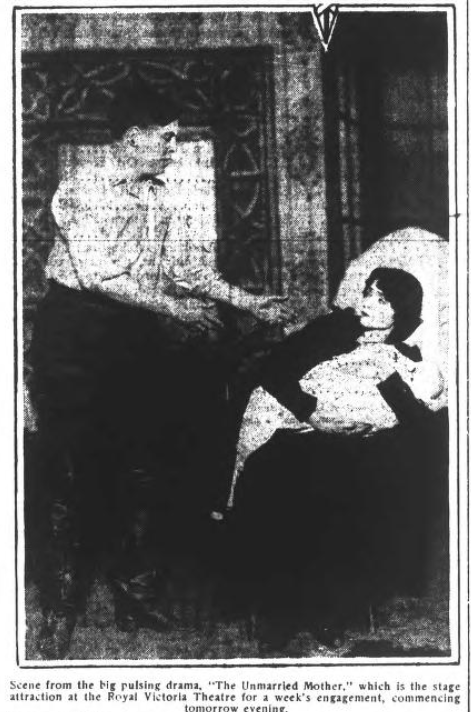
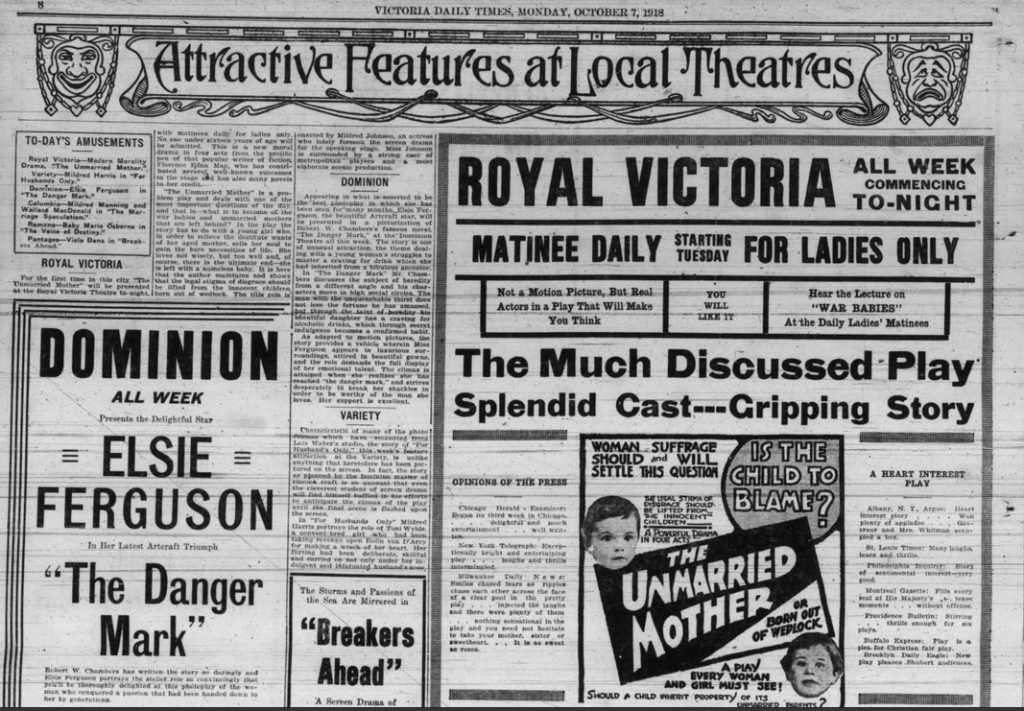
On the stage of the Royal Victoria Theatre was the modern morality play, “The Unmarried Mother” which dealt with “one of the important questions of the day – what is to become of the war babies and unmarried mothers that are left behind? The author Florence Edna May maintains and shows that the legal stigma of disgrace should be lifted from the innocent children born out of wedlock. No one under sixteen years of age will be admitted” (Victoria Daily Times October 7 1918). As my great-grandma Ethel Gilman was about to turn seventeen, she may have been allowed to usher, but her younger sister Edith would certainly not have been allowed! The play was the second of a series of splendid road show attractions that Royal Victoria Theatre manager Cliff Denham had booked for the current season.
On the silver screen there was less weighty but equally dramatic fare. At the Columbia Theatre, Manager Eugene Clarke showing Mildred Manning and Wallace MacDonald in “The Marriage Speculation” and the second episode of the Greater Vitagraph serial “Vengeance and the Woman”, while on the Romano Screen, he was showing Baby Marie Osborne in “The Voice of Destiny”.
Up at the Dominion Theatre was the Paramount picture “The Danger Mark” featuring beautiful Elsie Ferguson in the leading role of a wealthy young society women who overcomes by supreme willpower the desire for intoxicants. “Woven throughout the theme is a delightful love story, the development of which is replete with numerous thrills.”
For something a little less thrilling, the Pantages was presenting Viola Dana in “Breakers Ahead”, a charming story of the sea and seafaring people. “This picture will have a strong appeal to persons familiar with sea life, who will be greatly pleased with the picturesque scenes.”
At the Variety Theatre was the big Jewel production de luxe “For Husbands Only”. “Contrary to its title it is not a sex play nor one restricted to men only, but is one for the whole family, young and old, all of whom will be delighted by its fascinating and tantalizing story” (The story — Mildred Harris played the role of Toni Wylde, a convent-bred girl, who has been taking revenge upon Rolin Van Darcy for making a wreck of her heart) (Victoria Daily Times October 7 1918)
The “Flu Ban”
An attractive programme at local theatres had been planned, but on the morning of Tuesday October 8 1918, readers of The Daily Colonist learned that “As a precautionary measure against the spread of Spanish influenza which has swept through Canada and the United States during the past month, Victoria will take action today to close its schools, churches, theatres, pool-rooms, dance halls and public meeting places until such time as danger is considered past…It is practically certain that the closing order will take effect today in time to stop the opening of moving picture shows.” (City Will Act to Check Epidemic, The Daily Colonist October 8 1918)
At 10 o’clock that morning the Provincial Board of Health made a formal recommendation to the Government Executive that all communities in British Columbia be given the power to order the closing of theatres, churches and other similar places without definitely tracing contagion to the buildings in question. At noon a special meeting of the Provincial Cabinet was called “to consider the draft of regulations submitted by the Attorney-General, made necessary in view of the absence of requisite by-laws empowering the City Council to take this procedure.” (Victoria Daily Times October 8 1918)
The newspapers outlined the meaning of places of assembly and especially provided the lengthy “legalese” of the word “theatre”. The Victoria Daily Times October 8 1918 wrote: “For the general information of the public it should be noted that the word “theatre”, mentioned as a “place of assembly” includes the building, rooms and places where any play, concert, opera, circus, trick or juggling show, gymnastic or other exhibition, masquerade, public dance, drill, lecture, address or other public gathering is or may be held, performed, or takes place, and the approaches thereto, and the appurtenances thereof.” The Daily Colonist listed the same things but also clarified that it included “any moving picture theatre.”

What was it like in Downtown Victoria on the evening of Tuesday October 8 1918? “The city’s streets were practically deserted during the evening hours, and the few people that populated them drifted about aimlessly and somewhat peevishly. It was a case of “all dressed up and no place to go.” All was dark at theatre entrances, signs being posted conspicuously to the effect they were closed by order-in-council until further instructions.” (The Daily Colonist October 9 1918)
On Wednesday, October 9 1918, an advertisement appeared in the paper: “Persons who have bought tickets for “The Unmarried Mother” will be returned their money if they apply at the box office of the Royal Victoria today between 10 and 6 o’clock.”
With the stage dark, the live theatre performers were left idle. The Daily Colonist October 10 1918 commented: “Probably the most lonesome among the people who wandered aimlessly about the streets yesterday [October 9] were the theatrical folk. To them it was a realization of that stirring drama “Stranded”. Jack Claire and Victor Kahn had to be content with an admiring audience of hotel lobbyists. The Hills and the Tivoli girls, however, were entirely out of their element. There was no room for dancing, the streets were too slippery for trick cycling, and they were not in the mood for singing. Other members of the Pantages flock felt equally useless.”
How the epidemic affected the theatres
“Undoubtedly the outbreak will cause a very large economic loss and a regrettable mortality, but the medical experts state that if the people will take due precautions when they feel themselves affected, they can do much of minimizing the danger of the disease.”
The Daily Colonist October 5 1918
The Victoria Daily Times October 9 1918 observed, “That circumstance at present cannot be overcome, and the proprietor of the professional entertainment has necessarily to suffer together with the private citizen whose patronage he relies.” A few days later, the Victoria Daily Times reported: “To the average man in the street, who has been so fortunate as to escape the ravages of the epidemic, the term “Spanish grippe” has represented merely an unknown quantity responsible for curtailing much of his pleasures or at any rate such of his pleasure as lay in the direction of attendance at the picture theatre or the vaudeville show. To the management of these places of amusement, however, the epidemic synchronizes with a considerable loss of money, amounting to far more than is apparent to the casual observer. (How Epidemic has affected theatres, Victoria Daily Times October 14 1918)
A week after the “Flu Ban”, the Victoria Daily Times spoke with Manager Cliff Denham of the Royal Victoria Theatre. “The mandate prohibiting the holding of public gatherings came into effect of the second day of the booking of “The Unmarried Mother”. After only one performance the theatre was closed under the edict.” Since opening nights are notoriously never full (the public waits to see the reviews before booking a ticket), Manager Denham had not even been able to realize a “full house”. “Despite the edict, however, the management has to accept full responsibility for the expenses of the company while in the city, under the terms of the contract by which the shows are booked.” The ban also had the effect of cancelling four of the road shows with which Mr. Denham had planned to entertain the people of Victoria in the near future (and he couldn’t re-book because they were already committed to other cities).
There was another key problem facing the managers of the “moving picture houses”. The Daily Colonist October 15 1918 explains: “Theatre managements here are losing thousands of dollars as result of the closing-down orders. The moving picture houses have to accept full responsibility for the situation in that they must pay exhibitors for the use of the films, and whether or not they have ‘full houses’ the price is the same. Although they have not had a chance to display the pictures since the ban was clamped down on theatres, they have had to pay.”
As for the staff of the Royal Theatre (like the ushers, my great-grandma and great-aunt Ethel and Edith Gilman), salaries had been paid up to the end of the week. (But Royal Theatre Manager Denham was out of pocket since he wasn’t getting any income from tickets to “The Unmarried Mother”) Denham told the Times he was also faced with the problem of losing his staff, who, in view of the uncertain length of the theatre closure were looking for other jobs.
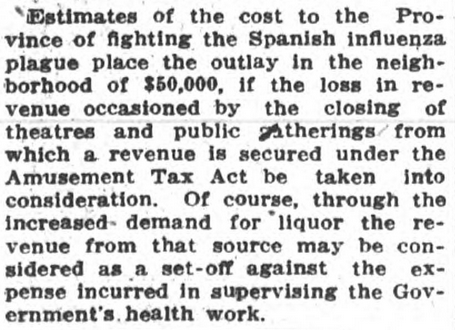
Theatre closures also had a negative financial impact on the provincial coffers. The Daily Colonist November 19 1918 reported: “Estimates of the cost to the Province of fighting the Spanish influenza plague place the outlay in the neighbourhood of $50,000, if the loss of revenue occasioned by the closing of theatres and public gatherings from which a revenue is secured under the Amusement Tax Act be taken into consideration. Of course, through the increased demand for liquor the revenue from that source may be considered as a set-off against the expense incurred in supervising the Government’s Health work.”
Finally, there was a loss of patriotic funds from theatre performances. (In addition to the ubiquitous “tag days” held all over Victoria, musical and theatrical performances raised money for the Red Cross and Great War Veteran’s Association etc. One popular group in Victoria in the WWI years was Reginald Hincks’ Red Cross theatre company – an amateur dramatic group who did comedies and pantomimes (often written by Hincks). This note appeared in the Victoria Daily Times on November 19 1918: “Among the many ventures that are awaiting the advent of that somewhat elusive period – the lifting of the ban – one of the most popular entertainments will be that to be given at the Princess Theatre by the talented Red Cross Society.”
“Practically ready for presentation when the pall of Spanish “flu” cast its shadow over Victoria, the comedy “All-of-a-Sudden-Peggy” has in the interim gained a smoothness and finish which portends that the new play will eclipse all the previous successes that redound to the credit of this fine company.” So, it seems like the troupe was running rehearsals during the “ban” on public gatherings? This could have been considered O.K. because it was “Red Cross work.” (We’d call this “essential services” for the war effort.) “It had been decided that in view of the sending forward of Red Cross supplies being a matter of national urgency, the work at the various branches and workrooms should not be retarded or hindered in any way….” (Epidemic does not hinder Red Cross, Victoria Daily Times October 9 1918)
Theatre renovation during the “flu vacation”
“Some of the theatre managers are taking advantage of the movie-less days to effect changes in the interior of their establishments.
The Daily Colonist October 10 1918
There were, however, some positive aspects to the so called “Flu Vacation”. During the “slackening period of the Spanish Influenza,” the managers were definitely not slack. Cliff Denham of the Royal Victoria Theatre changed the location of the film operating room “which was removed from the balcony to the main floor, resulting in a great improvement in the projection, which is now in direct line instead of following a steep slant from its former position. A new curtain was installed and the auditorium was thoroughly vacuumed cleaned.”
The entire Columbia theatre was renovated. Earlier, just before the “flu ban” on October 6, Manager Clark had promised “…some changes will be made in the interior arrangements of the house to make for greater comfort to the audiences, conspicuous among which will be the installation of a more adequate ventilating system….” Also, a new floor was put in downstairs and in the balcony and comfortable boxes were installed.
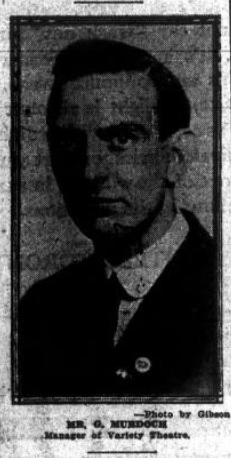
At the Variety Theatre, Manager Murdoch had been busy. The box office was moved to a central and more convenient position and the Cormorant Street entrance was closed and “closed and altered to include a large check room, where parcels, coats and umbrellas may be left by patrons, who will be free to enjoy the pictures in peace and comfort without the bother of looking after numerous belongings, a feature that will no doubt be greatly appreciated, especially during the wet weather season.” (Theatres Offer New Attractiveness, The Daily Colonist November 24 1918)
The Ban is Lifted
It had been an eventful few weeks – on the Western Front the Allies were fighting their way to victory and on the Home Front, Victorians were fighting disease (in October there were 1574 cases of influenza). By the second week in November, “flu” cases were declining. Good signs of drop in “flu” Dr. Price says, The Daily Colonist reported on November 10 1918. (On November 9 there were just 18 new cases.) Dr. Price said that “church, school and theatre would be all permitted to re-open at the same time (whenever that will be).”
On November 11 1918, the excitement of Armistice led to a surge of crowds all day in downtown Victoria – and a surge in the “flu”. On November 12, 104 new cases were reported. “I am not surprised,” said Dr. Price. “The crowds are to blame; the general progress from day to day shows that. If the people will only realize that the instructions we have given are for their own good, and not simply idle words meant to be disobeyed, we will have the epidemic mastered completely in a few days and it will be possible to lift the ban on meetings, theatres and churches – but not till then.”
That same week, the Victoria business were making an organized effort to have the “influenza ban on public assembly either withdrawn entirely or modified. The claim put forward is that the present conditions are working against the city’s interests and that other methods just as effective could be put in force without a consequent dislocation of business, as at present.” (Will try to have “Flu” Ban Lifted, The Daily Colonist November 14 1918) The businessmen proposed to quarantine families. “Theatres would be released from the effect of the embargo, public schools would remain closed, and public meetings would still be forbidden.”
Dr. Price did not find the plan feasible. He stated: “As a result of the measures we have taken, Victoria still holds the record for comparative immunity from influenza. The situation demands patience. The steps we have taken have proved to be the best. To change our course now would be like swapping horses in mid-stream.”
Late evening Tuesday November 19 1918, Victoria lifted the ban on public gatherings. Dr. Price indicated that he had given in not because he thought it was the best thing to do but because he felt under pressure because Vancouver had just lifted their ban. However, in neighbouring Saanich, the Council was unwilling to lift their ban. “Some discussion arose during the meeting with regard to the lifting of the influenza ban, it being the opinion of the councillors that to reopen the schools, churches and public halls would be perilous until all danger from the epidemic had disappeared. Dr. Vye, Medical Health Officer, it was reported, was extremely non-committal on the matter.” (Victoria Daily Times November 20 1918)
Footlights Flashing After Long Interval
The theatre-going public will welcome with joy the news that after seven weeks deprivation of entertainment the ban has been lifted, and the local theatres and moving picture houses will be open to-day.
Footlights Flashing After Long Interval, Victoria Daily Times November 20 1918
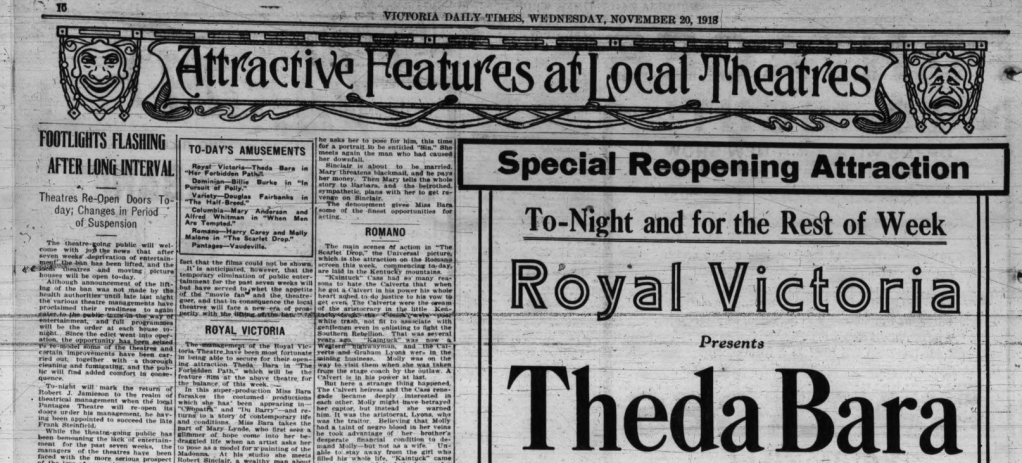
On November 20 1918, Victoria readers like Mrs. Helen Malon opened their papers to read “Flu” Ban Lifted, Theatres Open Today! As The Daily Colonist noted, “Many Victoria homes will be vacated this afternoon and evening while everyone in the family makes the rounds of the theatres.” The Daily Colonist commented: “recent events have changed the outlook on things and have shown the public how dependent it really is on the entertainment provided by the theatres and it needed the jolt, too. Only a short time ago, Kultur was being found on one continent and Spanish Influenza right here in our midst, but now the Armistice has been signed, the Influenza Ban is lifted, and there’s entertainment, and lots of it, for all.”
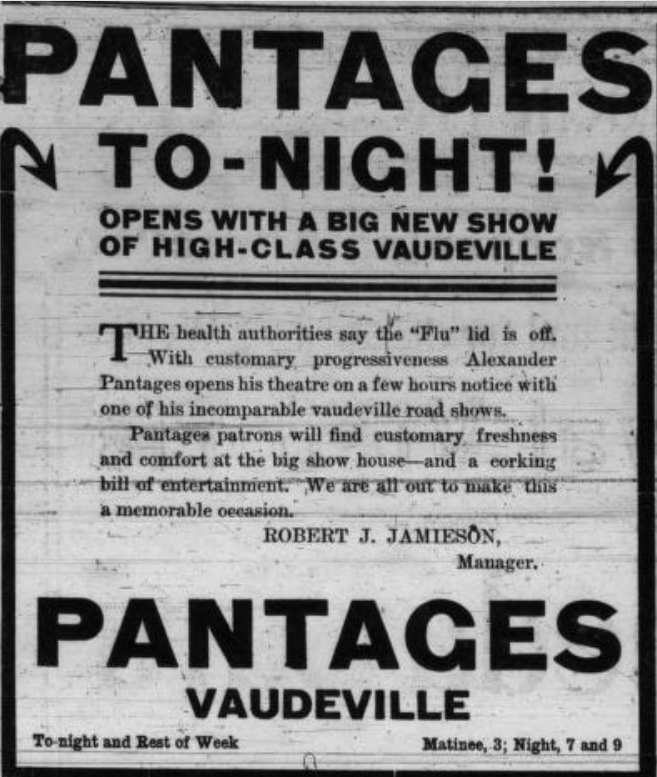
The “flu” lid was off, and the Pantages Theatre re-opened with a big show of “High Class Vaudeville”: “as a curtain-raiser, the wire walking act by the three Bullows sisters was a happy choice, and, despite one little misfortune, showed that they were expert trapeze artists. Their act was well presented and the three artists – all of them pretty – were exquisitely costumed.” (The Daily Colonist November 21 1918)
The Pantages Theatre also re-assured its patrons of a “wholesome and antiseptic atmosphere in the auditorium during performances and at all other times. The special ventilating system with which the house is equipped will make such a course thoroughly possible. Fresh air is drawn from the outside before being circulated throughout the auditorium by means of powerful fans. This will tend to allay a certain amount of the anxiety that may still be felt by some in regard to attending assemblies at this time.” [See also this description in the Victoria Daily Times May 19 1914 from when the Pantages was opened: “The ventilation of the building has been very carefully planned, and by fans which have been installed the air, three thousand cubic feet of it, is completely changed every three minutes.” ]
The Royal Victoria theatre too emphasized this point – “It has the best equipment obtained and the ventilation system is excellent.” (The Daily Colonist November 24 1918)
That week at the moving picture houses, the Columbia was showing a Vitagraph Feature, “When Men are Tempted” (“a five-reel picture that will surely please you”). The Dominion had Billie Burke, the most charming of stars, in “Pursuit of Polly”. The Romano was starring Harry Carey in “The Scarlet Drop” (“A special feature, one you will like, a genuine western picture.”)
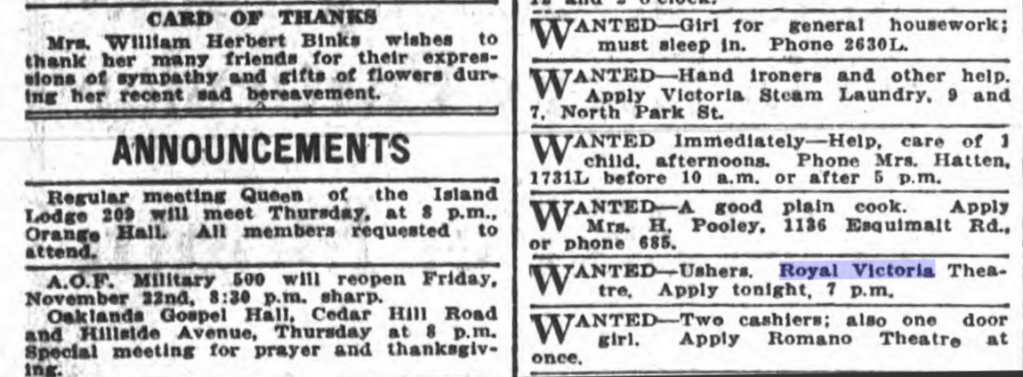
Over at the Royal Theatre, ushers were being hired. Note the ad in The Daily Colonist on November 21 1918 — Wanted ushers Royal Victoria Theatre and cashier (The Romano Theatre was also advertising for a “door girl”). So perhaps Ethel and Edith Gilman got their jobs back?
So, if the Gilman girls were back at work, they would have seen Theda Bara in “The Forbidden Path” (Theda Bara was a popular silent screen star whose name apparently was an anagram of “Arab Death”!)
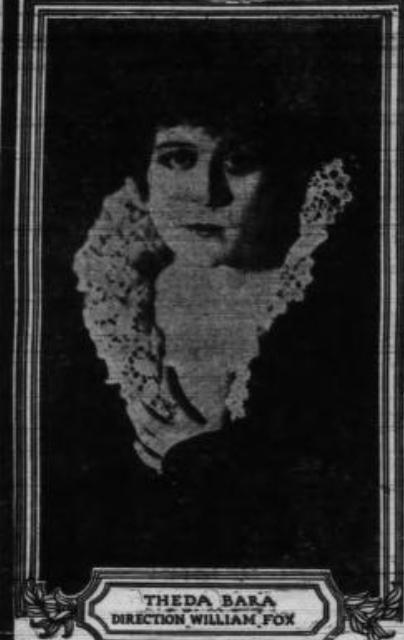
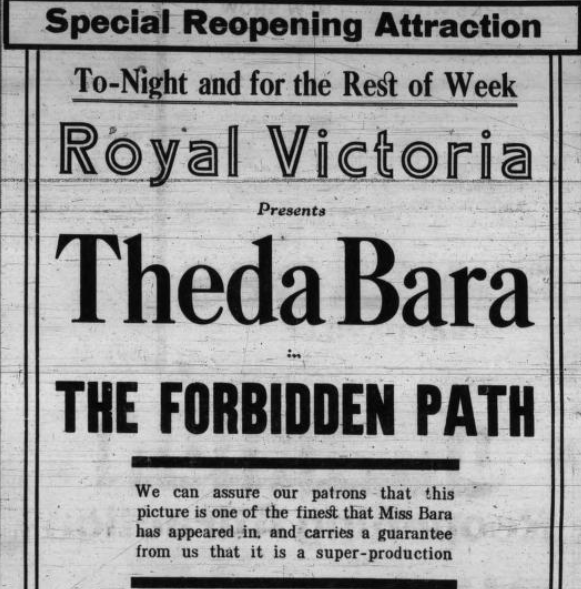
In this super-production Miss Bara forsakes the costumed productions which she has been appearing in – “Cleopatra” and “Du Barry” – and returns to a story of contemporary life and conditions. Miss Bara takes the part of Mary Lynde, who first sees a glimmer of hope come into her bedraggled life when an artist asks her to pose as a model for a painting of the Madonna. At his studio she meets Robert Sinclair, a wealthy man about town, who immediately sees a new field of conquest in the pretty girl…… (Victoria Daily Times) Of course, Bara is duped and falls from eminence but rises again… “She is once more a tenement girl – a captivating, entrancing tenement girl, who rises from her lowly position to one of comfort and even luxury.” (The Daily Colonist)
In addition to the melodrama, a two-reel Paramount Mack Sennett comedy was also shown, “which stars Ben Turpin, the well-known comedian, and is the cause of a great deal of hearty laughter.”
Went down town in the afternoon with Ruth and Pierre and I took Pierre to see the Variety show.
Mrs. Helen Malon, November 21 1918
The Malon family was once more back at the movies. They went to see Douglas Fairbanks in “The Half Breed” at the Variety Theatre. “The Half Breed” was “more than a mere story. It is an indictment of the white man’s blindness and indifference to the rights and feelings of the dispossessed Indians. It is a terrific arraignment of bigotry and intolerance.” (The Daily Colonist November 20 1918) Fairbanks played “the pathetic and heart-hungry character of “Low”, scorned and mocked by the derisive white man.”
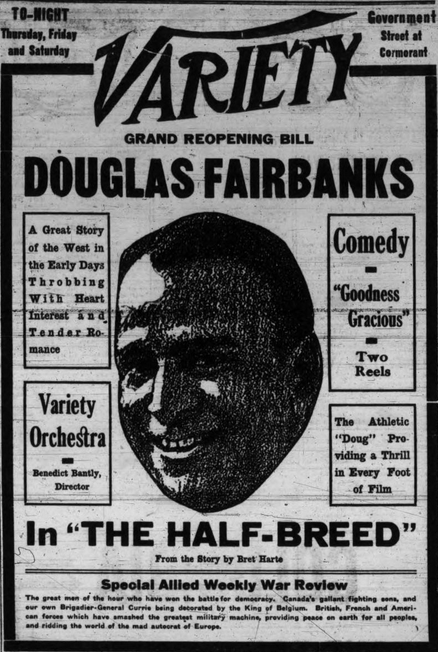
Before his advent in more romantic and swashbuckling roles, Fairbanks was known as a comedian: “Douglas Fairbanks has won his fame through the comedy roles and his golden smiles. How many realize, however, that he is a great actor, capable of interpreting the serious and pathetic roles…poor “Low” found a great interpreter in the comedian with the happy smile.” (The Daily Colonist November 21 1918) “The Half Breed” was also an exercise in realistic production values — Triangle found it necessary to film a Redwood forest actually ablaze — “In the course of filming, Sam de Grass and “Doug” lost their eyebrows and eyelashes from the singeing flames, and their hands were badly blistered. The flames could not singe Fairbanks’ famous smile, however.”
“A snappy, twentieth century, high-geared romantic-comedy drama travelling at high speed all the time.”
Review of “Bound in Morocco”
It was definitely a good week for Fairbanks fans! At the Royal Victoria Theatre later in the week, Douglas Fairbanks starred in “Bound in Morocco”, “A snappy, twentieth century, high-geared romantic-comedy drama travelling at high speed all the time.” This thrilling story of Algiers allowed “Doug” to present several new stunts: “One stunt, worthy of mention, is a dive that Mr. Fairbanks made from the top of a high sand dune to the shoulders of Fred Burns, who is passing by on a speeding horse. This is followed by an exciting hand-to-hand fight which is said to be a thrilling affair.” The show also starred Helen Jenner as one of the harem girls who interprets a famous Arabian dance and Mildred Lee, who won the Beauty and Brains contest recently conducted by the Photoplay Magazine. (The Daily Colonist November 26 and 27 1918)
“Live” theatre was up and running again too. The Red Cross Company opened the postponed “All of a Sudden Peggy” at the Princess Theatre on Tuesday November 26 1918. The play starred local popular soprano Eva Hart, “the leading lady of the Red Cross Company, as the capricious and lovable heroine who lands herself into several compromising situations from which she naively expects the hero [Reginald Hincks] to rescue her.” Mr. Hincks, “man of the world”, the Honorable Jimmy, “made a delightfully convincing hero of the “matinee idol” type.”
The advertisement said “Have a good laugh – you need it” and perhaps the casting was meant to be comical with the casting of “older” leads. Eva Hart was in her mid 30s and Hincks was 48 (though obviously if most men were off at war perhaps he was the youngest available!) Note – the amateur theatre company appears to have been made up of civil servants (a clerk of the Supreme Court and a clerk of the Land Office were in two comic roles).
Gregarious gatherings and re-opening the schools
“Have a good laugh — you need it?” But would children be laughing if they got the “flu” after going to the theatre? The Victoria School Board held a special meeting on the afternoon of November 21 to consider the reopening of the Victoria schools. November 25 had been the planned day for back to school but the Board postponed opening until December 2.
The Board wanted a “test period” to elapse – “Now that the theatres and other public entertainments are restored to favor, a few days will suffice to prove whether or not the withdrawal of the quarantine has been premature. By Monday any infection which may have resulted in the return of gregarious gatherings will just have had sufficient time to “incubate” and only in the succeeding days will the health officer be in a position to indicate whether or not the lifting of the ban has been deleterious.”
On November 25 1918 Esquimalt opened their schools, but the Oak Bay School Board decided to keep the “lid” shut on schools for the time being. Saanich Council gave their Medical Health Officer J.P. Vye full power to set the date for school re-opening. The Daily Colonist reported on December 1 1918 that Dr. Vye “has decided that the time has not yet come for the pupils to return to their studies.”
On Saturday December 7 1918, while their mother cooked and cleaned, Pierre and Yvonne Malon went to another show. They may have seen Charlie Chaplin as a doughboy in “Shoulder Arms”; Hughie Mack, the 350 Lb. comedian, in “The Geezer of Berlin”, a three-reel satire on “The Kaiser, the Beast of Berlin”; or Monroe Salisbury, a Scottish homesteader who fights the cattle barons who are trying to drive him from his land claim, in “Winner Takes All.”
Many Victoria school children may have been at the movies that same weekend. After one week, schools were closed on December 10 1918 until the New Year (and in fact did not open until mid-January). Though the schools were officially closed “simply as a precautionary measure,” The Daily Colonist reported: “it is understood that influenza has broken out among the school children.”
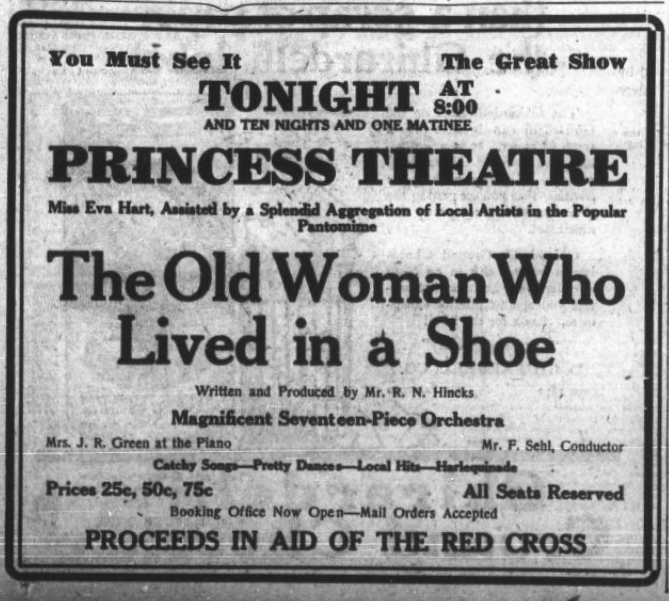
In December 1918, there was a second wave of the “flu” in Greater Victoria, this time affecting children — Yvonne and Pierre Malon both got sick all over the Christmas holidays. The new wave of flu impacted the Red Cross Company’s annual pantomime. The Victoria Daily Times December 28 1918 promised: “Victoria kiddies are to have the opportunity to see a real Christmas pantomime of the old-fashioned variety.” But see this notice from January 8 1919: The Old Woman Who Lived In a Shoe” has definitely decided to take up her abode in Victoria at the Princess Theatre on Saturday evening January 11 and will be in residence for ten nights and one matinee. Somewhat belated owing to the unavoidable postponement of the production….”
The pantomime charmed its audience on opening night with “sparkling patter, very tuneful songs, captivating dances and an “abundance of clever allusions to Tanlac, Government jobs, the epidemic and other features of topical interest … Little Boy Blue provided endless entertainment with a small horn and a pail of disinfectant.”
The Show Goes On into 1919 and 1920
In January the “flu” was in its second wave, but by no means as serious as what in October had compelled the “Flu Ban”. On Saturday January 25 1919, Vancouver Island and Lower Mainland health authorities held an all-day conference at the Legislative Buildings. The main decision of the conference was that no general ban would be made effective. “While dances, both public and private, will be prohibited, no steps barring public meetings, church services, theatre performances, or school classes will be taken at any rate as yet.” (The Daily Colonist January 26 1919)
Two discussions of the conference related to theatres:
1 – a campaign of education through the columns of the press as well as in moving picture theatres will be inaugurated to impress upon the public the necessity of taking reasonable and needed preventative measures (A suggestion emanating from the conference was that slides in motion picture theatres be utilized for the purpose of disseminating the most effective kind of simple advice.)
2 – power given to municipal authorities to take steps to enforce regulations providing for proper ventilation in places of public assembly, to the end that there shall be provided a means of keeping air fresh and continually renewed. In respect of this last provision, while many theatres are possessed of modern plants for renewing the air, many other places are not so provided, and presumably such places will be closed to the public unless they are made to greet the wishes of the medical authorities.
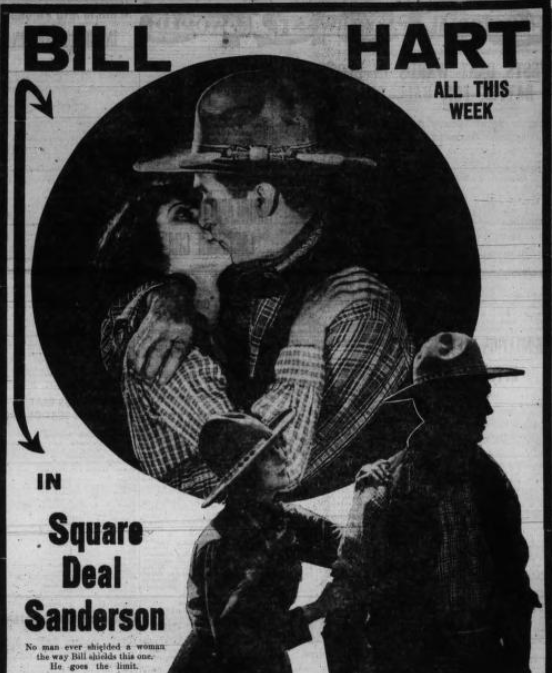
Romance and breeziness in every foot of film
Review of “Square Deal Sanderson”, 1919
The medical men at the conference agreed that the epidemic was receding. By March 12 1919, The Daily Colonist reported that “The epidemic is practically dead now.” On Thursday March 13 1919, Yvonne and Pierre Malon went to their first “show” after several months. That day, the most likely “kid-friendly” show was at the Dominion – William S. Hart in “Branding Broadway”, about a cowboy in New York. On April 16 1919, The Daily Colonist reported “Influenza has gone.” A month later, on Saturday May 17 1919 it was “too cold for a picnic” so the Malons and friends went to the Pantages, showing “The College Girl Frolics”, with a cast of seven charming girls and two bright clever men. (The Daily Colonist May 14 1919)
It was now Fall 1919 and a year since the influenza epidemic and “Flu Ban”. The Malon family was as busy as seeing shows. On September 23 1919, Mrs. Malon and her brother George (just returned from four years overseas service) went to the Dominion Theatre. William S. Hart was starring in a Western, “Square Deal Sanderson” – “hard riding, fighting and gun play a plenty. There is romance and breeziness in every foot of film.”
On October 4 1919, Yvonne and Pierre Malon went to the Dominion Theatre to see Dustin Farnum and Irene Rich in “A Man in the Open”, another Western in which “exciting events culminate in big dramatic situations.” On November 29 1919, Pierre and Yvonne Malon were at a show, probably “Wolves in the Night” (William Farnum as a mining engineer whose life is imperilled by plotters. “Locale American Northwest, Chile and the Financial District of New York City.”)
On December 2 1919, Mrs. Malon went to the Variety Theatre, to see “The Turn in the Road” (“Emotional Punch in Appealing Story… beautiful drama of devotion and sacrifice…carrying the story of love, pathos, and human emotion that makes the production one of absorbing human interest.”) Mrs. Malon’s diaries end the next day, December 3 1919, so we can’t see what happened when influenza came to Victoria once again in Winter 1920…..
Influenza is here
The Daily Colonist February 1 1920
In Winter 1920, influenza arrived in Victoria once again. On January 31 1920, Dr. Arthur G. Price, City Medical Health Officer stated that there had been twenty-three cases reported in three days. “He added that the cases were neither lighter nor heavier than last year, and that the disease had not changed since it was in the city last.” (The Daily Colonist February 1 1920) Within ten days, practically 700 cases had been reported to Dr. Price (Fifty cases were reported on February 11 1920) and there had been ten deaths. On February 11 1920, Dr. Price stated that it would “greatly aid if all dances are cancelled. People are crowding into theatres and thus making our fight so much harder….”
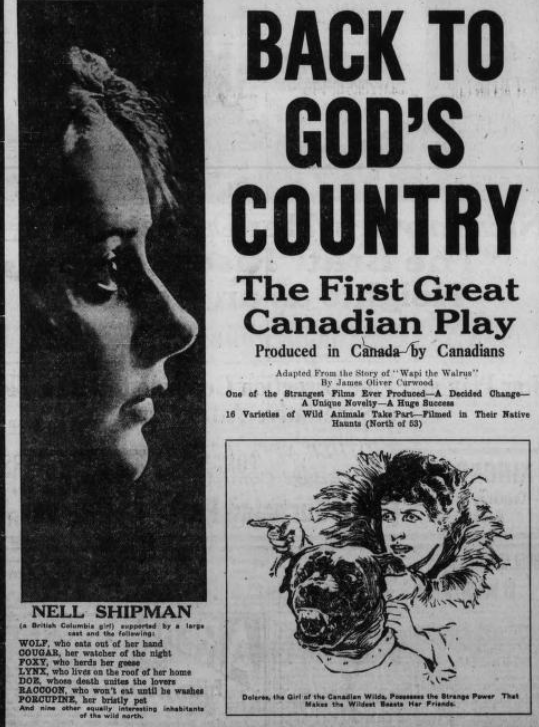
There was lots happening at Victoria theatres that week. At the Columbia, Tom Mix was playing in “Ace High”, a tale of adventure in the service of the North West Mounted Police. The Royal Theatre was showing “Back to God’s Country”, “A Canadian Picture, Taken in Canada, Acted by Canadians for Canadians,” starring Nell Shipman, a British Columbia Girl supported by a large cast and a wolf, cougar, fox, lynx, doe, raccoon and porcupine (!)
We don’t know if the Malon family were “crowding” into the theatres (Mrs. Malon’s diaries ended in December 1919) but I suspect either of these wilderness Western adventures would have been popular with the Malon children. (A side note – The Gilman girls would not have seen “Back to God’s Country” as ushers, since they had left the theatre and were now clerks at H.O. Kirkham Grocery).
One person who was at the theatre was my grandpa Harold Monks, living in Saanich that Winter. He wrote in his Canadian Pocket Diary: “Sat Feb 14 – Glorious Day. Went to see “The Luck of the Navy” Princess Theatre, played by Percy Hutchison and Coy, London. Very good.” Percy Hutchinson was billed as “The Eminent English Actor” and this was “The First All English Company to Visit Canada Since 1914” [a counterpoint to the all–Canadian “Back to God’s Country”!]
“The Luck of the Navy” was a spy drama in which Lieut. Clive Stanton, commander of a submarine, discovers that his second in command is a German spy. Harold’s assessment of the show was shared by the reviewer of the Victoria Daily Times: “A melodramatic example of the playwright’s art, the piece opens quietly, with the action proceeding through successive thrills until a really gripping climax tops it all off.”
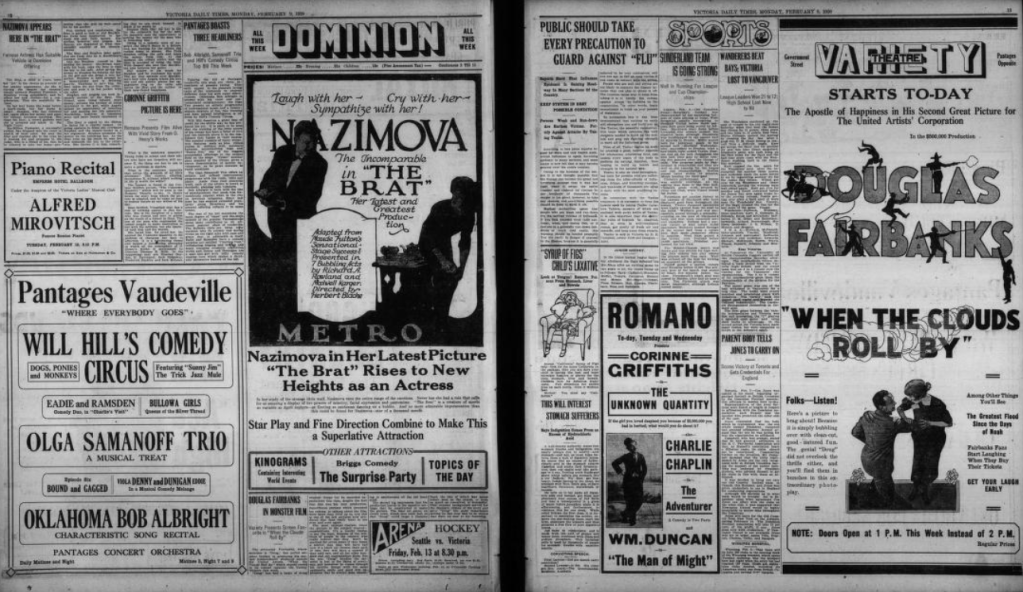
The public wasn’t going to desist from going to shows, but here was a great opportunity for some topical advertising. In the Victoria Daily Times, between large ads for Douglas Fairbanks in “When the Clouds Roll By”, Charlie Chaplin in “The Adventurer” and Nazimova in “The Brat” was an “infomercial” — “Public Should Take Every Precaution to Guard Against ‘Flu’”, a seemingly serious article that turned out to be an advertisement for Tanlac, “the powerful reconstructive tonic which contains the very elements needed to give you the fighting strength to ward off the influenza germ.”
“The putting on of the ban is the last thing in the world I want to do.”
Victoria Medical Health Officer Dr. A.G. Price
Harold Monks didn’t get ill from going to see “The Luck of the Navy” and his diary shows that was busy going to friends’ houses, having tea and roasting marshmallows over the fire. But some people were obviously getting ill. On Saturday February 14 1920 The Daily Colonist carried a headline “Recommends council apply for “flu” ban”. Dr. Price’s recommendation for a ban would be discussed on at the Monday February 16 council meeting. On Monday, “a gloomy day” (Harold Monks’ diary), the council met, but clearly didn’t accept the recommendation, as nothing is reported in the paper on February 17.
A few days later Dr. Price quit! “Refusing to be associated with the futile half measures which would only bring blame on him in the end,” Dr. Arthur G. Price last night tendered his resignation from the office of medical health officer to the city council. The council declined to accept the resignation, and will ask Dr. Price to reconsider his action, which was induced by the Provincial Board of Health’s refusal to grant him the powers he asked for respecting precautions against the influenza epidemic. ‘The reasons for taking this stance are that I am not receiving adequate support in my endeavours to suppress the epidemic of influenza in the city.'” (The Daily Colonist February 23 1920).
But on Monday night, March 1 1920, Dr. Price withdrew his resignation and remained as city health officer. The same day, Dr. Henry Esson Young, Provincial Health Officer, wrote: “The Provincial Board of Health is in touch with all points of the province and with the authorities of other provinces and is advised weekly by the Federal Department of Health in Ottawa. All these reports from various sources show that the epidemic has not at any time approached in severity the epidemic of 1918 and that it is rapidly on the wane.”
— The End —
 Stephanie Ann Warner